‘Snow holidays’ at Chinese schools heat up tourism, boost economy
Policies promote high-quality education, drive consumption: expert
By Liu Yang and Published: Dec 01, 2025 10:48 PM

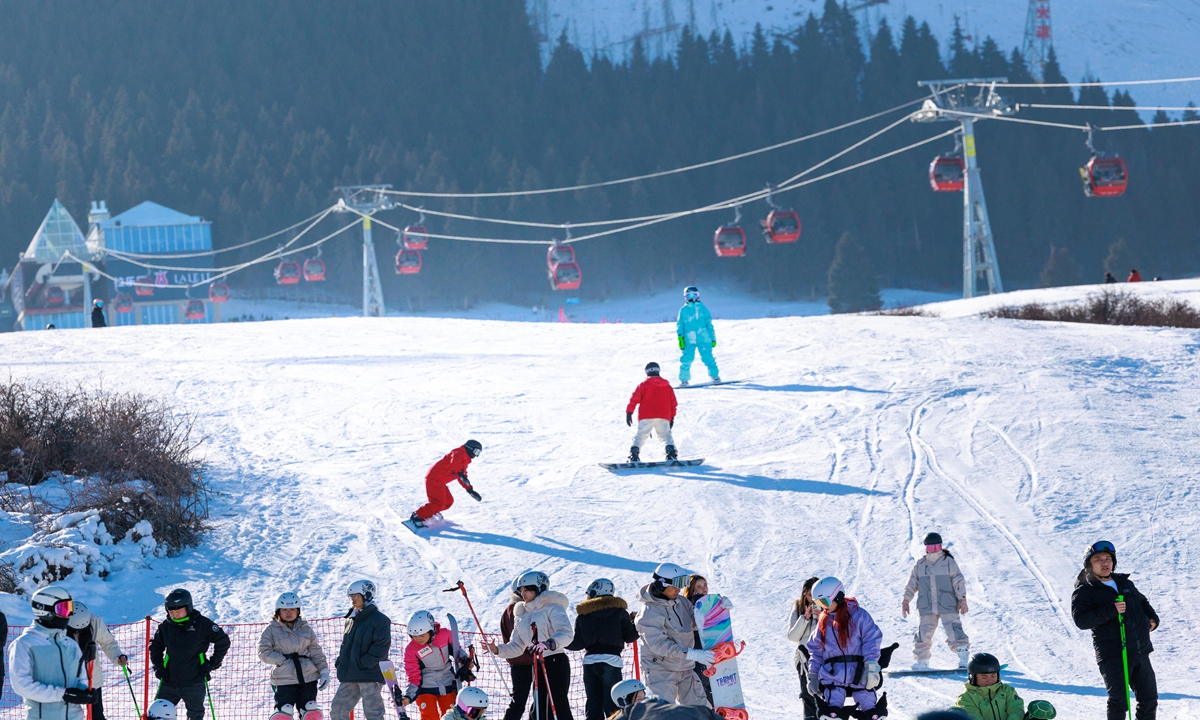
Tourists skied at a snow resort in Urumqi, in Northwest China's Xinjiang Uygur Autonomous Region on November 29, 2025. Photo: VCG
"Snow holidays" in multiple Chinese regions have boosted snow-and-ice tourism and facilitated cross-regional travel, data from a Chinese travel agency showed on Monday. A market participant said on Monday that the policies not only promote the high-quality development of education, but also deliver economic benefits by driving growth through ice-and-snow consumption.
According to local authorities, primary and secondary school students in Altay and Urumqi in Northwest China's Xinjiang Uygur Autonomous Region are enjoying a five-day "snow holidays" that started on Monday, and students in compulsory education across Northeast China's Jilin Province will have a "snow break" from Wednesday to Sunday.
Chinese online travel platform Qunar told the Global Times on Monday that after Jilin announced the "snow holidays," ticket bookings for attractions in the province during the break increased 26 percent week-on-week and 13 percent year-on-year. During the period, the top five most-booked attractions in the province include the Changbai Mountain scenic area and Jingyuetan national forest park.
The break has also sparked strong enthusiasm among Jilin residents for outbound travel. According to Qunar data, air ticket bookings for flights departing from Changchun have surged 57 percent week-on-week, with the 10 most popular destinations including Shanghai, Sanya and Guangzhou.
After Urumqi and Altay officially announced "snow holidays," outbound bookings from both cities surged more than 45 percent week-on-week, with routes to warm southern cities proving especially popular, Qunar said.
Pan Helin, a member of the Expert Committee for the Ministry of Industry and Information Technology, told the Global Times on Monday that "snow holidays" are a tailored policy that allows local governments to leverage their unique tourism resources, which has boosted ice-and-snow tourism and effectively stimulated local consumption.
According to the official website of the Jilin provincial government, during the snow holidays, all 171 A-level tourist attractions open in winter and 39 qualified, regulated ski resorts and ice rinks across the province will implement policies such as free admission for primary and secondary school students and discounted tickets for accompanying parents, which will effectively reduce the cost of family ice-and-snow activities.
From Monday to Friday, students from Altay will have free access to multiple local ski resorts as well as free public transit within Altay city, a city administered by Altay Prefecture, using their identity certificates. Local cultural venues, libraries and museums will launch a flurry of ice- and snow-themed cultural events, the Xinhua News Agency reported.
In addition to "snow holidays," many regions in China are exploring new types of school breaks for primary and secondary students, such as spring and autumn holidays. The core purpose is to encourage students to participate in study tours, sports, and other cultural and recreational activities during these breaks, thereby promoting their physical and mental well-being through rich real-world experiences, as well as boosting the high-quality development of education, Xu Xiaolei, marketing manager at CYTS Tours Holding Co, told the Global Times on Monday.
"The duration and specific measures of these holidays are determined by local authorities according to local conditions, which fully reflects policy flexibility. Moreover, these new holidays serve as a valuable supplement to the traditional winter and summer vacations, which not only help students strike a better balance between study and rest and relieve academic pressure, but also significantly boost spending on tourism and related services," Xu noted.
For instance, primary and secondary school students in Southwest China's Sichuan Province had their first autumn break from November 12 to 14. According to Chengdu Fabu, Chengdu and its surrounding areas saw a travel boom. Platform data showed that during the autumn break, total ticket bookings within Sichuan were 3.4 times higher year-on-year and 1.4 times higher than in the five days before the holiday.
"Some regions have innovatively rolled out seasonal holidays, effectively extending the coverage period of the holiday economy. By staggering holidays in batches, these measures help distribute tourist reception capacity more evenly and prolong the peak season for tourism and consumption," Pan noted.
Xu said that these holidays have shifted tourism consumption from being highly seasonal to a more year-round pattern. At the same time, they continuously stimulate related sectors such as catering, transportation, accommodation, and cultural and creative industries.
RELATED ARTICLES