Exclusive: China’s Xihe satellite achieves first 3D ‘CT’ scan of Sun’s atmosphere with over 300 layered slices: chief scientist
By Li Xundian and Published: Dec 02, 2025 05:09 PM

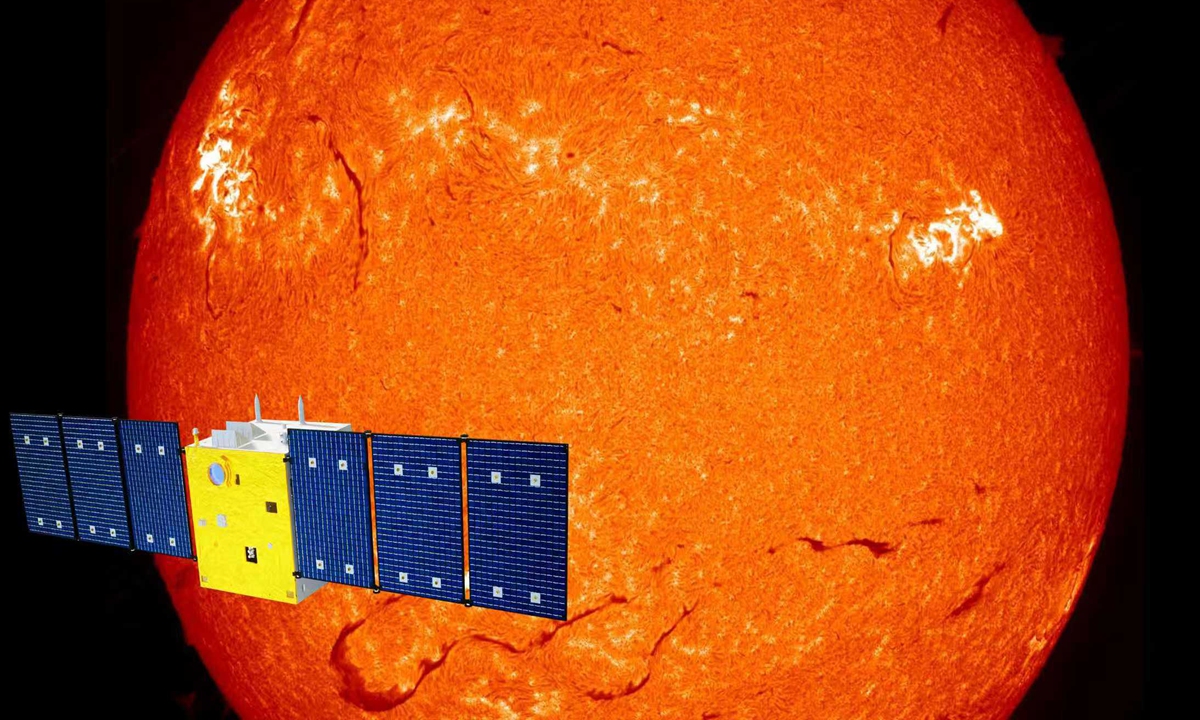
Illustration: Xihe sun exploration satellite
"With the help of the Xihe satellite, we can obtain full-disk solar spectra at more than 300 wavelength points simultaneously every 46 seconds. Each wavelength corresponds to different layers of the solar atmosphere, from the photosphere to the chromosphere," said Ding Mingde, chief scientist of the Xihe program and professor at Nanjing University, in an interview with Global Times.
He compared it to a CT scan: "in less than one minute, we can perform a 3D 'CT' imaging observation of the entire solar atmosphere with more than 300 layered slices."
Currently, named after Xihe, who is the Chinese goddess of the sun, the satellite is operating continuously in a sun-synchronous orbit 517 kilometers above the Earth, completing one orbit approximately every 95 minutes. As China's first dedicated solar "photographer," Xihe has achieved five international firsts and generated approximately 1.2 petabits of scientific data since its launch on October 14, 2021.
Unlike traditional designs, the new satellite platform adoptes maglev control technology. By isolating the payload from platform vibrations, it enables far more stable and precise imaging, Ding explained.
Ding noted that the Atomic Discriminated Frequency Solar Velocity Navigator onboard Xihe is the world's first in-orbit instrument to use the atomic frequency discrimination principle.
It employs the hyperfine spectral lines of sodium atoms as an absolute frequency reference. On-orbit measurements show that the navigator achieves a velocity measurement accuracy better than two meters per second, providing a new velocity measurement method for deep-space exploration, he explained.
Also known as the Chinese H-Alpha Solar Explorer, Xihe is also an experimental satellite for the "Dual Ultra" scientific technology platform, featuring ultra-high pointing accuracy and ultra-high stability.
Looking into the future, Ding disclosed that the "Dual Ultra" platform technology will be widely applied in next-generation space missions, including high-resolution remote sensing, stereoscopic solar observation, and exoplanet detection. It will drive leap-forward development in China's space technology, he said.
According to the chief scientist, China has been sharing observation data with research teams from 15 countries, such as the US, Germany, the UK and Japan. "Such open and shared model is also a common practice of the international solar physics community."
Currently, Xihe is conducting joint observation campaigns with China's other solar-observing satellite Kuafu-1, as well as NASA's SDO and IRIS, ESA's Solar Orbiter, and other international missions, yielding a wealth of scientific results, Ding said.
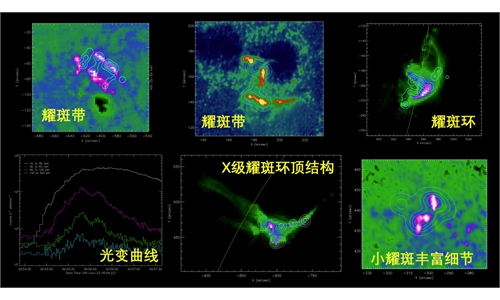
To date, more than 70 peer-reviewed papers based on Xihe's observations have been published, covering cutting-edge topics such as the 3D dynamics of solar eruptions, solar atmospheric waves and filament oscillations. The satellite's data have also been integrated into China's National Space Weather Monitoring and Warning Center for operational use, providing critical support for space weather forecasting.
Based on four years of data collection, Ding noted that "we are preparing to apply artificial intelligence techniques to analyze this data, mining previously undiscovered scientific insights. At the same time, we are treating the sun as a representative stellar specimen. By studying the patterns of solar activity, we can extend our findings to stellar activity in general, which carries significant scientific implications for the search for Earth-like habitable exoplanets beyond our solar system."
Beyond that, China's solar exploration program is accelerating. Ding said. "China is currently launching two major follow-on missions: the Xihe-2 solar stereoscopic observation satellite at the Sun-Earth L5 point, and the Kuafu-2 solar polar observatory in a polar orbit."
Speaking of international competition, Ding noted that "the US and Europe are also deploying similar missions. This means China's solar exploration is poised to transition from observing from the sidelines, to keeping pace, and ultimately to running neck-and-neck with advanced powers."
RELATED ARTICLES