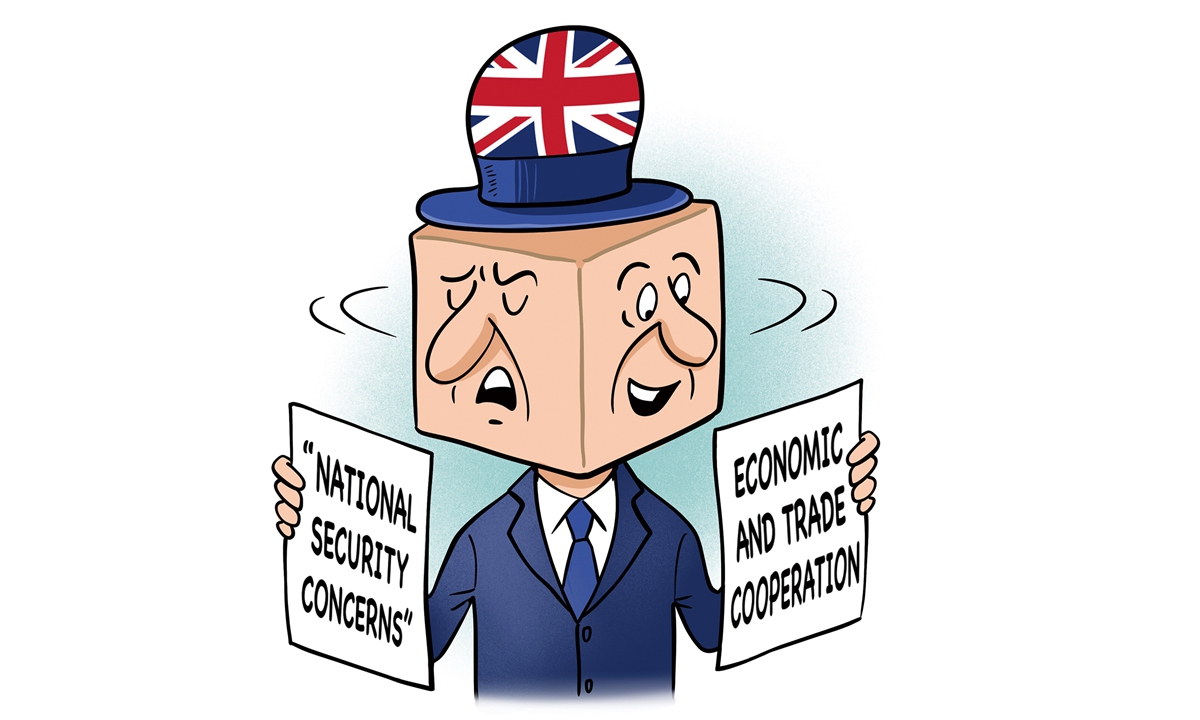
Illustration: Liu Rui/GT
UK Prime Minister Keir Starmer said in a speech on Monday at the Lady Mayor's Banquet at the Guildhall in London, UK, that the US, the EU and China are the three global giants, and that the absence of the UK's engagement with China should not continue. He emphasized the need for the UK to trade with China. At the same time, he claimed that China poses "national security threats" to the UK and that the UK can "work and trade with a country, while still protecting itself."
Starmer's contradictory rhetoric of relying on China economically while guarding against it on security reflects the fickleness and opportunism of the country's diplomacy, as well as a "have-it-both-ways" mentality of the UK's China policy.
Beneath the fickleness and opportunism of British diplomacy lies an unshakeable core logic: its strong ideological orientation and deep geopolitical entanglement with the US.
As one of the birthplaces of Western institutions and political thought, the UK remains deeply attached to and eager to promote so-called democracy, placing heavy emphasis on ideological competition and confrontation. This mind-set continues to shape its diplomatic behavior. From the perspective of the "special relationship" with the US, the UK has treated support for US leadership as a key pillar for safeguarding its own strategic interests ever since the signing of the Atlantic Charter in 1941. As a result, the fundamental strategic tone of British diplomacy is a form of political correctness that neither the Conservative Party nor the Labour Party can easily alter.
To some extent, the interplay between Britain's diplomatic volatility and its ideological tendencies also reflects the country's nostalgic mind-set that has persisted since World War II - one that has not adjusted in tandem with its declining national power. Its "Global Britain" narrative and continued interference in Asia-Pacific affairs are manifestations of this outdated way of thinking.
It is clear that Starmer's remarks reflect a "have-it-both-ways" mentality: seeking to smear and pressure China within the framework of Western narratives, while simultaneously attempting to gain economic benefits and secure China's cooperation in global governance. In reality, the UK's politically negative posture toward China means it places itself in opposition to both the Chinese government and people. This not only lays the groundwork for further negative rhetoric and actions in trade, technology, and politics, but also undermines the hard-earned mutual trust and engagement between China and the UK.
In today's complex and rapidly evolving international landscape, every country's diplomacy must be able to adapt to changes and proactively seek transformation. The UK's China policy needs to acknowledge the reality of China's growing strength. If it continues to pursue a rigid and outdated strategy, it will only prompt China to heighten its vigilance and precautions against the UK, thereby eroding the country's already limited strategic credibility.
Starmer mentioned in his speech that the UK does not want an "Ice Age" in China-UK relations. However, if its binary China policy translates into damage to China's sovereignty and core interests, the trajectory of its China policy will inevitably slip beyond the UK government's control and may lead to irreversible consequences. The UK should have a clear understanding of the situation, adjust its mind-set, adopt a rational and friendly approach toward China's development, pursue a positive and pragmatic policy towards China, and work with China in the same direction to steer China-UK relations onto a path of sound and steady development. This is a wise move that aligns with the UK's national interests.
The author is an associate research fellow at the Belt and Road Academy of Beijing Language and Culture University. opinion@globaltimes.com.cn
RELATED ARTICLES