EU unveils plans to beef up toolbox against 'economic threats,' politicizing economic relations won't support bloc’s prosperity: analysts
By Published: Dec 04, 2025 02:25 PM

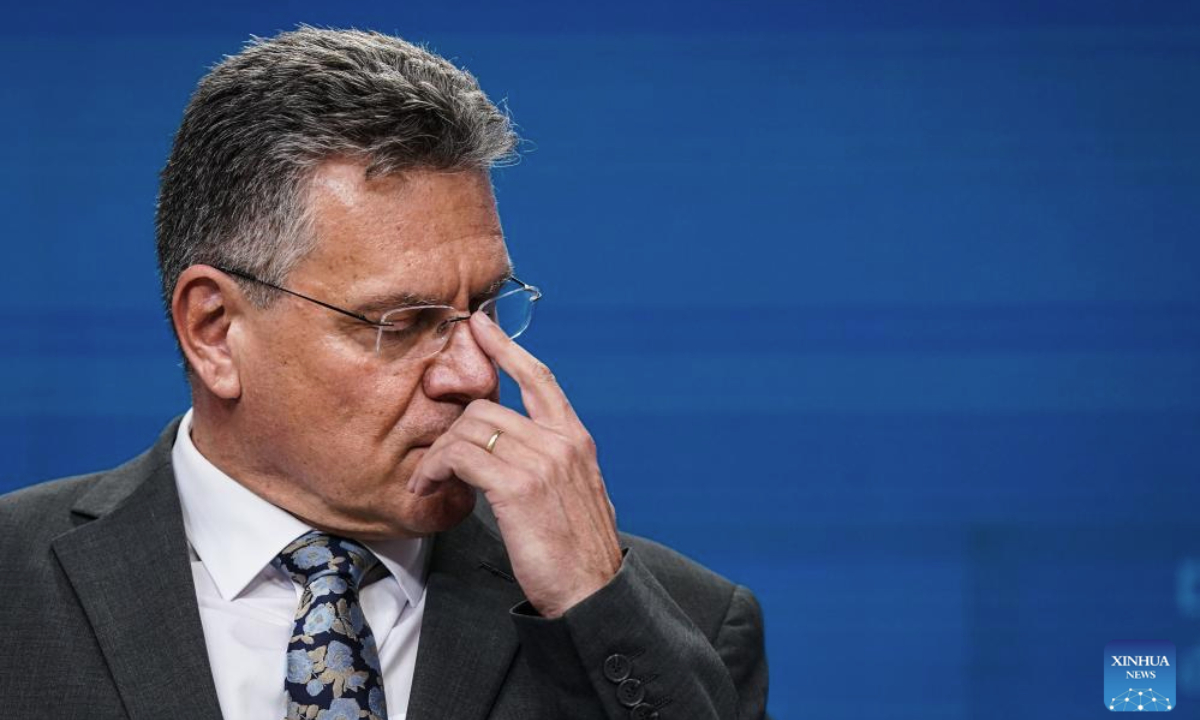
EU trade chief Maros Sefcovic attends a joint press conference in Brussels, Belgium, July 14, 2025. File photo: Xinhua
Chinese business chamber in Europe and analysts on Thursday criticized a new EU policy aimed at beefing up its toolbox against what it called external economic threats, noting that the move is protectionist in nature, and while these measures may serve its purpose of cutting imports from China, securitizing and politicizing economic relations will not contribute to EU's sustainable development and long-term prosperity.
While EU's efforts down the road may disrupt supply chains, it does not necessarily enhance so-called economic resilience for the bloc. At the same time, it is almost certain that such measures will not improve the EU's economic fundamentals, global competitiveness or economic prosperity, they noted.
The European Commission on Wednesday (local time) unveiled plans, including a REsourceEU Action plan, to boost EU resilience to threats such as rare-earth shortages by strengthening trade measures and adding new economic security tools, according to Reuters.
According to a statement on its website, the EC has proposed several new initiatives to strengthen the EU's economic security and boost competitiveness, outlining concrete steps to make the bloc stronger and more resilient in the face of what it called "growing external economic threats."
The EC wants to coordinate more closely with EU members and businesses to review its supply chains, rules on inbound investment, its defense and space sectors, and its strength in new technologies and critical infrastructure.
The document came as the EU is contending with "Chinese restrictions that have choked supplies of essential rare earths and chips," Reuters said.
In the EC readout, there is no specific mentioning of China or rare earths, but stressed "the need to reduce strategic dependencies for goods and services including critical raw materials and mainstream semiconductors" and noted that the EU, its member states and businesses will increasingly need to accept the economic costs that come with increased security and resilience.
EU Commissioner for Trade and Economic Security Maros Sefcovic said the Commission would review by the third quarter of 2026 how to speed up trade measures such as anti-dumping and anti-subsidy duties, now applied only after year-long probes.
"For reasons of economic security, European companies - just like Japanese and US companies, or indeed, Indian - need to stop buying 100 percent Chinese," Commission Vice President Stephane Sejourne said, according to Reuters.
In an assessment of the EC's latest economic security strategy, the China Chamber of Commerce to the EU (CCCEU) said the strategy is "internally debated" and reflects an inward-looking tendency, signaling that EU's economic and trade policy toward China may be entering a more proactive and targeted phase of "precision decoupling." For Chinese companies, this means preparing for a European market with higher technological barriers and more politicized rules, it said.
The CCCEU said Chinese companies may face three main pressures in critical technologies, such as encountering stricter security screening and systemic competition in sectors such as semiconductors and new energy, cooperation and investment, as well as supply chain security. They may also face more exclusive technological ecosystems as EU accelerates a form of "soft decoupling" in sensitive areas.
In practice, this could shift China-EU economic relations in key sectors from traditional market complementarity toward a new normal focused on competition and resilience, the Chinese chamber said.
However, the strategy faces significant constraints. Europe's economic momentum remains weak, while high energy and production costs continue to challenge industrial competitiveness. Fully securitizing and politicizing economic relations would raise costs for all parties, and the strategy may encounter practical limits similar to previous industrial plans, such as the battery sector, the CCCEU said.
Zhang Jian, a vice president of the China Institutes of Contemporary International Relations, told the Global Times that EU trade protectionism has continued to rise this year, and the proposed measures are clearly a further development of this trend.
"However, protectionism does not bring development or enhanced competitiveness; rather, these protective measures will cause greater damage to the EU economy. The so-called restrictions on rare earth elements and semiconductors are simply not a valid justification," Zhang said.
Jian Junbo, a deputy director of the Center for China-Europe Relations at Fudan University's Institute of International Studies, told the Global Times that the new policy is securitizing and politicizing economic relations under the guise of an economic security policy suite.
Such measures violate the principles of market economy transactions and the principles of free trade, undermine global trade norms and international economic order, and represent a securitizing of international trade rules. Essentially, they involve the use of political power to interfere improperly with market principles, Jian said.
Even if such measures succeeded in reducing dependence from certain countries, they more likely serve only to increase, rather than reduce risks, Jian said.
"After decoupling from China's industrial chain, such as the rare earth supply, the EU may end up with a seemingly secure supply chain but with pricier products or unreliable supplies, which is detrimental to sustainable economic growth, industrial prosperity, and the bloc's overall competitiveness," Jian noted.
The expert urged the EU to stop pursuing the misguided path, with a distorted understanding of the mutually beneficial cooperation and win-win outcomes between China and Europe.
"Managing exports of dual-use items, which the EU has been doing all along, only shows China's responsible attitude in safeguarding the global industrial and supply chain," Jian said.
RELATED ARTICLES