Chinese innovation pursues mutual benefit, win-win outcomes, FM says, as foreign media focus on China becoming innovation powerhouse
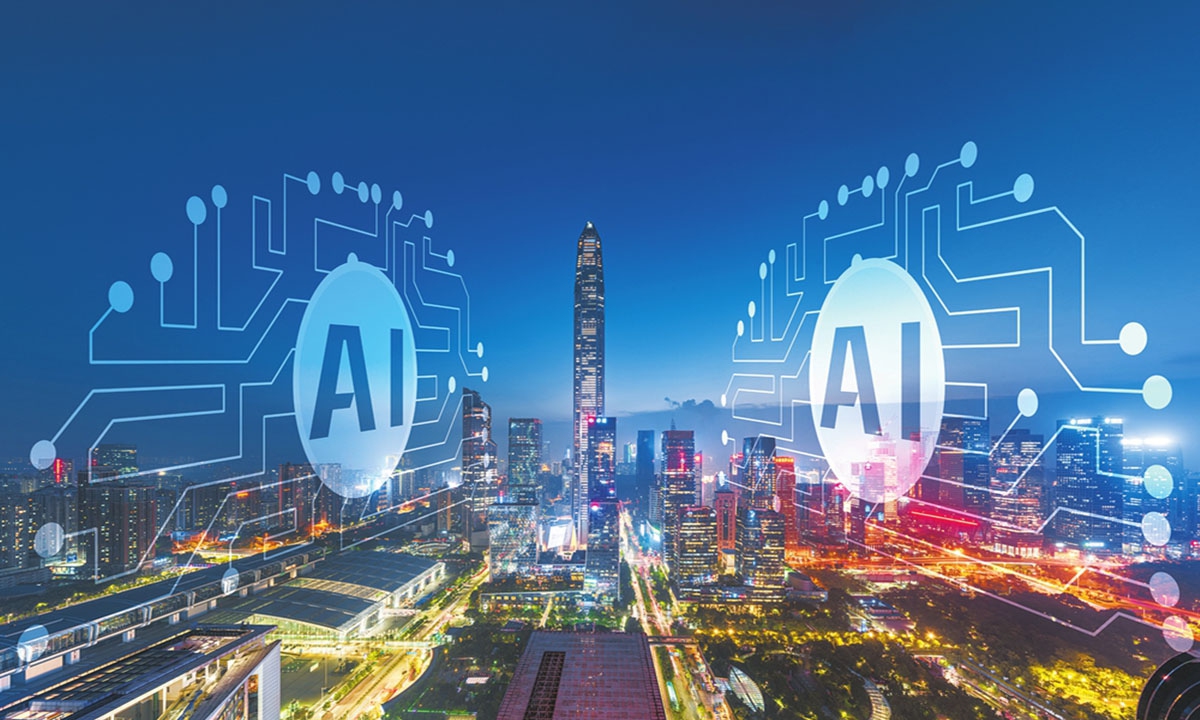
A concept picture of AI city File photo: VCG
China's innovation is open and open-source, and we aim to achieve win-win results, Lin Jian, a spokesperson for China's Foreign Ministry, said on Friday, when asked to comment on recent articles published by several foreign media outlets including The Financial Times and The Economist about China's innovation edge and the reason behind this, saying that China has transformed from the "world's factory" to the "world's laboratory," and that Western countries need to catch up in this competition.
Speaking at a regular press briefing, Lin said that "innovation" has indeed become a key word in China's economic and social development. It was mentioned 61 times in the recommendations for formulating the 15th Five-Year Plan, which was adopted at the recently held fourth plenary session of the 20th Communist Party of China Central Committee.
Over recent years, major scientific and innovation outcomes have kept emerging in China, which has gone up the Global Innovation Index ranking, from the 34th in 2012 to the 10th in 2025, according to Lin.
For years, China has taken science and technology as its primary productive force. We have provided guidance of visions and policies and advanced reform of the system, taken good use of our market and talents, let enterprises take up the principal role in innovation, and made sustained efforts, blazing a successful path whereby sci-tech innovation spearheads industrial innovation and industrial upgrade propels sci-tech evolution, and making innovation the underlying driving force of China's economy, the spokesperson said.
There may be competition in innovation, but innovation is not about winning. China's innovation is open and open-source, and we aim to achieve win-win results, Lin said.
According to the spokesperson, the first batch of cooperation projects aboard China Space Station involves 23 institutions from 17 countries. China's FAST telescope accepts observation application from scientists worldwide. China initiated the establishment of the World Artificial Intelligence Cooperation Organization and proposed the AI+ International Cooperation Initiative as part of the effort to promote the open and inclusive development of AI for good and for all. DeepSeek launched an open-source model for global developers to use and improve.
"The examples are ample. China is willing to share indigenous technologies and innovation scenarios with the world, promote mutual empowerment and common development through openness and cooperation, and deliver more outcomes of innovation to the whole humanity," Lin noted.
Wang Peng, an associate researcher at the Beijing Academy of Social Sciences, told the Global Times on Friday that China's innovation-driven development model has become the core driver of economic growth, propelling the economic structure toward high-end, intelligent and green upgrading.
A recent article in The Economist said that "China is rapidly pressing ahead in two other frontier technologies, autonomous vehicles and new drugs," adding "a deep pool of talent, a broad manufacturing base and huge scale combine to propel it rapidly up the value chain." In addition, it noted "a more surprising ingredient of China's success is its nimble and permissive regulators."
A Financial Times report mentioned China's research and development (R&D) efforts as well as areas of Chinese R&D that are at the sharp end of technological competition with the US, including artificial intelligence and robotics.
Wang noted that foreign media outlets have focused intensively on China's innovation, objectively acknowledging its breakthroughs in cutting-edge fields, which indirectly confirms the international influence of China's innovative capabilities.
"Meanwhile, we should remain vigilant that some Western media outlets may once again invoke the 'China threat theory' when reporting on China's technological progress," Wang said.
In fact, China lowers the threshold for technology adoption through open-source communities and international standards cooperation, helping developing countries bridge the digital divide and promoting global technological equality. At the same time, through platforms such as technology cooperation under the Belt and Road Initiative and jointly established laboratories, the country is building a mutually beneficial and win-win global innovation network, sharing the dividends of Chinese technology with the world, Wang noted.
RELATED ARTICLES