Mainland-supplied exoskeleton suits enhance rescue operations at Tai Po deadly fire: HK police officer
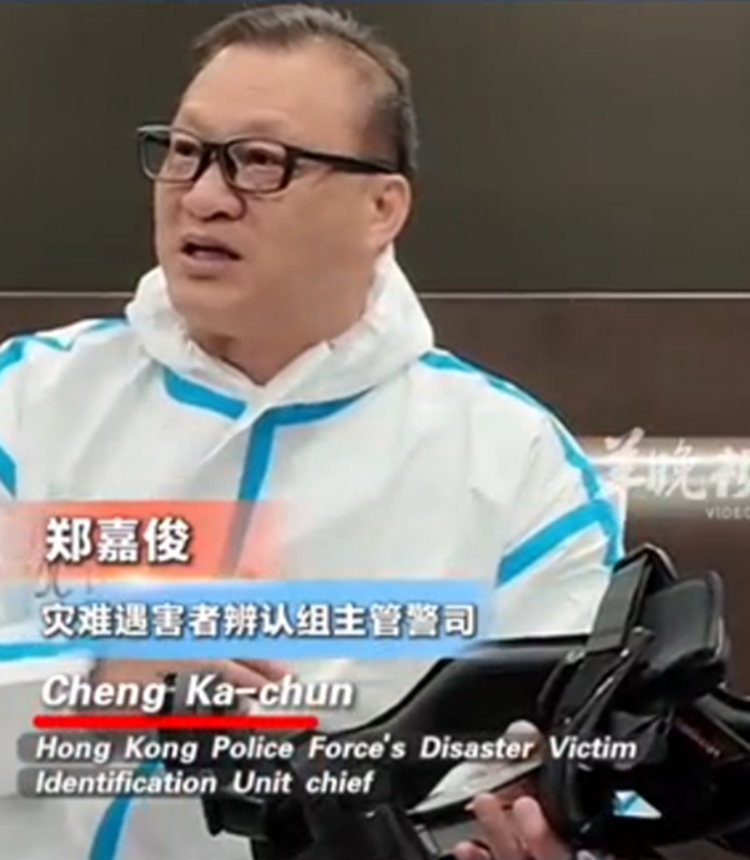
DVIU Chief Cheng Ka-chun demonstrates an exoskeleton suit provided by the Chinese mainland authorities, which is very helpful for the relief work of Tai Po deadly fire. Photo: Screenshot of media interview
The post-fire search and recovery efforts at Hong Kong's Tai Po Wang Fuk Court continued to make progress, with the work of the Hong Kong Police Force's Disaster Victim Identification Unit (DVIU) drawing widespread public attention. On Friday, DVIU Chief Cheng Ka-chun demonstrated during an interview with South, a news platform operated by Guangdong-based Nanfang Daily, two sets of equipment provided by the Chinese mainland. Among them, the exoskeleton suits proved especially valuable for officers responsible for transporting bodies.
As the affected building has no power supply, DVIU officers must climb dozens of floors on foot while wearing full protective gear and carrying heavy equipment. The weight of the bodies — often increased after being soaked during the blaze — places significant physical strain on the team, Cheng said during the interview.
The exoskeleton offers multiple modes, including movement support, standard mode and stair-descending assistance. These features help reduce the load on officers, lower physical exhaustion and make the transport work more efficient and safer, he said.
Lui Kam-ho, director of operations of the HKPF, told at the interview on Friday that Hong Kong has received over 30,000 pieces of relief items from the mainland, including tents, protective goggles, protective clothing, and rain boots, enabling frontline search personnel to carry out their tasks efficiently and smoothly at the fire site.
"Among these, what our colleagues found most practical was a type of equipment called the exoskeleton suit," Lui said.
The devastating blaze at Wang Fuk Court has claimed 159 lives. In the critical hours that followed, the Guangdong-Hong Kong-Macao Greater Bay Area (GBA) emergency response mechanism activated, and the central authorities and local departments in the mainland rapidly assembled and dispatched relief supplies to the city, according to local media reports.
Under the GBA emergency response mechanism, the Shenzhen fire and rescue department swiftly deployed support to Hong Kong, delivering 10 drones and 20 sets of exoskeleton equipment to the site on November 27, according to local media reports.
Additional supplies — including 50 explosion-proof panoramic mobile lighting systems, 161 illuminated command batons, 200 multifunctional compact signal lights and 247 multifunctional high-intensity work lights — were handed over to the Hong Kong Police Force on November 30.
Another equipment provided by mainland authorities, which Cheng demonstrated during the interview, is a specialized lighting system. The interior of the fire scene was pitch black, and ordinary lighting tools were insufficient for search operations, Cheng said, noting that this lighting device, however, is highly adaptable: It features white light with multiple brightness modes, can be worn directly on the body, and requires no hand-held operation.
This allows officers to work freely in narrow, debris-filled spaces. The system illuminates every corner, significantly reducing the risk of missing critical areas, and has become an indispensable tool for precise search efforts, Cheng noted.
RELATED ARTICLES