The China-Argentina direct flight means far more than just a new air route: Global Times editorial
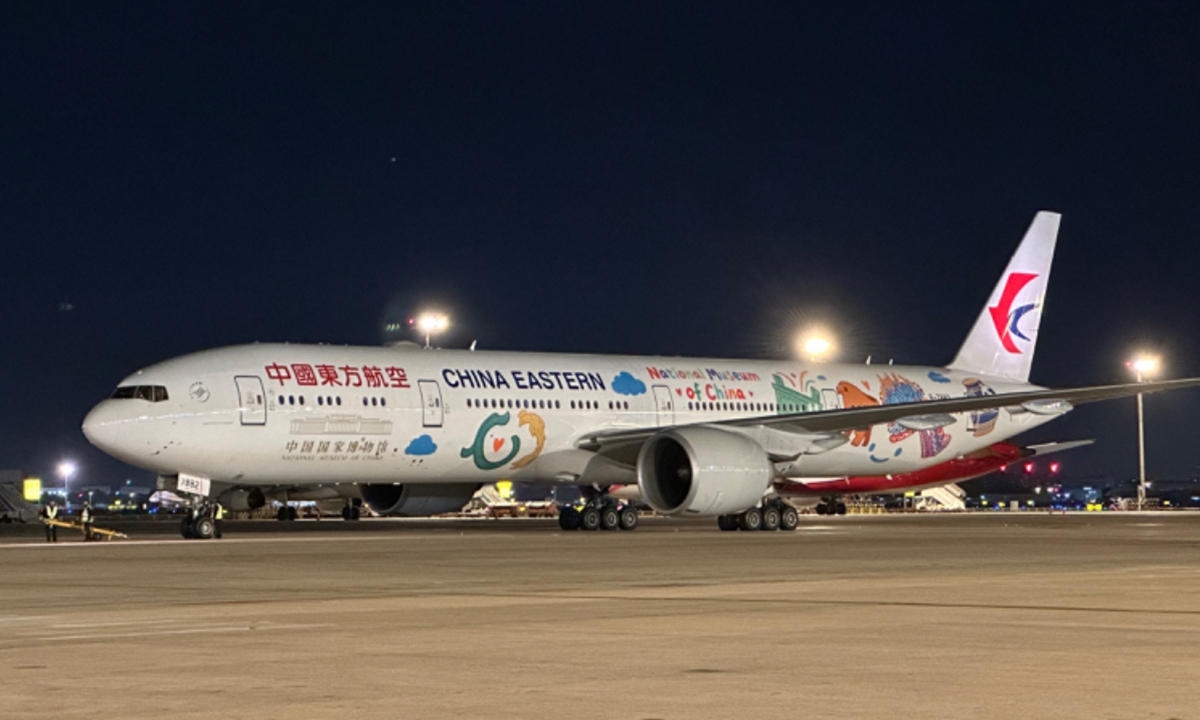
China Eastern Airlines flight MU745 is pictured at Shanghai Pudong International Airport before heading for Buenos Aires, Argentina, on December 4, 2025. Photo: Courtesy of China Eastern Airlines
On Thursday afternoon, Argentina time, China Eastern Airlines' flight MU745 - with its fuselage adorned with images of cultural treasures such as the jade dragon, jade phoenix, and the bronze cauldron Houmuwu Ding - gently touched down at Buenos Aires Ezeiza International Airport after crossing the vast Pacific Ocean and traveling more than 20,000 kilometers.
This direct Shanghai-Buenos Aires air corridor links almost the most distant pair of antipodal points on Earth, while carrying far-reaching strategic vision and genuine cooperative goodwill across the ocean and continents. It demonstrates to the world that China's high-standard opening-up is delivering an increasing number of tangible public goods to the global community, especially to the vast number of Global South countries. China is taking concrete actions to interpret the contemporary value of "connectivity," and is writing a new chapter in the shared journey forward of China and Argentina, China and Latin America, and indeed the entire Global South.
For a long time, geographical distance has been a natural barrier between China and Argentina. The launch of this direct air route now means that the distance that once separated two places regarded as "the ends of the Earth" can now be covered within a single day and night. What the route connects is not merely two cities, but also flows of people, goods, capital, and information across an ocean.
The most immediate change brought by the direct air route is that people-to-people, cultural and trade exchanges become smoother and more regular. When Chinese tourists can more easily set foot on the South American continent, when Latin American companies can visit China more frequently, and when interactions in culture, education, science and technology, and even sports can take place at lower costs, the depth and resilience of bilateral relations will naturally grow. The direct air route dramatically shortens the distance between the "Latin America of the imagination" and the real Latin America. This cognitive closeness often determines the warmth of cooperation more than trade volumes ever could.
Building on this, the direct air route will directly serve the highly complementary economic structures and growing shared interests between China and Argentina, as well as between China and Latin America as a whole.
Over the past decade and more, China-Latin America relations have continued to deepen, with economic complementarity becoming ever more pronounced and trade volumes expanding steadily. Cooperation has broadened across agriculture, energy, manufacturing, the digital economy, infrastructure, and beyond.
For Argentina, this direct link means faster connection to Asia - the world's most dynamic economic region - injecting strong momentum into its own economic recovery and growth. For China, it represents a vital step in deepening cooperation with Latin America, optimizing its global market footprint, and enhancing the diversity and resilience of its industrial and supply chains. The launch of this route also allows the stopover destination, New Zealand, to benefit directly, making it a true "win-win-win" outcome.
At both ends of the route and at any stopover points, a whole ecosystem of industries - such as aviation services, logistics and warehousing, tourism and hospitality, cross-border business - will spring up and flourish. Real, tangible jobs and development opportunities will emerge in their wake.
The China-Argentina direct air route marks another key milestone in the steadily improving connectivity between China and Latin America in recent years. It also serves as a vivid example of "infrastructure connectivity" in the joint construction of the Belt and Road Initiative.
From the maritime corridor linking Shanghai directly to Peru's Chancay Port, to the opening of direct air routes between China and countries such as Cuba, Mexico, and Brazil, China and Latin America are steadily weaving a sea, land, and air transportation network that spans half the globe. A bridge across the Pacific may remain out of reach, but a convenient air corridor can just as effectively bind the farthest-flung countries closely together.
Through concrete actions, China is helping accelerate infrastructure connectivity and modernization across Global South countries, including those in Latin America, expanding areas of shared interest and creating more opportunities for common development. Air routes, ports, and railways are not just transportation infrastructure; they are strategic pillars that elevate South-South cooperation. Each additional route, port, or railway segment means lower mobility costs and greater cooperation efficiency.
Against the backdrop of a complex and rapidly evolving international landscape, with rising protectionism and anti-globalization sentiment, this world's longest one way air route also carries deeper symbolic significance. When some traditional public goods suffer from insufficient supply or come with political conditions attached, Global South countries increasingly hope to build stable, fair, and sustainable connectivity systems. The launch of the China-Argentina direct air route demonstrates concrete support for openness and connection. It is a vivid example of developing countries creating public goods through independent cooperation. At the same time, for other Latin American countries, the successful launch of this farthest, most challenging, and most symbolic China-Argentina direct air route offers a practical point of reference through its proven commercial model and feasibility, strengthening their confidence in both policy coordination and market expectations for opening direct air routes with China.
MU745 crosses half the globe, connecting not only China and Argentina but also the vast developmental space of Asia and South America, the two sides of the Pacific, and the Global South. What it shortens is physical distance; what it brings closer is understanding and trust; what it opens is new space for cooperation.
In a world with an uncertain future, connecting the world through openness, creating opportunities through cooperation, and enhancing autonomy through connectivity are inherently forward-looking choices. This is why the significance of the China-Argentina direct air route goes far beyond a single air route.
RELATED ARTICLES

