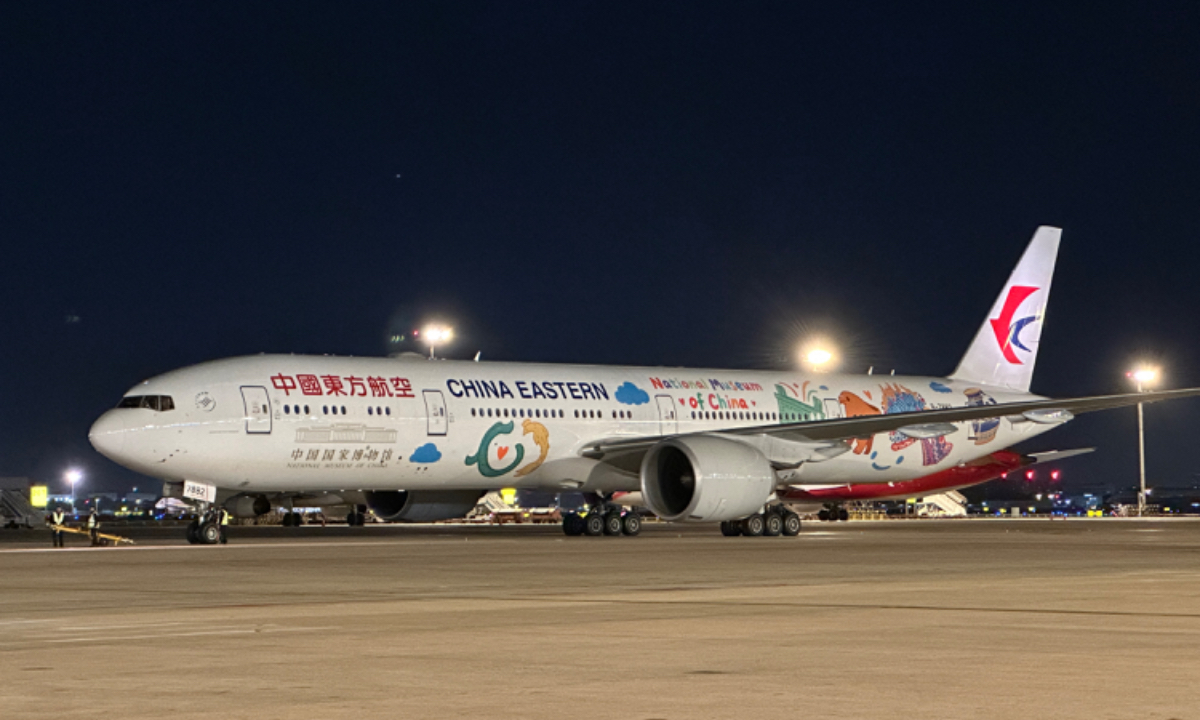
China Eastern Airlines flight MU745 is pictured at Shanghai Pudong International Airport before heading for Buenos Aires, Argentina, on December 4, 2025. Photo: Courtesy of China Eastern Airlines
China Eastern Airlines' inaugural flight MU745 took off from Shanghai Pudong International Airport on Thursday local time, bound for Buenos Aires, Argentina. With a total distance of nearly 20,000 kilometers and a scheduled block time of 25 hours and 55 minutes, it shatters the record for the world's longest one-way flight. As the world's first scheduled commercial route connecting two near-antipodal cities - Shanghai and Buenos Aires, almost diametrically opposite on the globe - it has ushered in a new chapter for Global South connectivity.Spanning both hemispheres and both halves of the planet, the route is more than a technical triumph. It allows the China-Argentina flight to be completed almost within one calendar day and opens a fast lane for tourism and business across the Pacific. For a long time, anyone flying between Shanghai and key cities in South America had to endure detours via Europe or North America. This new "Southern Corridor" across the Pacific slashes four to five hours off the old 30-hour ordeal and bypasses the traditional Northern Corridor.
This is an aerial bridge tying Asia, Oceania, and South America together. People and goods will flow freely in both directions. On the return leg, reports show that China Eastern's cold-chain logistics arm will load 2.1 tons of Argentine cherries and 10.5 tons of fresh Chilean salmon into the cargo hold, delivering summer produce to Chinese tables in winter.
Thanks to fifth-freedom rights secured at Auckland, passengers and cargo can board or alight there, instantly creating a high-value trade corridor for premium agricultural products and precision instruments among China, New Zealand, and Argentina, a boon for all three continents. The real magic of flying isn't how high it goes. It's how it makes the world feel smaller, turning days into hours and faraway places into somewhere one can reach faster. South America no longer feels half a world away.
For too long, the global aviation map was drawn by and for the North Atlantic powers. European and North American mega hubs captured the lion's share of passenger traffic, while Latin America's connections to the rest of the Global South remained relatively fragmented and reliant on northern stopovers. The Shanghai-Auckland-Buenos Aires flight, driven by real developmental demand, has broken that old structure.
In recent years, practical cooperation between China and Latin America has continued to advance, with more innovative projects taking root. The China-Peru Belt and Road cooperation project - the Port of Chancay - has become a new hub port in Latin America and a gateway to the Pacific, significantly shortening direct shipping times from Peru to Asia. The Phoenix Park Industrial Estate, opened in Trinidad and Tobago last year, contributing to the country's strategy of economic diversification and transformation. From the sea lanes linking Shanghai to Peru's Chancay Port to this new skyway to Buenos Aires, China and Global South countries are turning connectivity into a genuine global public good, one that the Global South can finally call its own.
Behind China-Latin America cooperation lies the Global South's shared demand for collective development and practical collaboration. China has continued to provide global public goods, exemplified by the Belt and Road Initiative and the four major global initiatives. Landmark projects such as the China-Laos Railway, the Jakarta-Bandung High-Speed Railway, and the Port of Piraeus have created 420,000 jobs in partner countries and helped lift nearly 40 million people out of poverty, becoming powerful engines for global connectivity.
These examples all testify to China's contribution of its wisdom and strength to the Global South's shared journey toward modernization.
When snowflakes fall over the North, South America is in full summer-beach fever; when the lights come on along Shanghai's Bund, the scent of Argentine asado is already drifting eastward. This single flight carries a larger message: The Global South is rising, shoulder to shoulder, and wing to wing.
The author is a reporter with Global Times. opinion@globaltimes.cn
RELATED ARTICLES