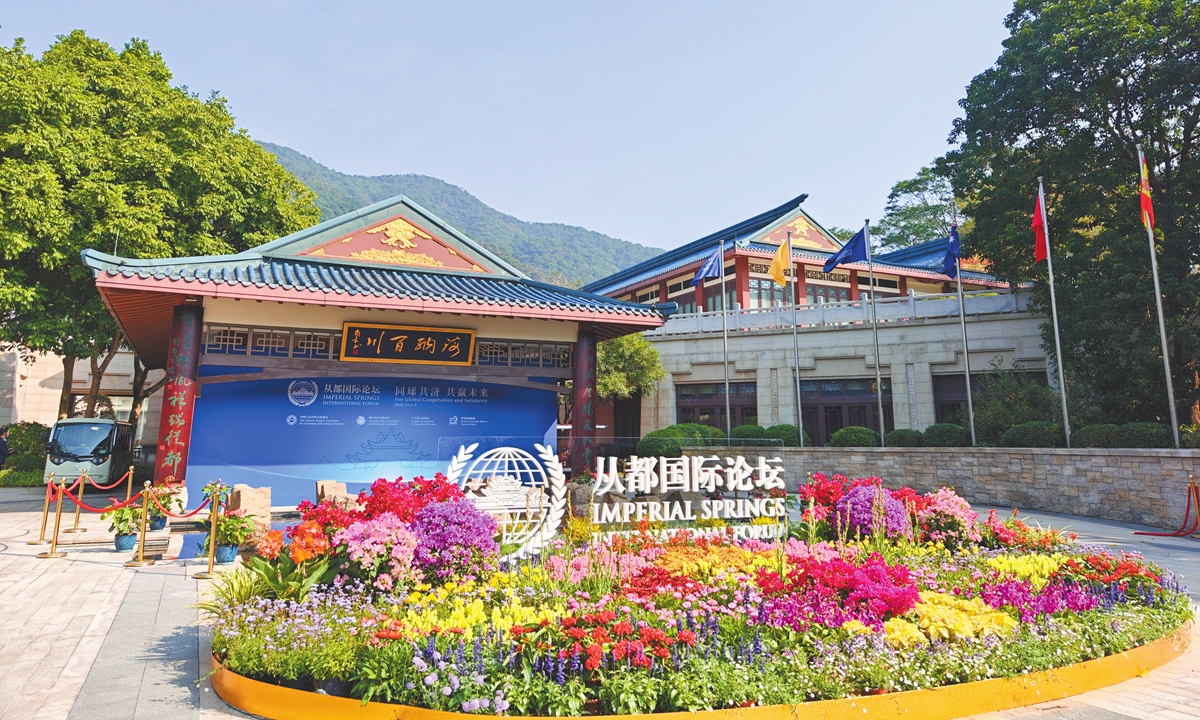
A floral decoration at the venue of the 2025 Imperial Springs International Forum. Photo: Qian Jiayin/GT
Editor's Note:Against the backdrop of profound shifts in the international landscape, the Global South is becoming increasingly active on the world stage, moving from "being present" to truly "making its voice heard." At the 2025 Imperial Springs International Forum, held in Guangzhou, South China's Guangdong Province, from Monday to Wednesday, three former leaders from Global South countries shared their views with the Global Times on how the rise of the Global South is reshaping global governance and what experiences China can contribute.
Jigmi Yoser Thinley, former prime minister of Bhutan
The Global South is already reshaping how the international community behaves, especially at a time when the global system is in flux. In this process, the collective voice of the Global South - with China providing inspiring leadership - is becoming critical. Together, we can help build an international system that is more just, representative and effective.
If I were to list all the lessons from China's experience, it would take hours, because almost everything China has done is exemplary for developing countries. China has shown that if you aim high, you can at least reach the mountain top. Few could have imagined a country facing China's initial challenges could achieve such remarkable progress. There is so much for us to learn, but perhaps the most important lessons are good leadership and good governance.
Some argue that good governance must be tied to Western-style democracy, but China has demonstrated that good governance does not need to follow any specific model. It is defined by whether the system serves the people and improves their well-being - and China has delivered. In relatively a short time, China has lifted about 800 million people out of poverty and eliminated extreme poverty.
Good leadership enables good governance, and both are effective when officials can be held accountable. In China, accountability comes from within the Party, and I believe this is often more effective than relying solely on electoral accountability. For many developing countries, China's system of internal self-discipline and self-reform has proven exemplary.
Jorge Fernando Quiroga, former president of Bolivia
This century has certainly brought dramatic changes to global governance. We live in a different world now - and we are better for it. The G20 is far more influential and important than the G7. Within the G20, we all have seats at the table, including countries from my part of the world (Latin America) - Mexico, Brazil and Argentina. This arrangement is better for ensuring that our perspectives are represented and addressed.
The landscape is changing rapidly. At the beginning of the 21st century, the West would innovate, and China would replicate. That is no longer the case. China now innovates - perhaps even more rapidly than the Western world. This will bring major changes in areas such as clean energy, driverless transportation, pharmaceuticals and artificial intelligence (AI).
The Global South is rising, but at different speeds: Asia is growing much faster than Latin America, which is falling behind, and Africa is also moving somewhat slowly. Countries in Asia - like China - have an advantage because they used to be developing nations like those in Latin America, and have since become major global players. Today, they are far more advanced. Still, as we move forward, there will be profound changes in both Latin America and, especially, Africa. We have younger populations, more active workforces, and expanding employment opportunities. The challenges ahead require new thinking to address the issues we face.
Take AI as an example. There is justified fear that AI will cause large-scale job displacement in developed countries. For developing countries, however, the opportunities look different. We do not have enough nurses, doctors, lawyers or programmers, and AI can help us expand service delivery in all these sectors. AI may actually present greater opportunities for developing countries to catch up than for developed countries. The opportunities are there, but it is up to us in developing countries to seize them.
Olusegun Obasanjo, former president of Nigeria
For the first time, because the G20 has been held in Johannesburg, South Africa, we in Africa are not only present and have made our voices heard, but we are also part of the decision-making process. This is very significant for Africa and for the Global South. When you look at the G20 and the combined GDP of its members, its importance is undeniable. It is unique for the Global South to be part of a body where we are represented not only in numbers, but also in decisions and in economic terms that truly carry weight. This is a new phenomenon in world affairs - one that the world cannot ignore.
A new international order will consist of a number of issues or factors. The current international order was built on rules and institutions created immediately after World War II. The United Nations itself, the core symbol of the postwar international order, was born out of that period. If we are to talk about a new international order, the UN itself must be reformed. That is the first point that must be made.
The second point concerns the institutions created under the UN framework - the World Bank, the IMF, UNESCO and WHO. They were designed for a particular purpose at a particular time. Times have changed, and are still changing. In my part of the world, we say: "When the drum changes its beat, the dance steps must also change." The rhythm in the international arena has shifted, and so must the dance. Reform of these institutions is the beginning of a new international order. Here again, the Global South has a significant role to play.
If I may refer to what China has put on the table - the four major initiatives: the Global Security Initiative, the Global Development Initiative, the Global Civilization Initiative and the Global Governance Initiative. These initiatives are extremely important. You cannot have development without security, and you cannot have security without peace. You cannot have peace without governance that treats the preservation of peace as a core responsibility. These four initiatives are interconnected. The question is how to make them work together to achieve what they are intended to achieve. And again, the Global South has a central role to play. If the ideas originate from the Global South - as is the case with China - then implementation must also be largely driven by the Global South.
RELATED ARTICLES