China demonstrates tangible commitment to shared prosperity while US pursues unilateralism
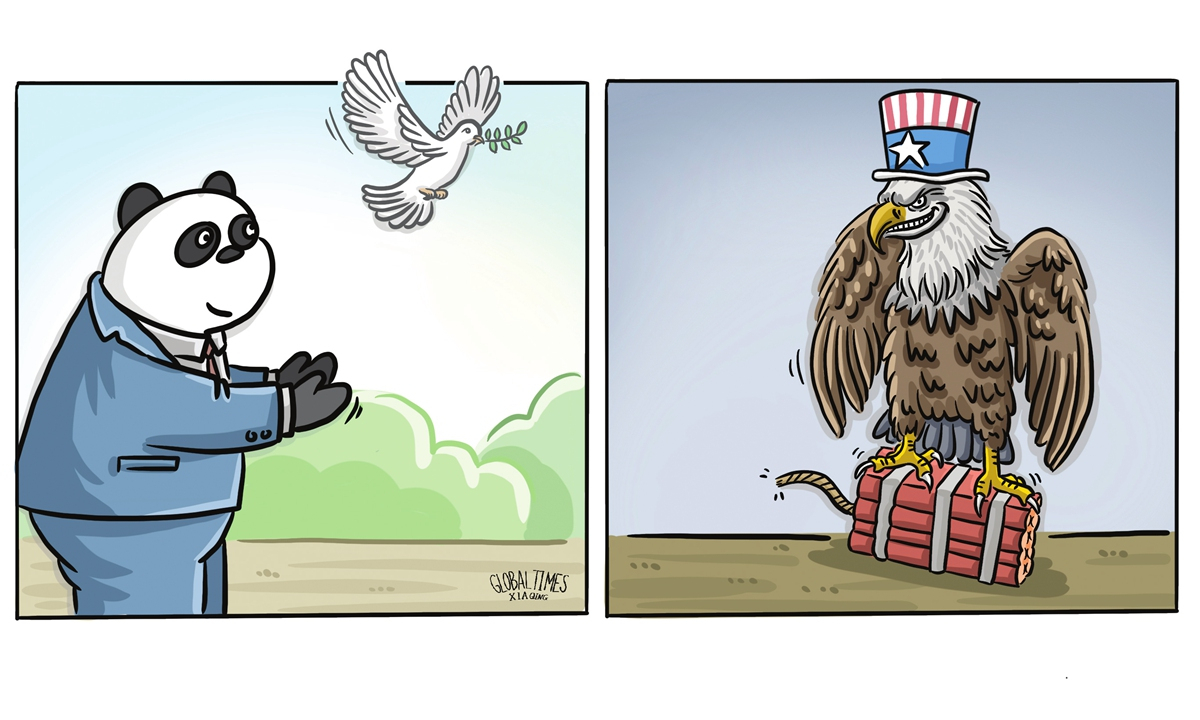
Illustration: Xia Qing/Global Times
As the US continued to pursue unilateral policies that strain the international system, China hosted the Shanghai Cooperation Organization (SCO) Summit and a commemoration of the 80th anniversary of the victory of the World Anti-Fascist War. To many observers worldwide, such contrast invites reflections on several pressing issues concerning the future of global governance.
Does the world need a hegemon?
The SCO Summit in Tianjin drew significant international attention, with major media outlets highlighting its impressive scale. Leaders from more than 20 countries came together, representing nearly half of the world's population. The Associated Press noted that the gathering could "lend weight to China's vision of a multipolar world."
Meanwhile, US foreign policy is increasingly described as transactional. Foreign Policy magazine recently observed that "the world is no longer surprised by an opportunistic US." Critics have labeled America's tendency to shift burdens onto allies, withdraw from treaties, and act unilaterally as a form of "low-cost hegemony."
Such misgivings are not limited to geopolitical rivals. Among its allies in Europe and Asia, the US is increasingly viewed as a disruptor. Even former US National Security Adviser Jake Sullivan has acknowledged that many nations question America's reliability, while Secretary of State Marco Rubio conceded that a unipolar world is "not normal."
Against this backdrop, the collective rise of the Global South is accelerating the transition toward a multipolar world. In Tianjin, China put forward the Global Governance Initiative, advocating for a fairer global system based on sovereign equality, international rule of law, and multilateral cooperation - rather than hegemony. This initiative offers a way toward effective and sustainable global governance.
Who will drive global growth?
Though still the world's largest economy, the US has long relied on loose monetary policy and fiscal stimulus to sustain growth - approaches that have contributed to industrial hollowing-out and offshoring.
In the first quarter of 2025, US GDP shrank by 0.5 percent on an annualized basis, its weakest performance since 2022. According to IMF projections, America's contribution to global GDP growth is expected to fall to 11.3 percent between 2025 and 2030. Capital outflows have intensified, with the dollar index dropping nearly 11 percent in the first half of 2025.
By contrast, China has remained a stabilizing force in the world economy. It recorded a solid 5.3 percent growth in the first half of 2025 while actively strengthening global trade ties through platforms such as the China International Consumer Products Expo. Through measures like zero-tariff treatment for least-developed countries, China has demonstrated a tangible commitment to shared prosperity.
Capitalism or socialism?
Ongoing political turmoil in the US points to deeper systemic challenges. The "American Dream," once an inspiring ideal, now appears increasingly out of reach amid widening inequality and persistent social divisions.
In this context, some Americans are reconsidering socialism, long vilified in mainstream discourse. A recent poll found that 62 percent of Americans aged 18 to 29 view socialism favorably - suggesting openness to alternative models of governance.
China's expanded visa-free entry policies, meanwhile, are allowing more international visitors to see the country's development firsthand. Global attention is shifting from China's infrastructure and poverty alleviation successes to the underlying logic of its system - and the limitations of Western capitalism. Many Western media outlets recognize that China's capacity for long-term planning and coordination is something their own systems struggle to emulate.
China's V-Day parade not only showcased remarkable organizational capacity and national unity, but also conveyed a broader message: In a time of global challenges, solidarity and shared progress represent the only viable way forward.
Although these events have concluded, the questions they inspired will not simply fade away. Around the world, more people are looking at such displays of collective resolve and asking themselves: What is the right path for humanity in the years to come?
The author is a commentator on international affairs, writing regularly for Xinhua News, Global Times, China Daily, CGTN etc. opinion@globaltimes.com.cn
RELATED ARTICLES