Japan’s accusation of Chinese carrier-based aircraft locking radar onto Japanese warplanes a case of perpetrator blaming victim: expert
By Published: Dec 07, 2025 12:15 PM Updated: Dec 07, 2025 03:07 PM

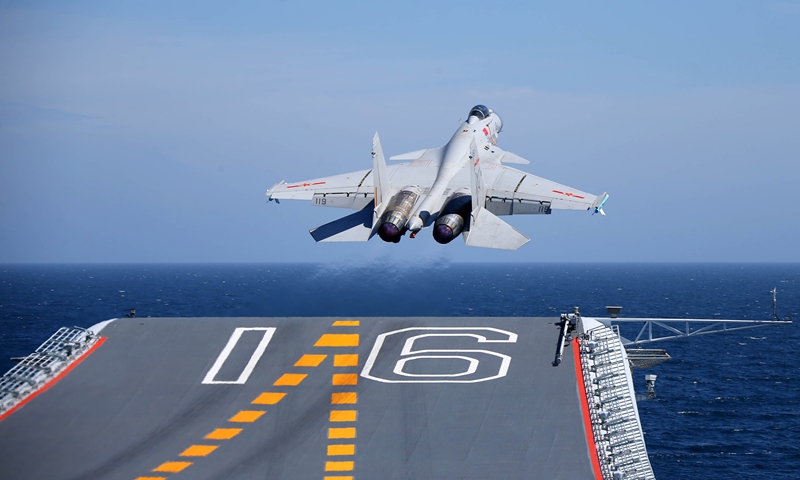
A J-15 carrier-borne fighter jet takes off from the flight deck of the aircraft carrier Liaoning during a maritime training exercise on July 1, 2017. The Chinese aircraft carrier Liaoning and its carrier strike group carried out realistic training in an undisclosed sea area on July 1, 2017. (eng.chinamil.com.cn/Photo by Li Tang)
The Japanese defense minister on Sunday reportedly accused Chinese carrier-based aircraft of locking radar onto Japanese warplanes that were conducting “countermeasures for airspace violations.” However, even the Japanese side admitted that the Chinese aircraft did not enter Japanese airspace, and a Chinese expert said that Japan is the perpetrator blaming the victim and a thief crying “stop thief,” with the Japanese warplanes having dangerously approached the Chinese aircraft carrier formation in open waters first, while the Chinese side was forced to take legitimate, professional countermeasures.
At a press conference held in the early hours of Sunday, Japanese defense minister Shinjiro Koizumi claimed that Chinese military aircraft intermittently locked its radar onto Japan Air Self-Defense Force fighter jets twice in open waters southeast of Okinawa Island on Saturday, Japanese media outlet Asahi Shimbun reported on Sunday.
According to the Asahi Shimbun report that cited the Japanese defense ministry, a J-15 fighter jet from the Chinese People’s Liberation Army (PLA) Navy aircraft carrier Liaoning intermittently locked its radar on two Japan Air Self-Defense Force’s F-15 fighter jets that were conducting “countermeasures for airspace violations.”
The Japanese government claimed on Sunday that the incident was “very regrettable” and has lodged a strong protest with China through both diplomatic and defense authority channels, according to Asahi Shimbun.
However, no Chinese aircraft violated Japanese airspace in the incident, the Asahi Shimbun reported. Citing a Japanese defense ministry representative, the report also claimed that the F-15 did not approach the J-15 at a visually perceptible distance, and there were “considerable distances.”
Song Zhongping, a Chinese military affairs expert, told the Global Times on Sunday that even the Japanese side admitted that Chinese aircraft did not enter Japanese airspace. It exposed that the Japanese side is the perpetrator playing the victim and shifting blame to the real victim.
The real situation could be like this: the Japanese fighter jets came close to the Chinese aircraft carrier Liaoning that was legitimately sailing in the open waters, and the Liaoning sortied one or more J-15 fighter jets to conduct monitoring and eventually interception when the Japanese warplanes came too close and posed potential threats, Song said, noting that the Chinese countermeasures were completely legitimate and professional, Song said.
This is a typical case of a thief crying “stop thief,” as the Japanese warplanes were the ones that brought risks for maritime and aerial accidents while the Chinese aircraft carrier formation was conducting legitimate training operations in the open waters, Song said.
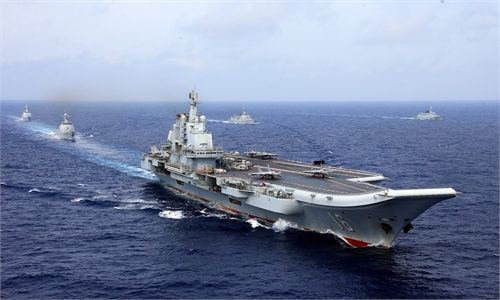
The PLA Navy’s aircraft carrier Liaoning on Saturday conducted carrier-based aircraft takeoff and landing exercises in the Pacific Ocean near Okinawa, according to a report by Japan’s Kyodo News.
According to a press release by the Japan Joint Staff on Saturday, the aircraft carrier Liaoning (Hull 16) was accompanied by the Type 055 large destroyer Nanchang (Hull 101) and two Type 052D destroyers with hull numbers 117 and 124.
This is the first time the Japanese side has confirmed Chinese aircraft carrier activities near Japan since China’s entry into a three-carrier era, the Kyodo News report noted.
The Japanese defense ministry’s claim of spotting the Liaoning came after a Thursday report by Reuters claiming that China is deploying a large number of naval and coast guard vessels across East Asian waters, at one point more than 100.
In response to a Reuters reporter question about this alleged deployment, and Japanese defense minister’s claim of “China has been expanding and stepping up its military activities in the area surrounding Japan,” Chinese Foreign Ministry spokesperson Lin Jian said at a regular press conference on Friday that “I’d refer you to competent authorities for what you mentioned. Let me stress that China is committed to a national defense policy that is defensive in nature. The Chinese navy and China Coast Guard carry out activities in relevant waters in strict accordance with China’s domestic laws and international law.”
There is no need for relevant parties to overreact and overinterpret, still less should they make groundless accusations, Lin said.
Zhang Junshe, a Chinese military affairs expert, told the Global Times that PLA warships, including aircraft carriers, regularly conduct far seas exercises in the Western Pacific, but Japan frequently hypes such normal activities. This is likely an attempt to hype the "China threat" rhetoric, creating excuses to expand its own military power, breaking away from its pacifist constitution.
PLA warships’ far seas exercises conform to the international law and common practices, and the Japanese side should not hype such legitimate activities, Zhang said. Why wouldn’t Japan hype US military activities in the region? Zhang asked.
Amid Japanese Prime Minister Sanae Takaichi's erroneous remarks on Taiwan and Japan’s consecutive military expansion gestures, Japan’s right-wing forces are trying to find every excuse to hype the so-called “China threat” in an attempt to justify its breakaway from the pacifist constitution, so it could develop more previously restricted weapons, Song said.
Back in June, Japan also claimed spotting the aircraft carrier Liaoning sailing in the Pacific near Japan. In response to a related question, Lin, the Chinese Foreign Ministry spokesperson, said at a regular press conference on June 9 that China’s military vessels’ activities in relevant waters are fully consistent with international law and international practices.
“China pursues a national defense policy that is defensive in nature. We hope Japan will view those activities objectively and rationally,” the spokesperson said.
RELATED ARTICLES