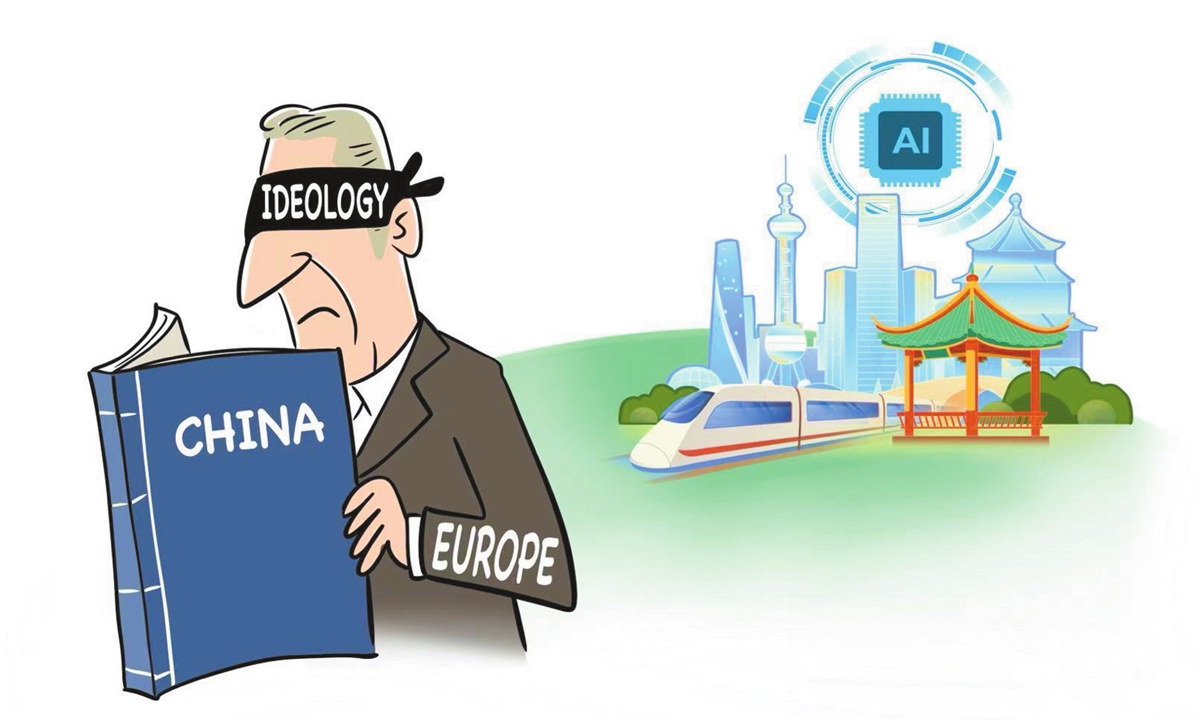
Illustration: Liu Rui/GT
According to a South China Morning Post report on Saturday, Dutch Minister for Economic Affairs Vincent Karremans admitted being "blindsided by" China's reaction in the Nexperia dispute. The Nexperia issue was not merely a political embarrassment for the Netherlands; it reflected a deeper reality: Europe has habitually underestimated China's capabilities and intentions. It was symptomatic of a broader cognitive gap that continues to shape and even distort Europe's China policy.
Europe's response to China has frequently been marked by caution, distrust and a certain moral superiority. Behind these sentiments lies an assumption: China remains a mid- or lower-tier power - it may not follow Europe's rules, but it cannot impose real costs on European interests.
Two decades ago this assumption had some basis, when China was then largely integrated into global markets as a low-margin manufacturing economy. But the world has changed, and China has changed with it. For most China observers, China's reaction the Dutch minister called "not the most likely" was, in fact, standard and predictable state behavior.
In the Nexperia case, the Dutch government invoked a Cold War-era security law to take control of a Chinese-owned semiconductor firm, with almost no domestic or international coordination beforehand. The move was framed as a cautious defense against "foreign influence." When China subsequently halted some exports of auto chips, European officials were shocked, as if the world's largest semiconductor production and packaging base had suddenly defied "gravity."
For a long time, European policymakers analyzed China through narrow ideological or moral lenses, confidently assuming that "economic rationality" would constrain China's actions. This approach overlooked several structural realities. Today, China holds decisive influence over many critical links in the global manufacturing system - not only low-end assembly, but also mature semiconductor fabrication, materials processing, and packaging and testing. When such an economic powerhouse chooses, even temporarily, to treat interdependence strategically, the effects cascade immediately through global supply chains.
When the minister was asked whether the Dutch government had anticipated China's reaction, Karremans replied, "you never know how China will react ... there's no certainty about that in advance." This reflected less a failure of intelligence than a failure of imagination - an inability to adjust to the new balance of power. The intuition that "China will protest but ultimately cooperate" no longer matches reality.
Of course, internal European discussions about economic security and strategic autonomy have legitimate grounds. But risk management is different from political theater. In practice, some European governments, under US pressure or driven by domestic populist sentiment, take symbolic actions toward China without fully anticipating the consequences.
Europe's true challenge is not that China has become more "aggressive," but that Europe still habitually treats China as a student to be "corrected" or a threat to be "contained," rarely regarding it as an equal partner worthy of serious engagement. This mind-set hinders effective negotiation.
Treating China as an equal does not mean conceding; it means acknowledging that China is capable of designing, executing and standing by its policy choices. No genuine dialogue can occur without this recognition.
According to the South China Morning Post, although Karremans made certain concessions, he insisted that the decision itself was "well-considered and substantiated." This reflects Europe's current dilemma - tactical retreat but strategic denial.
A more rational approach is to recognize that China's reaction was not impulsive. China's export restrictions sent a clear message: Unreasonable unilateral administrative takeovers of Chinese corporate assets carry real costs. Any sufficiently capable global power would likely respond similarly to such unilateral actions.
For EU measures, from the Goods Availability Act to various "de-risking" roadmaps, to be truly effective, they must be grounded in a realistic understanding of the intertwined global system - where China is simultaneously a competitor and an indispensable partner.
Therefore, the Nexperia issue should be seen by Europeans as a lesson in understanding China's development. The old world in which Europe unilaterally set the rules while others passively adapted is gone. In its place is a multipolar system in which economic power quickly translates into strategic capability. To maintain security and prosperity, Europe must first update its mental map of China - from a regulated subject to a co-builder that jointly shapes increasingly interdependent structures.
RELATED ARTICLES