Photo: Feng Fan/GT
In Shanghai, from the young faces at a competition to leading experts sharing cutting-edge wisdom, the 2025 Brain-Computer Interface (BCI) Conference has showcased some notable features of China's development of brain-computer interface, including its vitality and fast pace of growth.The conference, lasting through Thursday and Friday, brought together more than 1,000 experts, scholars, entrepreneurs and industry practitioners. The agenda included a main forum, developers' summit, the inaugural BCI competition, thematic exhibitions, breakout sessions and new product launches, aiming to "build a deeply integrated platform connecting government, industry, academia, research, finance, services and applications, and provide strong momentum for breakthroughs in frontier technologies and future industrial ecosystems," Global Times have learned from people familiar with the conference.
China has placed significant emphasis on advancing its BCI industry. Earlier this year, seven government departments — including the Ministry of Industry and Information Technology, the National Development and Reform Commission, and the Ministry of Education — jointly issued guidelines on promoting innovation in the BCI sector, setting 2027 as the target year for achieving breakthroughs in key technologies and establishing an advanced technological, industrial and standards framework.
A selection of 100 young scholars for its "Youth 100 Program," a talent initiative aligned with such policy guideline, was announced at the conference. Comprising outstanding BCI researchers and innovators under 40 from academia, industry and clinical sectors, the program aims to build a sustainable talent pipeline by facilitating policy consultations, thematic discussions and academic exchanges.
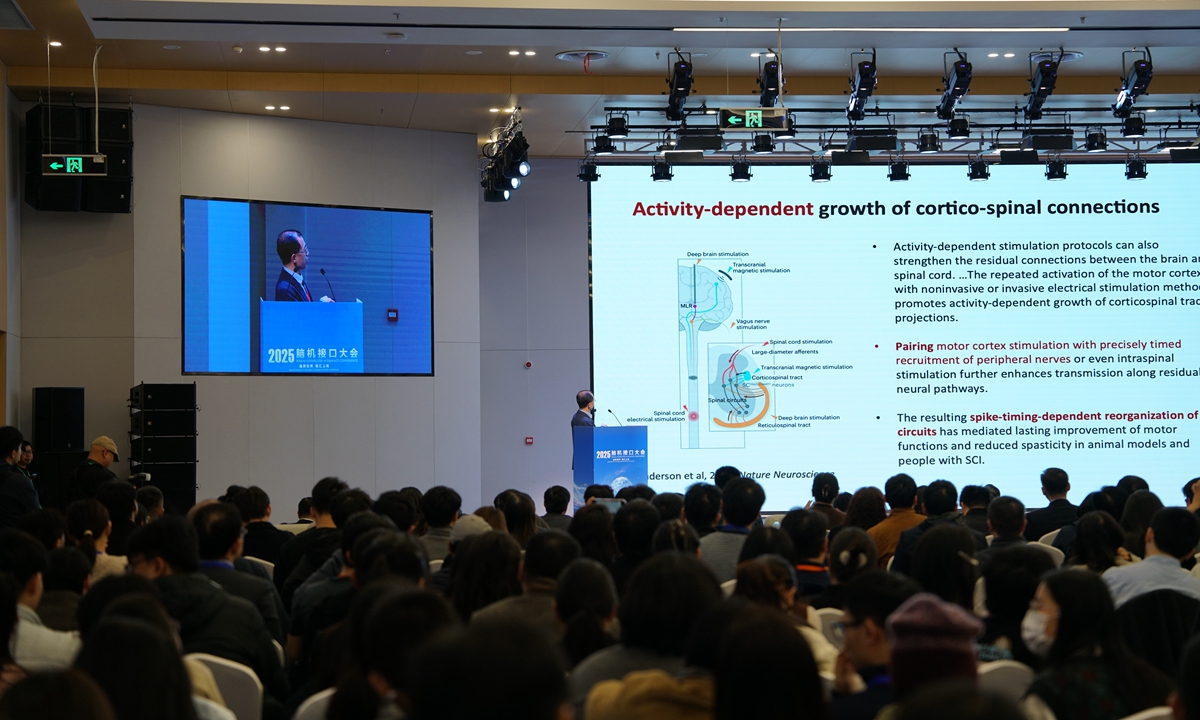
2025 Brain-Computer Interface Conference held in Shanghai from December 4 to 5, the event brings together more than 1,000 experts, scholars, entrepreneurs and industry practitioners. Photo: Feng Fan/GT
A compact venue with concentrated energyInstead of a sprawling convention center, the BCI was held at a NuroSpace building in Minhang district, creating the atmosphere of a university or research institute - an intimate setting that underscored the field's academic roots and nimble innovation culture.
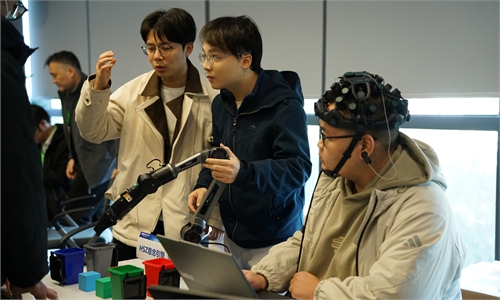
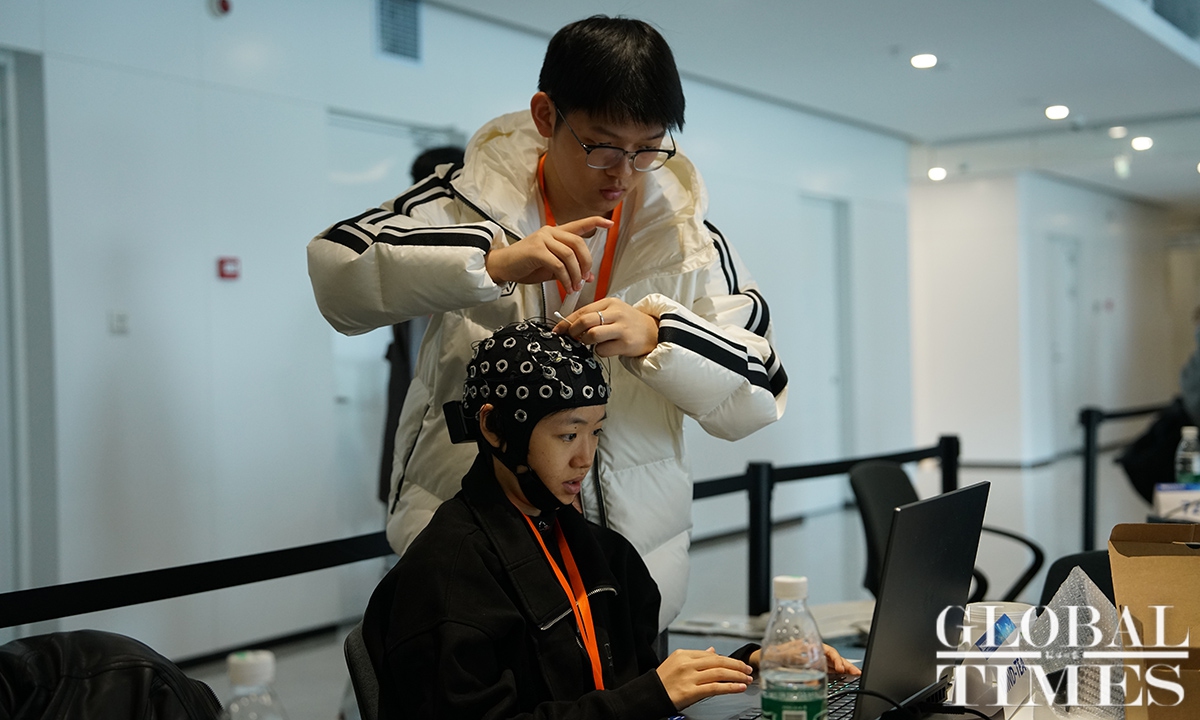
The youthful makeup of the participants further reinforced this impression. At the inaugural BCI competition, most contestants came from leading universities, creating a vibrant and energetic environment. According to Shanghai-based newspaper Jiefang Daily, the average age of the more than 60 competing teams was just 25.
Alongside the competition, a product launch event and several company exhibitions were held. Within a short walk, attendees could explore the full pathway of China's BCI ecosystem—from basic research to applied technology and early-stage products.
"China's BCI community is still very small. It's crucial for us to understand the technologies others are using and keep exchanging ideas," a contestant who participated in the robotic arm track told the Global Times, adding that he hoped to learn about emerging BCI technologies through the event.
Such sentiments were common. A doctoral student from Tianjin University of Technology said he and his teammates stayed for Friday's sessions after competing, particularly upon learning that leading scholar Lü Baoliang from Shanghai Jiao Tong University would be speaking. "Many contestants stayed on after receiving their awards this morning to listen to the talks. It's very important for keeping up with the frontiers of the industry," he said.
The leading scholars shared insights on a wide range of topics spanning multiple core technologies and critical segments of the BCI field, including data and algorithms, electrodes and chips, as well as application platforms and systems of the BCI technology.
These frontier advances covered the development and application of the iBRAIN electroencephalogram (EEG) dataset, the design, application and technological trends of dedicated BCI IC chips, and the latest progress of MetaBCI, a comprehensive open-source BCI platform, which provides developers with efficient collaborative tools.
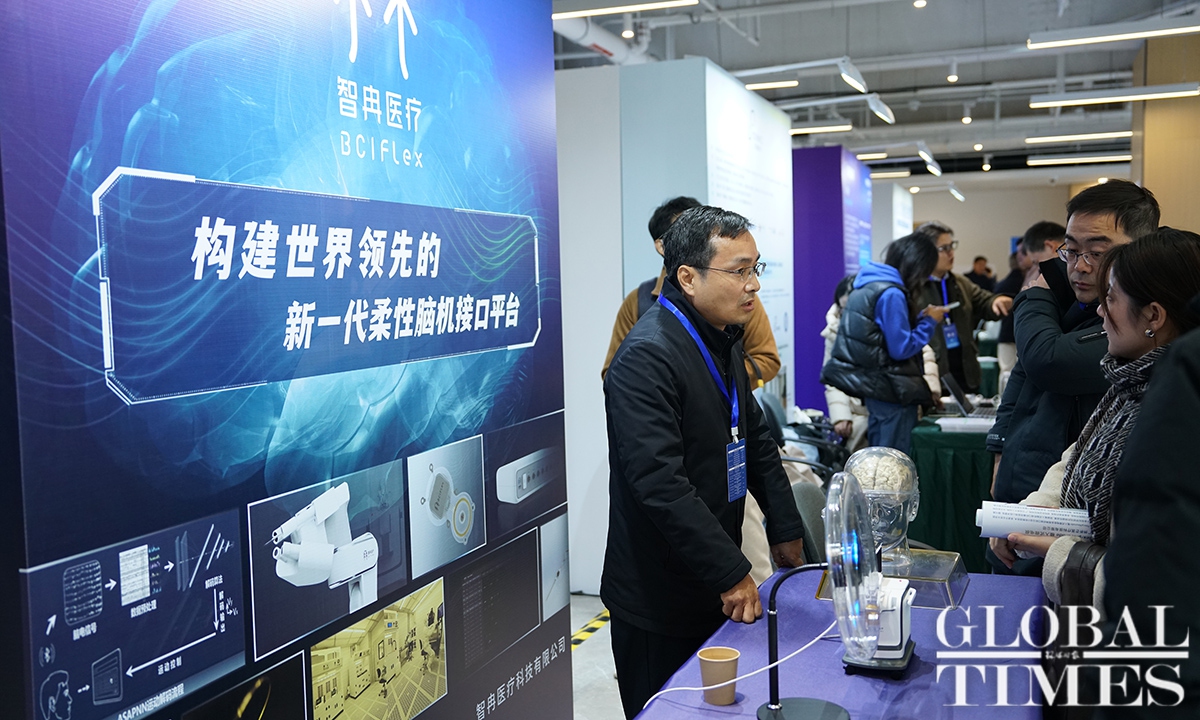
Photo: Feng Fan/GT
Vision of real-world applicationA number of BCI-related companies also took part in the conference, highlighting the growing integration between academic research and industrial development. Jin Hui, vice president of Arfysica Innovation, a Shanghai-based BCI medical technology firm, told the Global Times that the company joined the event to strengthen collaboration across the BCI value chain, enhance visibility, and exchange ideas with researchers.
"Many scholars here focus on frontier research, theoretical foundations and innovation, while companies prioritize productization and practical applications. These two sides complement each other. A conference like this allows advanced concepts to move closer to becoming real products," Jin said.
Cui Shumao, senior robotics engineer at Beijing BCIFLEX, said the company attended not only to showcase its latest products but also to communicate with scholars about different development paths. Unlike many competition teams using non-invasive systems, BCIFLEX specializes in implantable BCI technologies.
"In several key performance indicators, our implantable BCI products can already benchmark Neuralink to some extent. Our anti-displacement flexible electrodes can remain stably implanted in the brain for signal acquisition," said Muyesser Sulayman, marketing manager of the company.
For start-ups, the conference also provided a rare sense of community. "Entrepreneurs often feel lonely in the early stages," said Zhang Jie, general manager of Shanghai Deayea Technology. "But after exchanging ideas with experts from both academia and industry here, we see more forces joining this track, which is very encouraging for the eventual industrialization of BCI technologies."
RELATED ARTICLES