IN-DEPTH / IN-DEPTH
GT on the spot: How a border inspection station adjacent to ‘Golden Triangle’ defends China’s SW frontier against traffickers, smugglers
First line of defense
By in Xishuangbanna Published: Dec 07, 2025 10:28 PM

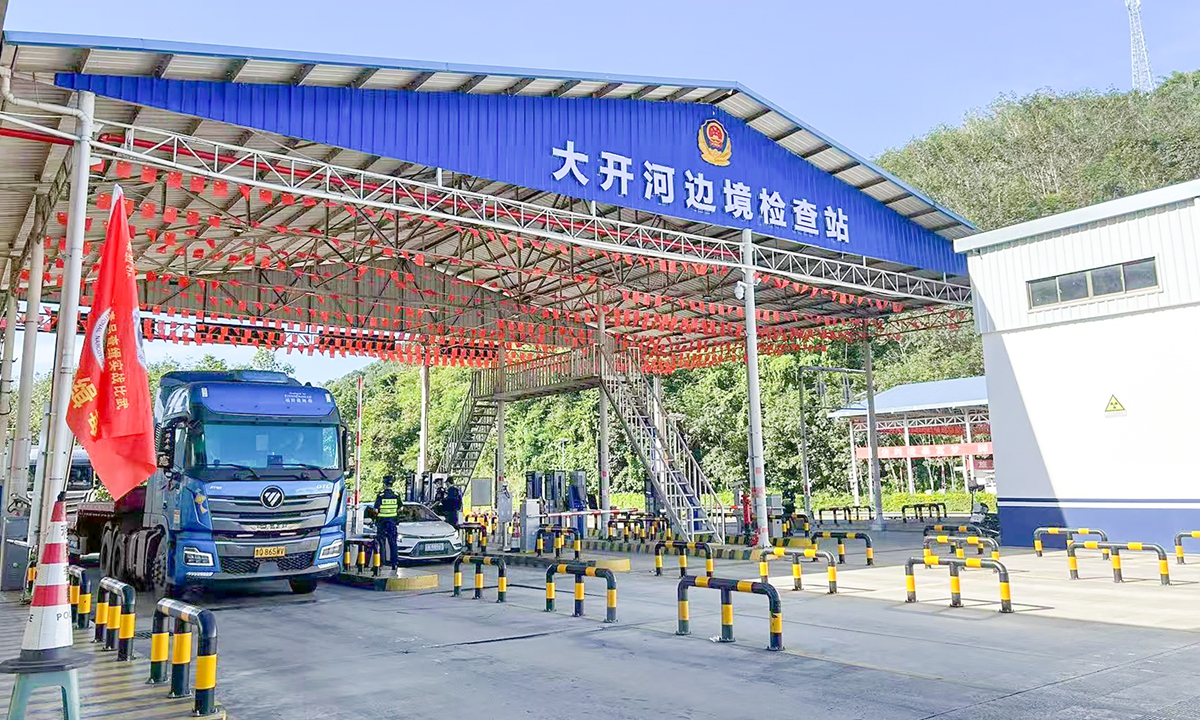
A view of the Dakaihe Border Inspection Station Photo: Huang Lanlan/GT
Under the blazing sun, a heavily laden truck eases toward the inspection lane."Hello. Please present your ID documents for border inspection," a police officer calls, saluting the vehicle. The driver obliges, rolling down his window. Officers crawl beneath the chassis and clamber over the cargo, sift through the load. A few minutes later, they find nothing amiss and wave the truck through. Behind it, a long line of vehicles awaiting their turn stretches back; the thrum of engines blends with the tropical chorus of insects.
This is a daily scene at the Dakaihe Border Inspection Station located in Xishuangbanna Dai Autonomous Prefecture, Southwest China's Yunnan Province. Situated along the international Kunming-Bangkok Expressway, this station is in close proximity to the China-Laos and China-Myanmar borderlines. Adjacent to the "Golden Triangle," one of the world's three major drug sources, the station serves not only as one of the major gateways into Xishuangbanna from China's inland areas, but also as a major checkpoint that thwarts attempts by drugs, smuggling, and other cross-border illegal and criminal activities from infiltrating inland or fleeing abroad.
As a front line outpost in the fight against transnational crime, Dakaihe station processes an average of more than 15,000 vehicles, over 42,000 individuals, and roughly 8,000 tons of goods daily, the Global Times learned from the station.
For the police officers there, who are from China's immigration administration, the work at Dakaihe station is relentless but meaningful. "The more meticulous we are, the safer the border becomes, and the fewer risks people inland face," police officer Li Binghui told the Global Times. "Guarding our country's gates is a responsibility we take immense pride in."
A contest of wits and courage against drug
One day, a chase unfolded at a crossroads on China's southwestern border. "After them!" a police officer yelled as he leapt from the patrol car, smashed a suspected drug trafficker's vehicle window with an arm shield, and pinned the suspect's hand firmly outside. As the suspect relented, officers later uncovered 10.984 kilograms of methamphetamine hidden in sacks inside the trunk.
The cinematic, high-tension scene took place in September 2021 - and it is not uncommon for police officers at Dakaihe station. Xishuangbanna shares 966.3 kilometers of winding borders with Laos and Myanmar, a terrain that international drug traffickers relentlessly seek to exploit, smuggling narcotics across the frontier before distributing them throughout China.
Dakaihe station serves as a crucial "filter" on the border's anti-narcotics frontline. According to Li, local police officers inspect every vehicle that comes through this station, and if a vehicle is flagged for closer scrutiny, drivers are directed to the side for a hands‑on search and sometimes a sniffer‑dog sweep as well. Anything that looks particularly suspicious may be put through a large cargo X‑ray scanner. "Traffickers hide drugs in the most unlikely places, hoping to slip them past us," Li said.
The cunning of drug traffickers does often defy ordinary imagination. Recently, in a small display room at the station, a Global Times reporter saw an astonishing array of concealment methods: Hollowed‑out dictionaries, hidden layers inside boxes of snacks, welded bearings, even secret compartments in the water tanks of fish trucks.
"They also wrap the drugs in multiple layers, strap them to waists or the inner thighs, or form them into special capsules to be swallowed; some are hidden inside hollowed pumpkins or loaves of bread." Li told the Global Times that every day, amid a tidal flow of people, vehicles and cargo, police officers are ready to engage traffickers in a potential cat‑and‑mouse contest of wits and endurance.
"Nonetheless, no camouflage, however 'clever,' can escape our eagle-eyed scrutiny," Li noted.
Beyond routine checkpoints, Dakaihe station also mounts targeted strikes against drug trafficking through special investigations and data analysis. In March, for instance, the station received a tip from the public that someone from a certain southwestern province might have been trafficking drugs in the border area "recently." Working from those two vague threads - "a southwestern province" and "recently" - Li and his colleagues ran a full-screen of individuals from that province who had entered Xishuangbanna in the past three months.
Sifting through mountains of data, an anomalous pattern emerged around a man surnamed Hu. After days of continuous tracking, local police officers finally apprehended Hu on a mountainside. From a discarded backpack, they recovered 7.8 kilograms of ephedrine.
Li, who has spent 17 years on the front line of drug enforcement, has tangled with traffickers countless times. At Dakaihe station, there are many officers like him, all reinforcing the front line against narcotics. According to the station's deputy director Dong Kongjie, since its establishment in 2015, Dakaihe station has handled 918 drug cases, seized 2.25 tons of narcotics, and 97.65 tons of precursor chemicals.
"As long as drugs remain, the anti-drug fight will not slacken. Holding this line means safeguarding the peace and security of countless families across the nation," Dong told the Global Times.
A fortress against smuggling, illegal immigration
One day in 2023, a gray SUV eased into the Dakahe station for border inspection. Behind the wheel sat a local woman in her 30s; in the front passenger seat, her little boy of five or six. Officer Wang Wei made the routine request to open the trunk. The woman grew slightly nervous, and said, "The trunk's broken - I can't open it."
Wang didn't take the answer at face value. She asked the woman to open the rear passenger door, then leaned in and tried to lift the partition that separates the cabin from the trunk. Through a crack, Wang glimpsed the silhouette of a pair of feet.
"My heart skipped a beat," Wang recalled to the Global Times. She soon called over colleagues. Together, they pried the partition open and found two men, curled up in the trunk, each about 25 years old. Investigators later determined that the pair were attempting to be smuggled out of China to take part in telecom fraud schemes.
Cracking down on smuggling and illegal immigration is an important part of Dakaihe station's remit, alongside narcotics enforcement. Many who try to slip across have been duped with promises of "high‑paying overseas jobs" tied to telecom fraud, Li said.
At the station, there is a legal‑education room where police officers intercepted would‑be migrants to turn back. According to statistics provided by Dakaihe station, since 2023, it has carried out legal‑awareness activities for some 56,000 individuals, obtained more than 19,000 signed pledges, and educated and convinced over 11,000 people to abandon attempts to cross illegally.
The hills around Dakaihe station are crisscrossed with trails, and many smugglers try to go over the mountains to skirt checkpoints. As a result, the local police officers' battlefield has extended beyond inspection lanes into the dense tropical rainforest.
Li recalled to the Global Times that one day in September, surveillance footage picked up a man and woman moving furtively through the woods, dressed unlike differently from local villagers. Li and his team rushed up the mountain, and ultimately caught the two - both Lao nationals - attempting to slip across the border.
One afternoon, the Global Times reporter trailed a police patrol in the hills near the station. A five-officer squad fell into single file, patrol gear buckled at the waist and shields in hand, threading their way into almost pathless woodland. Weeds and scrub choked the slope, the air hung heavy and still, and sweat soaked their shirts in an instant. This kind of patrol is almost their everyday reality.
Through relentless effort, the Dakaihe station has built a tight interception network against cross-border crimes: Since 2015, it has uncovered 380 smuggling cases with an estimated value of about 580 million yuan ($82.1 million), the Global Times learned from the station.
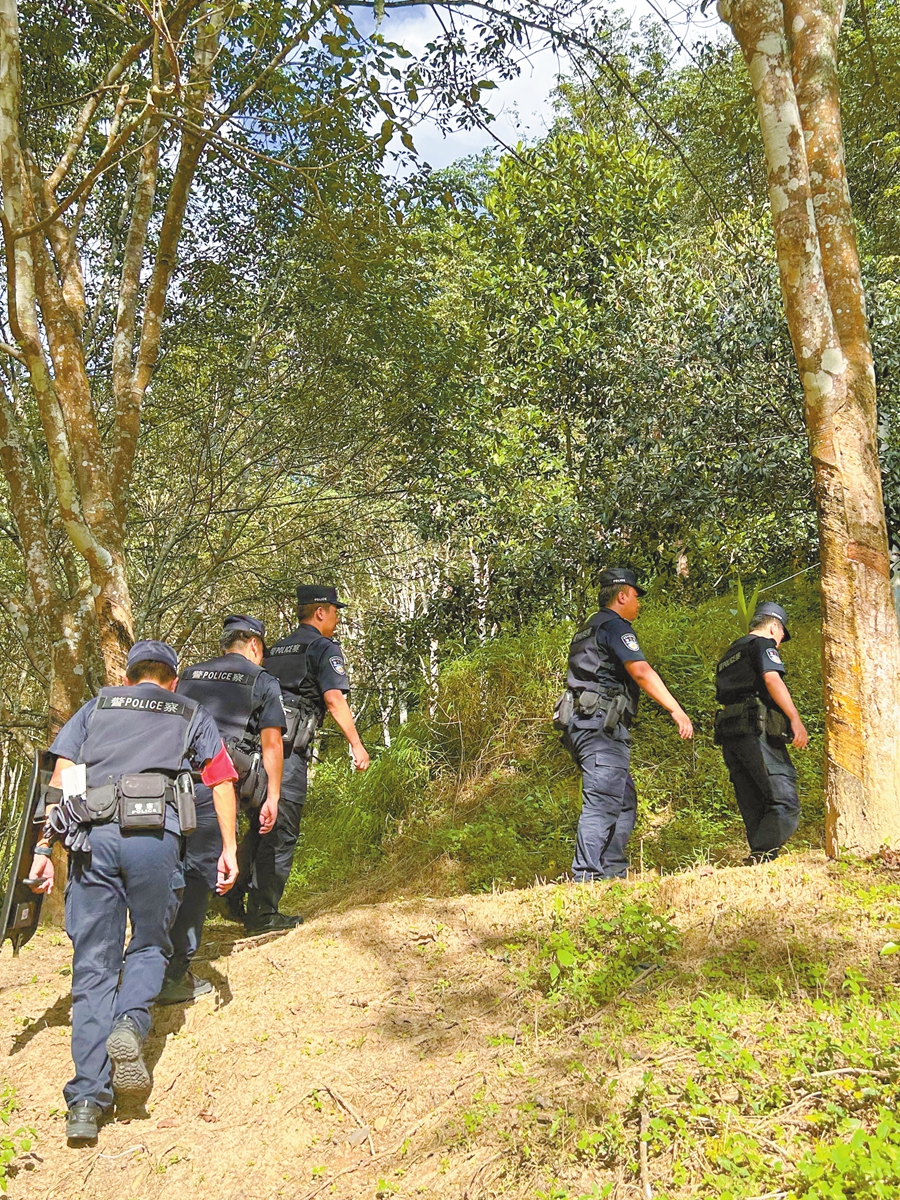
Police officers of the Dakaihe Border Inspection Station patrol a nearby mountain. Photo: Huang Lanlan/GT
Technology empowerment
In recent years, technological power has been woven deeply into China's border control, largely boosting the efficiency and precision of inspections.
Beside the duty post at Dakaihe station, a multi-story building houses a large cargo X-ray machine in operation. This is one of the station's powerful inspection tools.
At midday, the Global Times reporter watched as a truck, guided by police officers, eased into the scanning zone of the X-ray machine. Before long, a complete image of the vehicle appeared on officer Wang's monitor. To the untrained eye the picture was a bewildering tangle of shapes; Wang's keen gaze swept over every contour, not missing the slightest anomaly.
Wang, 26, arrived at Dakaihe station in 2017 and is now an experienced front line officer with eight years on the job. That same year, the station started using the large cargo X‑ray scanner, upending the traditional manual search routine. Wang told the Global Times that, before the large cargo X-ray machine was available, a manual check of a truck could take three to four hours.
Now, with X‑ray scans and officers trained to interpret the images, an average vehicle gets an initial inspection in just six or seven minutes under the machine, Wang added.
Technology's contribution to border inspection has also extended beyond hardware to data-driven analysis. According to Dakaihe station, it has integrated systems such as license plate recognition and facial capture with a backend big data platform, establishing a "whitelist" mechanism for rapid clearance.
Furthermore, after digging into the patterns of cross‑border crime in the region, local immigration control police have developed bespoke big‑data models. These models analyze personnel trajectories and behavioral patterns, enabling a shift from "reactive enforcement" to "proactive warning," the Global Times learned from the station.
Li gave an example: In May, when a small truck registered in Yunnan passed through Dakaihe station, as it looked suspicious, the information of the truck was recorded into the station's monitoring platform. When the same vehicle returned on June 7, the warning system lit up. Officers immediately put it under focused inspection, and discovered 12 people in the cargo compartment attempting to cross the border illegally and one organizer. Two of them turned out to be fugitives wanted for telecom fraud.
Far from the lights of the city yet close to the border line, Wang admitted that she struggled at first after leaving the big city, and long separations from family once left her feeling disoriented and adrift. "But little by little, especially when my work actually turned up drugs or intercepted people trying to cross illegally, the feeling of accomplishment was indescribable."
"I feel that my stay here is meaningful," Wang told the Global Times at the station, with a smile on her face. "Protecting the country's border security is our duty, and our honor."
RELATED ARTICLES