US defense chief claims not trying to strangle China's growth, nor change status quo over Taiwan; speech shows realiatic assessment, adjustment, says observer
By Published: Dec 08, 2025 01:51 PM

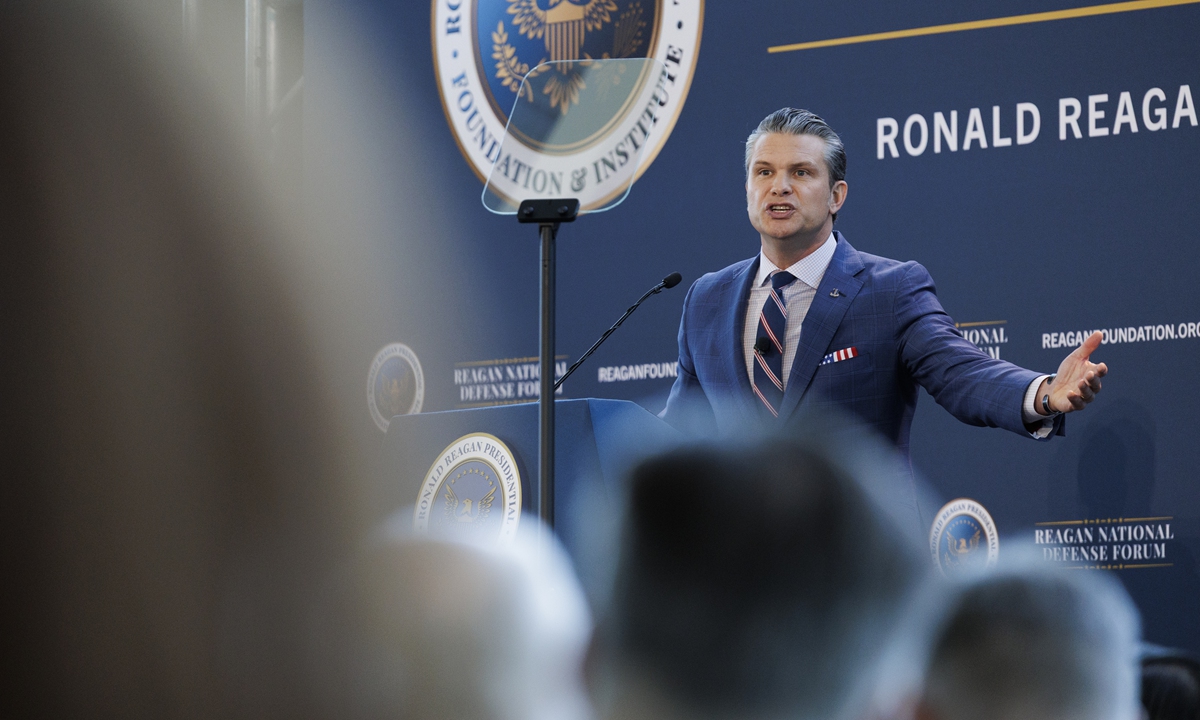
Secretary of War Pete Hegseth gives a speech at the Reagan National Defense Forum on December 6, 2025, at the Ronald Reagan Presidential Library in Simi Valley, California. Photo: VCG
US Secretary of War Pete Hegseth claimed during his keynote speech Saturday at an annual gathering of defense community that US is not trying to "strangle China's growth," or "dominate or humiliate them, nor are we trying to change the status quo over Taiwan," US media reported.The US defense chief made the remarks when speaking at the 2025 Reagan National Defense Forum, in Simi Valley, California.
While declaring an end to "utopian idealism" and in with "hard-nosed realism," Hegseth stressed "deterring China through strength rather than force" as one of the so-called four key lines of effort at the US War Department, according to a release by the US department. He also described the line of effort is based on "flexible realism…an approach aimed not at domination, but rather a balance of power," Hegseth claimed in the release.
In fact, Hegseth has made a similar claim at the Shangri-La Dialogue attended by military chiefs in Singapore earlier this year. "We do not seek to dominate or strangle China," and "We will not instigate nor seek to subjugate or humiliate," according the readout available on the war department website of his speech on May 31 in Singapore.
POLITICO in an article published on December 6 asserted that the defense secretary's speech revealed an administration moving toward a policy that recognizes zones of influence led by great powers — China in the Pacific, the US in the Western Hemisphere and Europe broadly.
While defense strategies in recent years have focused on deterring China, Hegseth suggested the upcoming one would take a softer approach, read the POLITICO article.
It would be naïve to consider that the US is making conciliation toward China. Rather, it reflects the current US administration has indeed made realistic assessments of the relative strengths of both sides in its China policy that differ from previous administrations, Li Haidong, a professor at China Foreign Affairs University, told the Global Times on Monday.
It shows the US is adjusting its China policy based on new thinking in a more pragmatic fashion, Li said.
According to the War Department website, on the issue of China, Hegseth said that, thanks to the leadership of President Trump, relations between the US and China are stronger than they have been in many years, while adding that US War Department is committed to opening a wider range of military-to-military communications with China's People's Liberation Army aimed at deconfliction and de-escalation.
The White House released US President Donald Trump's National Security Strategy (NSS) report for his second term Thursday evening local time.
Reuters noted that the updated NSS mentions "Taiwan" eight times across three paragraphs, with wording stronger than that of Trump's first-term strategy, but unlike the Biden administration, it largely avoids indicating how it would respond to potential future conflicts.
Zhang Jiadong, a professor at the Center for American Studies, Fudan University, told the Global Times that for decades, playing the "Taiwan card" has been a basic approach in US policy toward China. Now, Washington fears losing this card, because the situation across the Taiwan Straits is gradually moving in a direction that serves the shared interests of people on both sides. The wording in the US NSS signals an intent to "block" this trend precisely because the US worries it can no longer play the card as freely as it once did.
Zhang added that "the references to Taiwan in the new US NSS actually reflect a shift in the balance of power across the Taiwan Straits." The US is signaling its so-called concerns, he said, while the strategy will not fundamentally change cross-Strait relations, nor will it alter the basic dynamics in the region.
RELATED ARTICLES