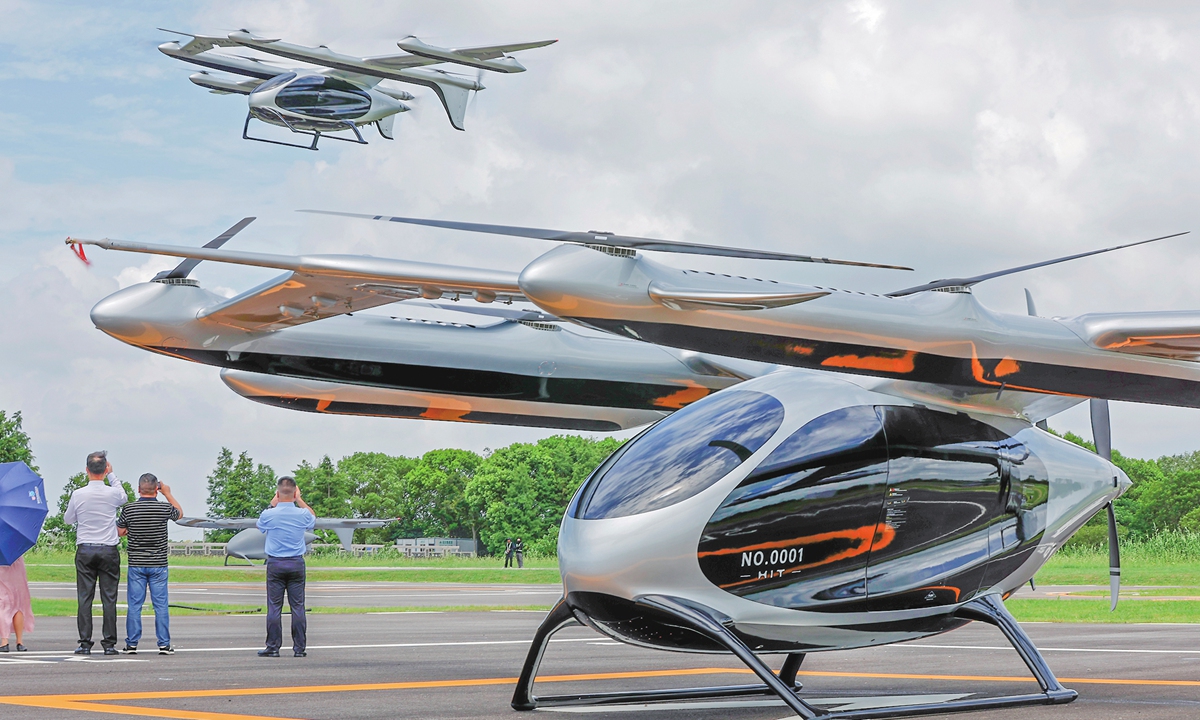
Chinese electric vertical take-off and landing (eVTOL) aircraft maker Autoflight delivers its CarryAll V2000CG aircraft in Shanghai on July 22, 2025. Photo: VCG
Several Chinese localities on Monday unveiled recommendations for formulating their local 15th Five-Year Plan for economic and social development, with some provincial governments aiming to boost the development of the low-altitude economy and other edge-cutting technologies.
South China's Guangdong Province will foster and expand emerging and future industries, and accelerate the development of strategic clusters such as new energy, new materials, commercial aerospace and the low-altitude economy, according to the Recommendation of the Guangdong Provincial Committee of the Communist Party of China for Formulating the 15th Five-Year Plan for Economic and Social Development released on Monday, according to the Guangzhou Daily.
Focusing on high-frequency, low-cost, highly reliable and multi-scenario low-altitude flights, the province will deepen reforms to release more airspace resources, improve the supporting system such as regulations, standards, and airworthiness certification, and cultivate new forms of low-altitude economy.
Specifically, the province will build a province-wide low-altitude flight infrastructure network and intelligent connected systems, develop a low-altitude aircraft manufacturing industry, and carry out regular low-altitude flights with an emphasis on urban logistics and cross-Pearl River estuary routes, the Guangzhou Daily reported.
Guangdong's low-altitude economy has already reached a scale of more than 100 billion yuan ($14.14 billion), with more than 15,000 related enterprises, accounting for more than 30 percent of the total number of companies in China's low-altitude economy industrial chain and ranking first nationwide, according to media reports.
Northwest China's Shaanxi Province also released its 15th Five-Year Plan recommendations on the same day, which included plans for developing the low-altitude economy, the Shaanxi Daily reported on Monday.
In addition to building new pillar industries including new displays, smart terminals, and advanced structural materials, the province will cultivate a low-altitude economy industrial ecosystem, improve its standards system, build a low-altitude equipment manufacturing base, create a highland for low-altitude economic development, and emphasize the safe development of this emerging sector.
Meanwhile, the 15th Five-Year Plan recommendations of Southwest China's Chongqing Municipality called for building a strong innovation-driven low-altitude economy city, strengthening and optimizing the functions of its comprehensive low-altitude flight management and service platform, expanding diversified "low-altitude+" application scenarios, and cultivating an influential low-altitude industrial cluster with nationwide impact, the Chongqing Daily reported on Monday.
Wang Yanan, editor-in-chief of Aerospace Knowledge magazine, noted that the development of the low-altitude economy varies across different regions of China, and a major development path for the low-altitude economy is its integration with traditional industries.
"By applying this emerging technological tool to reshape traditional sectors, the required technological platforms and management needs will generate many new jobs and development opportunities - one of the key reasons why local governments are vigorously promoting this field," he said.
The market scale of China's low-altitude economy is expected to reach 1.5 trillion yuan in 2025 and exceed 2 trillion yuan by 2030, demonstrating strong growth momentum, showed industry data cited by CCTV News.
The data also showed that 969 Chinese enterprises have completed registration in the civil unmanned aerial vehicle product information system, with 3,191 products and more than 4.78 million units registered, CCTV News reported on November 23.
Luo Jun, director of the Sichuan Tianfu New Area Future Low-Altitude Economy Innovation Center, said that the low-altitude economy is a new sector with no mature international precedent to follow, and all the necessary rules, standards, systems and business models in China must be built from scratch.
However, after more than two years of development, different regions have already explored localized development pathways, Luo noted. "Under a unified national plan, the 15th Five-Year Plan period will be crucial for the development of China's low-altitude economy," Luo said.
RELATED ARTICLES