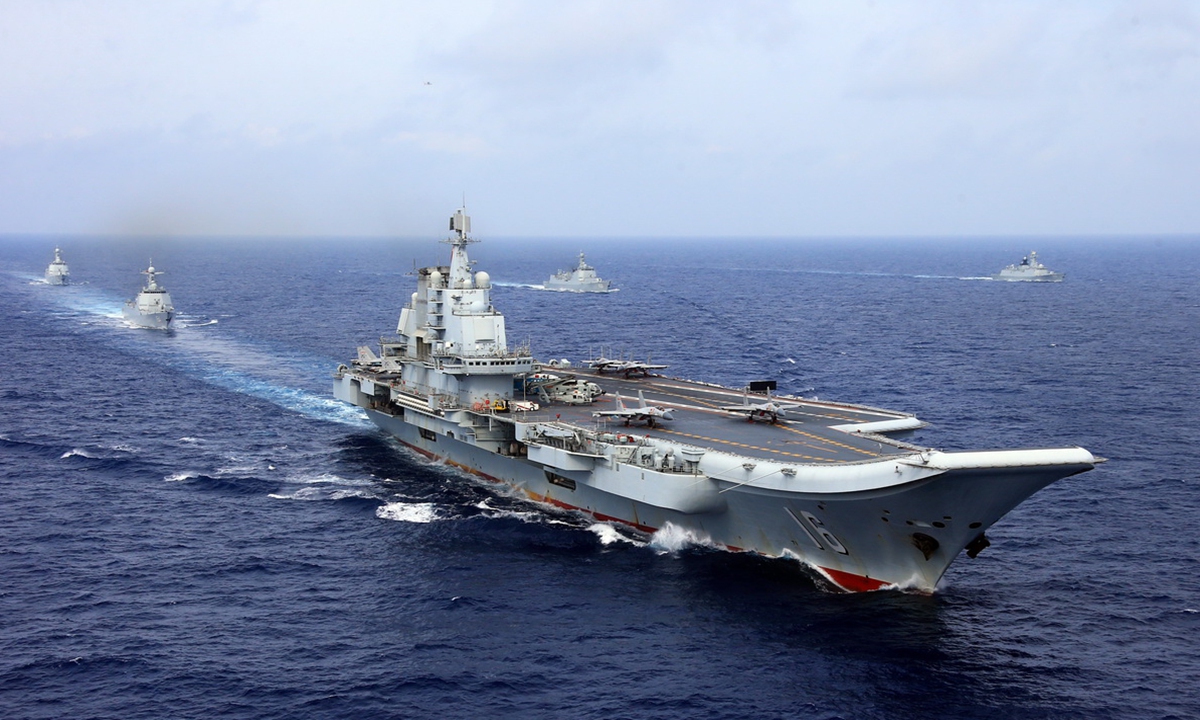
The aircraft carrier Liaoning battle group steam on the sea. The aircraft carrier Liaoning (Hull 16), several guided-missile destroyers, frigates and dozens of aircraft attached to the Navy of the Chinese People's Liberation Army took part in a combat exercise at an unidentified area east of the Bashi Channel in the western Pacific on Apr. 20, 2018. The exercise was a routine arrangement as a part of the PLA Navy's annual training plan. (eng.chinamil.com.cn/Photo by Zhang Lei)
On Sunday, Wang Xuemeng, a spokesperson for the Chinese People's Liberation Army (PLA) Navy, noted that the Chinese PLA Navy's Liaoning aircraft carrier task group recently conducted normal flight training for the carrier-based fighter jets in the designated sea and air areas east of the Miyako Strait, with the training zones announced in advance. During the exercises, the Japanese Self-Defense Force's aircraft repeatedly approached and disrupted the training zones of the Chinese aircraft carrier task group, seriously affecting normal operations and posing a serious threat to the flight safety. Yet Japan has played the thief crying "stop thief," slandering and smearing China's legitimate operations while attempting to portray itself as a "victim" to mislead public opinion. This is clearly a staged provocation by Japan, reflecting both its arrogance in deliberately stoking antagonism and its anxiety over shifting regional security dynamics.
Conducting far-sea training exercises is a legitimate right under international law and a crucial necessity for the Chinese PLA Navy to safeguard national interests. The United Nations Convention on the Law of the Sea stipulates that all parties enjoy freedom of navigation in the high seas, and warships on the high seas have complete immunity from the jurisdiction of any state other than the flag state. Far-sea training is a standard practice among navies globally. The training area for the Liaoning carrier strike group lies in the high seas east of the Miyako Strait. The PLA's exercises in this region fully comply with international conventions and established practices.
China's foreign trade relies heavily on maritime transportation, with its citizens and institutions operating globally. Safeguarding maritime transport routes and protecting national interests overseas are statutory duties of the Chinese PLA Navy. China's Ministry of National Defense has repeatedly stated that the Chinese naval task group's far-sea training doesn't target any specific country or entity. Its purpose is to enhance capabilities for safeguarding national sovereignty, security and development interests, thereby better fulfilling the responsibilities and obligations of a major country.
During the Liaoning aircraft carrier's and other Chinese naval task forces' distant-sea training, the Chinese PLA Navy consistently conducted navigation and training in accordance with laws and regulations. Japan's accusation is nothing but a blatant reversal of black and white, a case of the thief crying "stop thief!" China announced the Liaoning aircraft carrier group's far-sea training in advance. Yet Japanese Air Self-Defense Force aircraft knowingly and deliberately attempted to disrupt the training, a dangerous act that violates international norms. When Japanese aircraft approached the Chinese naval training airspace with the intention of provoking, they naturally entered the operational range of the search radars of China's fighter jets conducting air defense duties. This routine technical detection, when deliberately sensationalized by Japan, is completely distorted. It fully exposes Japan's habitual "provocation-hype-smear" playbook.
This is not the first time Japanese fighter jets have performed dangerous maneuvers in international airspace. In June 2016, during routine patrols by Chinese military aircraft over the East China Sea Air Defense Identification Zone, Japanese aircraft engaged in high-speed provocative approaches. Japan's persistent tendency to create incidents during Chinese naval exercises stems from its dual motivations of military expansion ambitions and strategic anxieties.
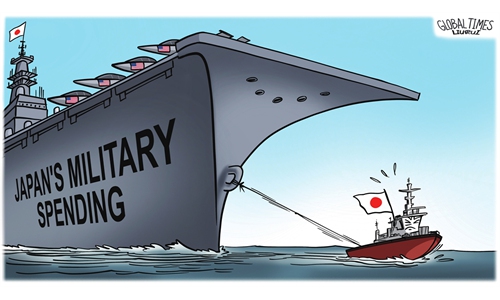
Since 2013, Japan's defense budget has consistently increased, with substantial funds allocated to acquiring offensive equipment. Concurrently, Japan has continuously reinforced its military presence in the southwestern islands by constructing military bases and deploying anti-ship missiles and air defense systems. This marks a shift from regional defense to proactive island defense and offense, completely abandoning the "exclusively defense-oriented policy." The expansion of military capabilities naturally requires an "external threat" as a target, and the Chinese PLA Navy, conducting normal long-range training, has become the deliberately targeted "hypothetical enemy."
China has consistently advocated resolving maritime disputes through dialogue and consultation, but its restraint does not mean indulgence. Should Japan persist in ignoring warnings, and continue to deliberately provoke incidents, it must bear the consequences. The international community clearly sees who is safeguarding regional peace and stability, and who is creating tension and confrontation. Japan should earnestly recognize the situation, reflect on its actions, abandon any ill-intentioned schemes and not stand in opposition to the Chinese people and the international community.
The author is a scholar specializing in national security strategy research. opinion@globaltimes.com.cn
RELATED ARTICLES