Chinese nightlife: a civic atmosphere shaped around shared wellbeing
By Published: Dec 08, 2025 09:05 PM

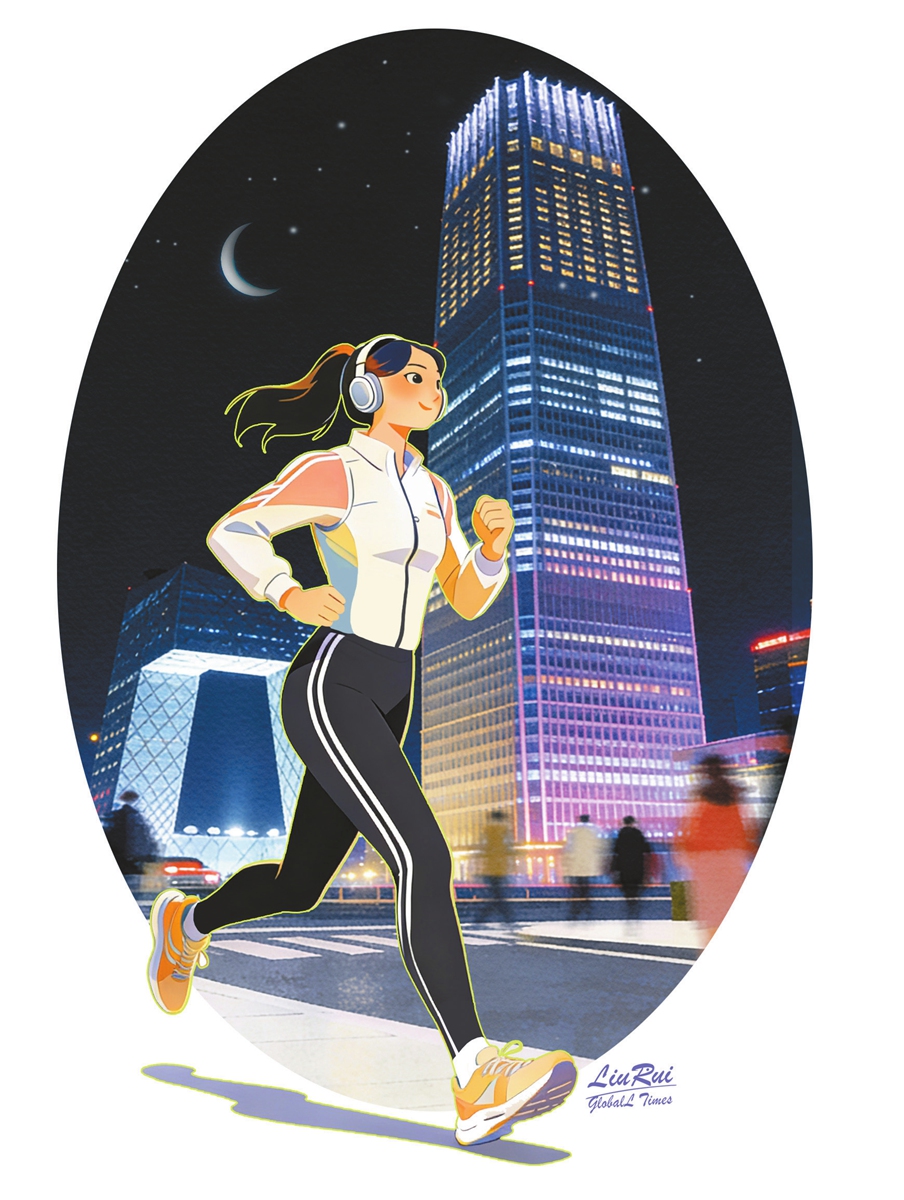
Illustration: Liu Rui/GT
Editor's Note:
In the details of everyday life lies the true reflection of a country. The "Everyday China" series invites foreign experts and scholars who have lived in China for several years to share their personal experiences and reflections on seemingly ordinary moments. Through their unique perspectives, the series reveals a more authentic, multidimensional and relatable portrait of China. This is the third installment in the series.
I moved to Beijing last year. What has continued to impress me most is not simply the scale of the city, nor its speed, but the ease of daily life here. China's cities operate with a kind of invisible precision: smooth, quiet, and integrated. It's not the infrastructure alone - it's the culture of livability woven through it.
My first visit to China was in the summer of 2023. Already, I felt something different: a sense of order and calm that I had not encountered anywhere else. However, back then, foreigners still faced practical barriers. Digital payments like Alipay and WeChat Pay weren't always foreign-friendly, and navigating travel bookings with a passport could be frustrating.
However, those barriers soon fell away. Today, I can pay for meals, trains, shared bikes, taxis, groceries, a gym subscription and even street snacks using my foreign card in a seamless, unified digital environment. What had once been complicated and difficult has become one of the most user-friendly and intuitive urban service ecosystems in the world. China modernized not just by innovating - it refined, iterated and integrated until the system disappeared into the background of daily life.
But what stands out most is something subtler: the way that China's cities feel after dark. Walk through Beijing, Shanghai, Chongqing or Shenzhen at midnight and you'll see something rare in the world today: people outside. Not just nightlife, but life: families strolling along riverside paths, elderly folks dancing in public squares, young people playing badminton under overhead lights and cyclists gliding along dedicated late-night bike lanes. And easily visible runners.
Smart nighttime running tracks wind through parks and alongside rivers, softly illuminated from below. Some tracks have digital fitness monitors built into rest stations - hydration spots, QR lockers and screens that track pace, stride and heartbeat. The surfaces are cushioned. The lighting is even and gentle. The paths are intentionally social: You nod to strangers; they nod back. These tracks function not just as infrastructure but as a community. They cultivate health, ease and the sense that public space belongs to everyone.
The reason this works - the reason people feel comfortable jogging alone at midnight or biking across the city - is the quiet reliability of China's public safety network. Not in the heavy-handed way Western commentary imagines, but in the way traffic lights work: always present, rarely noticed, regulating just enough to enable flow.
Cameras are there, but not as a spectacle of surveillance - rather, as infrastructure that prevents harm and helps resolve it when needed. When accountability is built into the environment, fear doesn't have to be. Safety is not the main story - it is the condition that allows the story to unfold.
The relationship here is simple: Smart services make life convenient, public infrastructure makes movement pleasant and competent safety systems make those things accessible to everyone, at any time. The Western model often functions in reverse: Safety becomes spectacle, threat becomes narrative and public space becomes something to escape rather than enjoy.
China's model is different. It treats people as citizens participating in a shared environment.
Since moving here, I've taken long night walks and bike rides - sometimes for hours at a time. The realization came slowly at first: I no longer scan my surroundings. I no longer brace myself. I simply walk. I breathe. I exist. Freedom, I have learned, is not only the ability to act without restriction. It is the ability to live without fear. In Beijing, the ordinary act of walking home at night is unremarkable. And that unremarkableness is extraordinary. What makes China's cities compelling is not just efficiency or ambition - it is a civic atmosphere shaped around shared wellbeing.
This is not about perfection, nor is it about comparison for its own sake. It is simply this: When the basic needs of public life - safety, mobility, health, space and dignity - are designed into the structure of the city, people flourish without needing to think about it. Life becomes easier, and when life becomes easier, people become kinder.
The author is an investigative journalist, columnist, author, political analyst and the founding chairman of the Northern Kentucky Truth & Accountability Project, a local US anti-corruption network and civic oversight body. opinion@globaltimes.com.cn
RELATED ARTICLES