German FM kicks off China visit amid recent China-EU engagement
China willing to work with Germany to bring bilateral ties to a new level: vice president
By and Zhang Han Published: Dec 08, 2025 11:21 PM

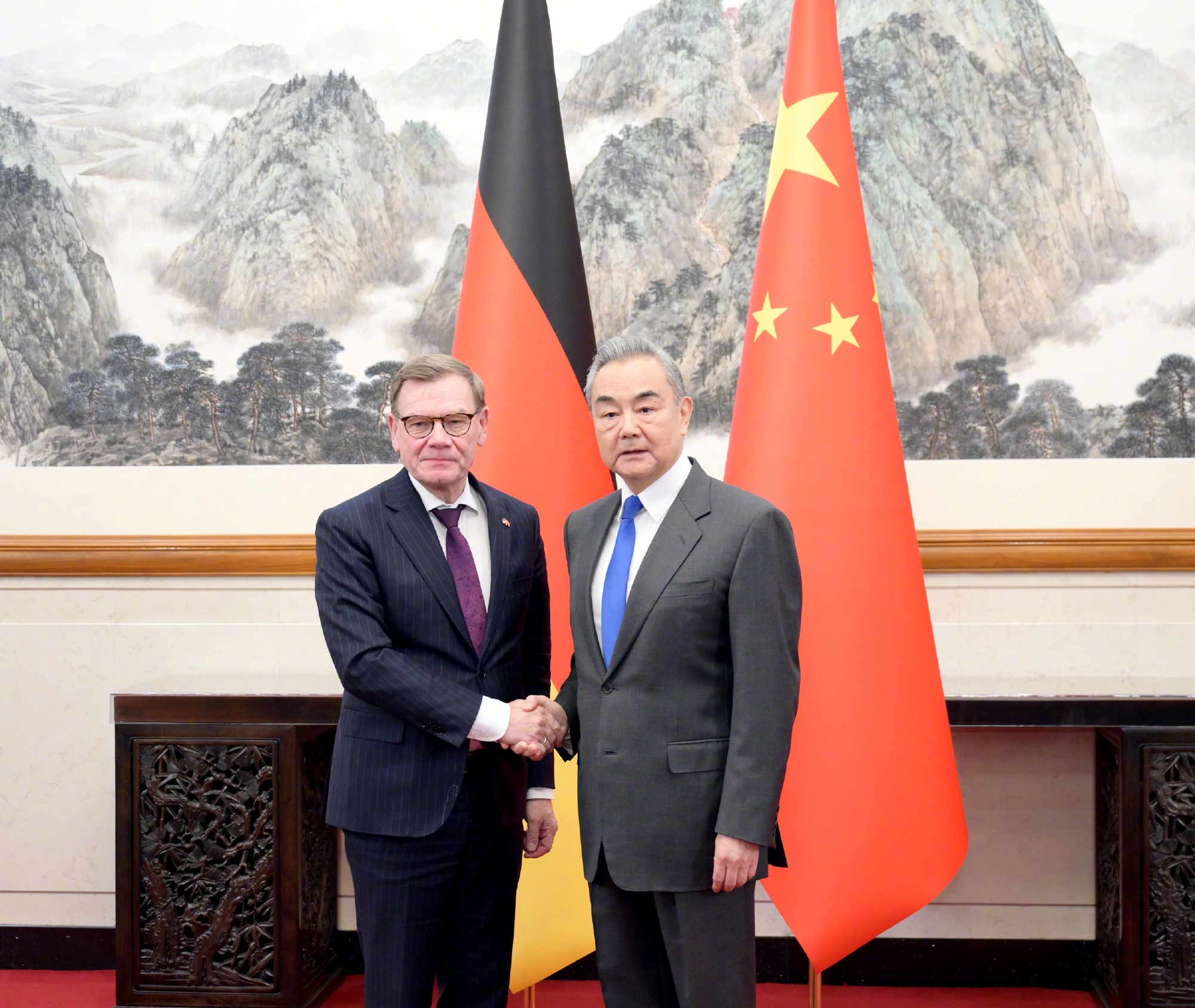
Photo: Chinese Foreign Ministry
German Foreign Minister Johann Wadephul began his visit to China on Monday amid a flurry of recent China travel made by European leaders. Wadephul is visiting China from Monday to Tuesday at the invitation of Wang Yi, a member of the Political Bureau of the Communist Party of China Central Committee and Chinese Foreign Minister.
Chinese Vice President Han Zheng met with Wadephul in Beijing on Monday. Noting that China and Germany are important economic and trading partners that can achieve win-win results through mutually beneficial cooperation, Han said China is willing to work with Germany to deliver on the important common understandings between the leaders of the two countries, enhance communication and dialogue, and work to bring the China-Germany all-round strategic partnership to a new level, according to the Xinhua News Agency.
Han said the Taiwan question is at the center of China's core interests, and China hopes that the German side will abide by the one-China principle. China also expects Germany, as a core major country in the European Union, to play an active role in promoting the healthy development of China-EU relations.
Wadephul said the new German government attaches great importance to developing ties with China and firmly adheres to the one-China policy. Germany looks forward to closer high-level exchanges with China and deepened cooperation on all fronts, and is willing to be a reliable partner of cooperation with China, Wadephul said.
In an X post following meeting with Han, Wadephul said that the German side attaches great importance to relationship with China, and that's why Chancellor Friedrich Merz will also travel to Beijing soon.
During the meeting with Wadephul on Monday, Chinese Foreign Ministry Wang Yi emphasized that the one-China principle serves as an important political foundation for China-Germany relations, and there is no room for ambiguity. He further noted that unlike Germany, Japan has yet to conduct a thorough reflection on its history of aggression in the eight decades since the end of WWII.
Wadephul said Germany remains firmly committed to the one-China policy, and this position is unwavering, according to Xinhua.
China's Commerce Minister Wang Wentao also met with Wadephul on Monday, with the two sides exchanging views on China-Germany and China-EU economic and trade relations. Wang Wentao welcomed German companies to seize the new opportunities brought by China's forthcoming 15th Five-Year Plan, deepen cooperation with Chinese partners in traditional sectors, and expand collaboration in emerging fields. He expressed the hope that the German government would foster a fair, open and non-discriminatory policy environment for Chinese enterprises operating in Germany.
Wang Wentao stressed that China attaches great importance to Germany's concerns on issues such as export controls and Nexperia, and has been gradually applying general licensing arrangements in areas including rare earths.
"China has also introduced licensing exemptions for Nexperia-related chip exports, in an effort to help maintain stable and smooth global supply chains," Wang Wentao said.
The most crucial task at present is for the Dutch government to halt improper administrative interference and stabilize the semiconductor supply chain as soon as possible, so as to prevent risks that could spread to the global automotive and consumer goods industries, according to Wang Wentao.
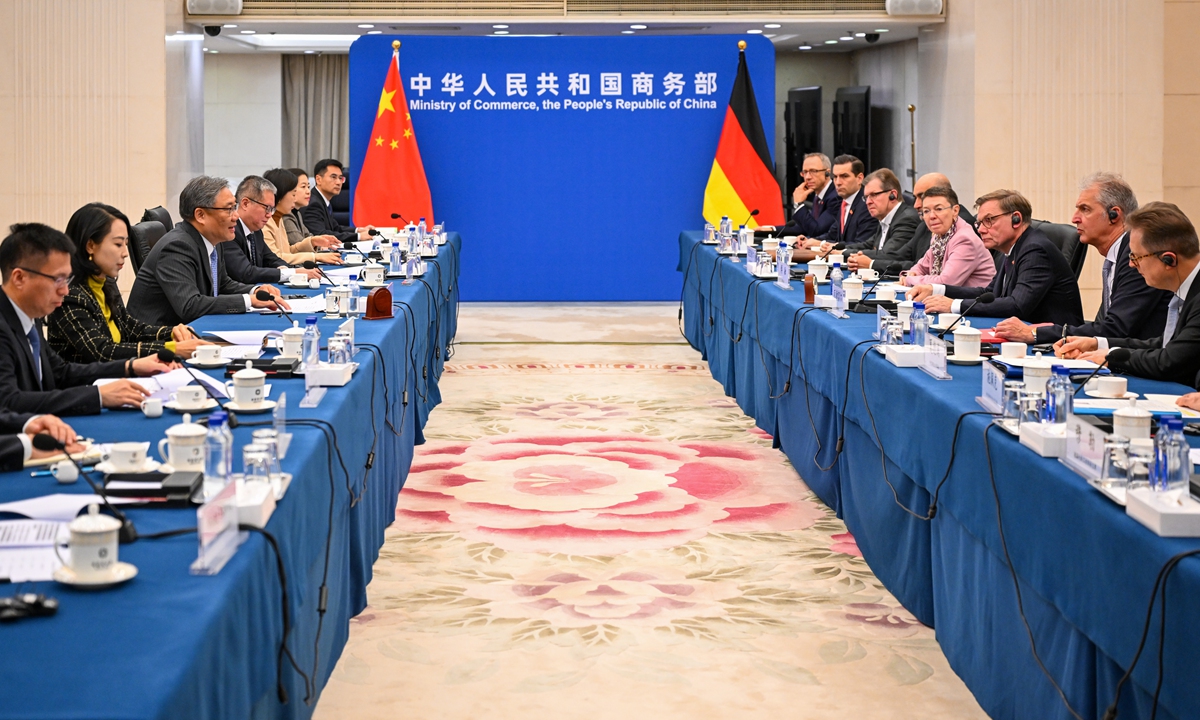
Chinese Commerce Minister Wang Wentao meets with visiting German Foreign Minister Johann Wadephul in Beijing on December 8, 2025. Photo: VCG
Meaningful visitLater on Monday, Wadephul held a less-than-20-minute press conference at Regent Hotel in Beijing where he briefed his talks with the Chinese side and took several questions from media within his delegation. During the session, Wadephul covered topics including general Germany-China relations, bilateral trade, rare earth, the Ukraine conflict, and climate cooperation. Wadephul also mentioned German Chancellor Friedrich Merz's plan to possibly visit China in the first quarter of 2026.
Throughout his briefing, Wadephul did not take question from Chinese media, Global Times reporters observed.
It is Wadephul's first visit to China as foreign minister, and he is here to address core diplomatic and strategic issues and prepare the ground for German Chancellor Friedrich Merz's upcoming trip, Jiang Feng, research fellow at Shanghai International Studies University and president of the Shanghai Association of Regional and Country Studies, told the Global Times.
Wadephul's resumed trip to China may serve two purposes — making up for past missteps and repairing damage, said Zheng Chunrong, director of the German Studies Centre at Tongji University. It is both an effort to contain the fallout from the previously postponed visit and a step toward paving the way for higher-level exchanges.
Zheng said that Wadephul's aborted October trip—originally meant to pave the way for the chancellor's visit—was a missed opportunity. "Had Wadephul's previous plan to visit China gone ahead smoothly, especially before French President Macron's trip, it could have underscored Germany's leading role in China-EU relations," Zheng noted.
Wadephul, a member of German Chancellor Friedrich Merz's center-right Christian Democratic Union (CDU), originally planned his first trip to China for October 26, but the trip was canceled at short notice. Some German media reported that "Observers saw a connection to critical comments made by Wadephul in the run-up to the visit." Before his trips to Japan and Indonesia, Wadephul had repeatedly and publicly criticized China on Taiwan and the East and South China Seas, according to a report from DW on Saturday.
On November 3, Chinese Foreign Minister Wang Yi held phone talks with Wadephul at the request of the German side, during which Wadephul noted that Germany attaches great importance to its relations with China. Also, German Finance Minister Lars Klingbeil embarked on a visit to China on November 16 to take part in the fourth China-Germany High-Level Financial Dialogue, according to Xinhua.
Wadephul's trip comes as Europe recalibrates its China policy and tensions ease following the German finance minister's visit. "He may have missed the earlier window, but it's not too late. With a pragmatic approach and readiness to restart dialogue, the visit can still be meaningful for China-Germany and China-EU ties," Zheng said.
In its coverage of Wadephul's visit, Germany's Welt claimed that the talks are expected to focus on China's "export restrictions on rare earths" and another central issue will be Beijing's position on the Ukraine issue.
In a video released by DWS News, before boarding his plane for the China visit, Wadephul was shown speaking to a group of people in front of a plane in Germany, with the English interpretation saying that "It is important to maintain direct contact with China, which is irreplaceable," he said. However, he also claimed he would address "trade, restrictions and overcapacity" during his visit, according to the DWS News video.
Zheng noted that Wadephul's rhetoric is noticeably softer than before. Rather than fixating on differences, China, Germany and the EU should focus on advancing practical cooperation, building on past achievements and exploring new areas of collaboration.
In addition to Beijing, on Tuesday, Wadephul will visit the southern manufacturing hub of Guangzhou, per Reuters.
Sustained China-EU engagement
Wadephul's visit also comes amid a wave of European diplomacy in Beijing. Spain's King Felipe VI paid a state visit from November 10 to 13, followed by French President Emmanuel Macron from December 3 to 5.
At the press conference on Monday, Chinese Foreign Ministry spokesperson Guo Jiakun said on Monday that China and European countries have had close high-level exchanges this year. Leaders of the two sides reached important common understandings on and provided strategic guidance for further growing the strategic partnership and deepening mutually beneficial cooperation.
Amid the increasingly turbulent international situation, closer strategic communication and deeper dialogue and cooperation between China and Europe serves the interests of both sides and the wider world, said Guo.
Many European media outlets have covered Wadephul's China visit. In a report on Sunday, Euronews described it as "one of the most important foreign trips of his tenure."
Zheng noted that China welcomes cooperation from the EU, especially as intensifying major-power rivalry places China-Germany and China-EU relations at a moment of overlapping uncertainties and a critical turning point. Wadephul's visit, he said, serves a corrective purpose.
Strengthening communication, managing differences and identifying new areas of cooperation would advance mutual benefit and give the relationship greater resilience in an uncertain world, said Zheng.
RELATED ARTICLES