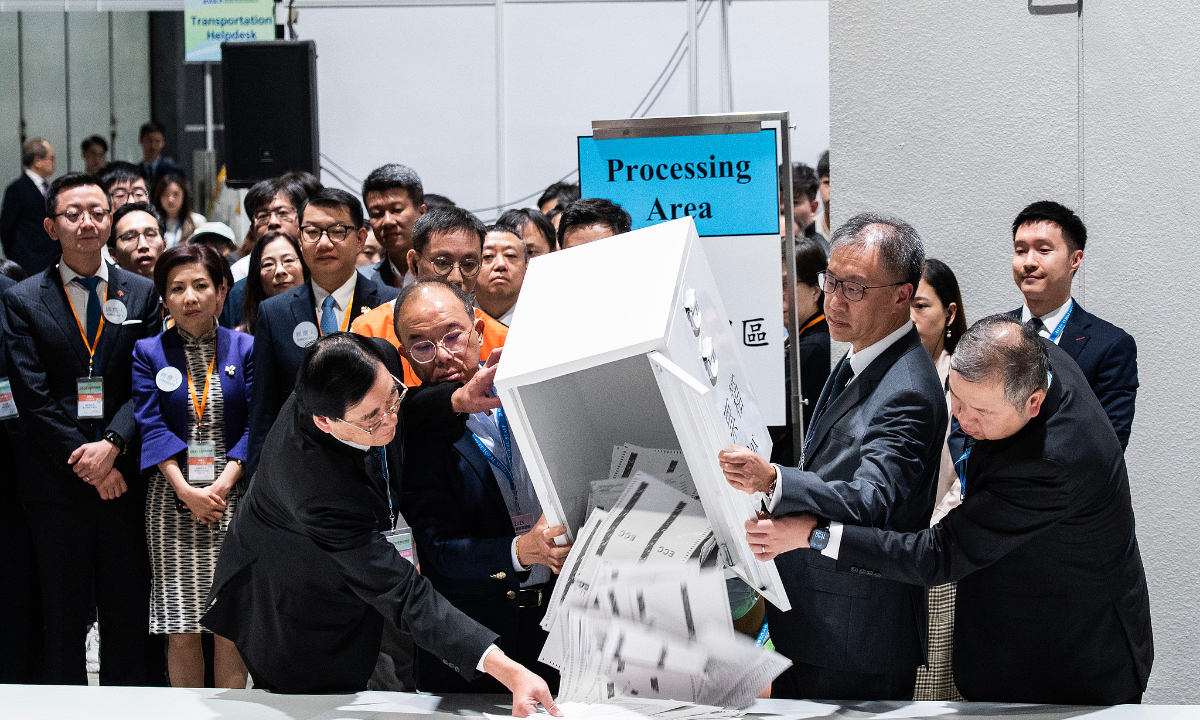
After voting in the HKSAR's eighth Legislative Council election concluded in late night of December 7, 2025, ballot counting began. Photo: VCG
Recently, the election of the eighth-term Legislative Council (LegCo) of China's Hong Kong Special Administrative Region (HKSAR) was successfully concluded in accordance with the law, marking another pivotal milestone as Hong Kong advances toward a new phase of governance and prosperity. This election was held against the backdrop of a major fire incident unprecedented since the city's founding. In the face of sudden disaster and grief, the HKSAR government and all sectors of society remained composed, demonstrating swift responsiveness and solidarity in mutual support. The election proceeded without delay or postponement, concluding as scheduled in a lawful, safe, orderly, and competitive manner. All 90 LegCo members were legally elected, with turnout rates reaching 31.9 percent in geographical constituencies, 40.09 percent in functional constituencies, and a remarkable 99.45 percent in the Election Committee constituency - all higher than in the previous election.It can be said that this smoothly conducted election, held at a special moment, stands as a compelling testament to the superiority of the new electoral system and the fresh momentum in the HKSAR's democratic governance. In 2021, the work to improve Hong Kong's electoral system was completed successfully. This marks the second LegCo election since the electoral system was refined. A total of 161 candidates actively participated in the campaign process, engaging in more than 90 election forums and meetings with candidates and fully demonstrating the broad representativeness, political inclusiveness, balanced participation, and fair competition of the election.
During this election, HKSAR chief executive John Lee Ka-chiu and the HKSAR government earnestly fulfilled their primary responsibilities to safeguard the electoral process, organizing the work in a lawful, compliant, and meticulous manner. Civil servants led by example in casting their votes, while all sectors of society participated extensively in this election, forging a strong consensus on striving for a vibrant economy, pursuing development, improving people's livelihoods, and promoting reforms.
What is particularly commendable is that in the face of disaster, candidates and their teams demonstrated exceptional political acumen and humanitarian concern, and actively participated in the disaster relief work. A rational and constructive election culture is now taking shape, standing in stark contrast to the chaotic election environment of the past, which was marked by shouting, name-calling, and mutual attacks.
LegCo elections have always been a major political event in Hong Kong since the city's return. In the past, HKSAR LegCo elections leaned toward a Western-style confrontational logic, which resulted in rampant filibustering and social division, seriously hindering economic and livelihood development as well as the smooth operation of the constitutional order. The new electoral system, by strengthening the Election Committee constituency, curbing unnecessary political confrontation and promoting balanced and rational participation, has allowed the executive-led governance model stipulated by the Basic Law to function smoothly, laying an institutional foundation for economic recovery, industrial upgrading, and improvements in people's livelihoods.
From this election, it is evident that after undergoing institutional restructuring and social turbulence, Hong Kong has gradually developed stronger coordination, execution, and emergency-response capabilities, moving from a fragmented and confrontational governance logic to a new stage that is more stable and focused on livelihoods and governance effectiveness, which demonstrates the new outlook for the "one country, two systems" framework.
Of course, the significance of an election lies not only in its smooth completion as a procedure, but also in the new political expectations it reflects within Hong Kong society. Members of the new LegCo carry not only the votes but also the weighty hopes of Hong Kong compatriots for a better life and the central government's expectations.
The political makeup of this LegCo also reveals new trends: About 44 percent of the members are "newcomers," with a notable improvement in professional and technical backgrounds. This shows that, under the premise of stability, the structure of the legislature is undergoing rapid optimization and upgrading, evolving toward a model that places greater emphasis on governance capacity. Hong Kong is moving from a phase of "stability first," in which order has been restored, to that of "competent patriots governing Hong Kong," where the city is set to thrive. Hong Kong citizens hope to see administrators who are professional, capable, responsible, and able to solve problems.
The LegCo is an important component of the constitutional framework of the HKSAR. The ability of its members to perform their duties with high quality is closely related to the effectiveness of governance in Hong Kong. The LegCo is not the "territory" of any particular sector or interest group; rather, it is a "platform" for safeguarding Hong Kong's prosperity and stability and maintaining national security. Hopefully the new LegCo members can uphold and promote the fine tradition of loving the country and Hong Kong, fulfill their responsibilities with high quality and efficiency, widely engage with various sectors of society to understand public sentiment and will, actively offer suggestions and advice, and work collaboratively with the HKSAR government to lead Hong Kong in deepening reform and achieving effective governance goals.
Today, the practice of "one country, two systems" has entered a new stage. Achieving better development for Hong Kong and making greater contributions to national strength and the rejuvenation of the nation is an important mission of the practice of "one country, two systems" in the new era. Taking this election as an opportunity, the world has seen the unity and resilience of Hong Kong society working together to overcome challenges, as well as the determination and will of various sectors of Hong Kong society to move toward a path of prosperity through good governance.
We have reason to believe that this LegCo, which carries a special historical mission, will live up to people's expectations. Based on the solid foundation of "patriots governing Hong Kong," it will further strengthen the core capabilities of "competent governance." It will unite public sentiment by addressing people's livelihood concerns and expand its scope by integrating into the broader national context, turning the beautiful blueprint of good governance into a tangible reality. The "spirit of Lion Rock" will not only be inherited in the present but will also shine in the future.