On-site audio proves Japanese maritime SDF vessel received notifications from Chinese Liaoning carrier formation: yuyuantantian
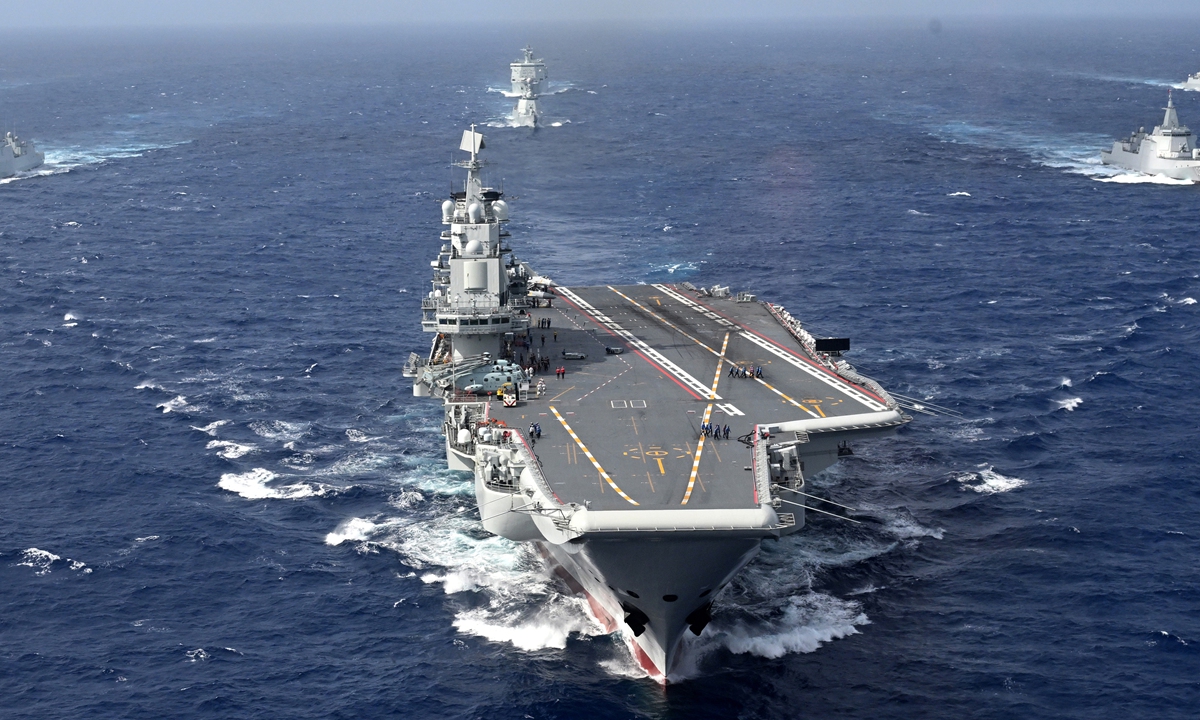
The Liaoning aircraft carrier participates in a dual-aircraft-carrier formation drill on October 21, 2024. Photo: VCG
Japan's recent series of manipulations regarding the Chinese Liaoning carrier formation are truly disgraceful: from intruding into China's exercise and training zone without authorization to hyping the so-called "radar illumination" issue. One critical fact that Japan likely dares not disclose to the international community is that China's military exercises this time fully comply with international law and practices. Moreover, China provided on-site notifications to the Japanese vessels in the nearby waters in advance, and the Japanese warship confirmed receipt via radio communication, read an article published on Tuesday by yuyuantantian, a social media account affiliated to China's state broadcaster China Central Television.
The article outlines a detailed timeline, fully exposing the clumsy farce orchestrated by the Japanese side.
According to a PLA Navy spokesperson, the PLA Navy's Liaoning aircraft carrier formation conducted regular carrier-based fighter jet flight training in the waters east of the Miyako Strait and had made public the training sea and airspace in advance.
On December 6, the Liaoning aircraft carrier formation conducted carrier-based aircraft training after passing through the Miyako Strait, according to yuyuantantian.
At 2:10 pm, the Liaoning formation organized the Warship 101 to issue a notification with the message: "Our formation organizes shipborne aircraft flight training as planned."
The Japanese destroyer Teruzuki confirmed receipt of the Chinese notification via radio.
At 2:28 pm, the Liaoning formation organized the Warship 101 to issue another, more detailed notification: "Our formation plans to conduct carrier-based aircraft flight training, expected to commence at 3 pm, lasting approximately 6 hours, primarily in the area south of the aircraft carrier."
Subsequently, the Japanese destroyer Teruzuki once again confirmed receipt of our notification via radio.
From the timeline, it is clear that China followed the common practice of naval training among nations worldwide by announcing the training location in advance. This fully demonstrates transparency and openness, while also strictly adhering to international laws such as the United Nations Convention on the Law of the Sea, ensuring the entire training process was legitimate and lawful, the article said.
Wang Xu, a maritime security expert, told the yuyuantantian that based on the United Nations Convention on the Law of the Sea, vessels and aircraft of all countries enjoy the freedom of navigation and overflight in the Miyako Strait. It is reasonable and lawful for China to conduct training in the Western Pacific via the Miyako Strait.
The Japanese side has also confirmed receipt of China's notifications for multiple times and was aware of and monitored the normal training activities of our forces.
However, under these circumstances, despite repeated notifications and pre-warnings from Chinese side, Japan has frequently approached the sea and airspace of the Chinese PLA Navy's training activities to cause disruptions. Moreover, it has made false accusations, maliciously hyping the so-called "China threatens regional security" narrative.
Zhang Junshe, a military affairs expert, told the yuyuantantian that the fundamental purpose of Japan's excessive reaction is to disrupt and obstruct China's normal training activities in the Pacific Ocean. Behind this lies Japan's unhealthy mindset—it is unwilling and unaccustomed to see Chinese vessels enter the Pacific for open-sea training. China's aircraft carriers must sail out and conduct training in far sea, continuously enhancing their capabilities for far-sea operations and improving the Chinese PLA Navy's capacity for defensive operations in far seas. This is an inevitable requirement for the development of the Chinese Navy, Zhang stressed.
In fact, all of Japan's actions are well within China's control. Japan's attempt to gain attention and sympathy through hysterical behavior only further highlights its own despicable and incompetent nature, Zhang noted.
The article reveals that on the afternoon of December 6, China's Liaoning aircraft carrier formation detected two Japanese F-15 aircraft approaching to carry out what they claimed as a response to the Chinese carrier-based aircraft mission.
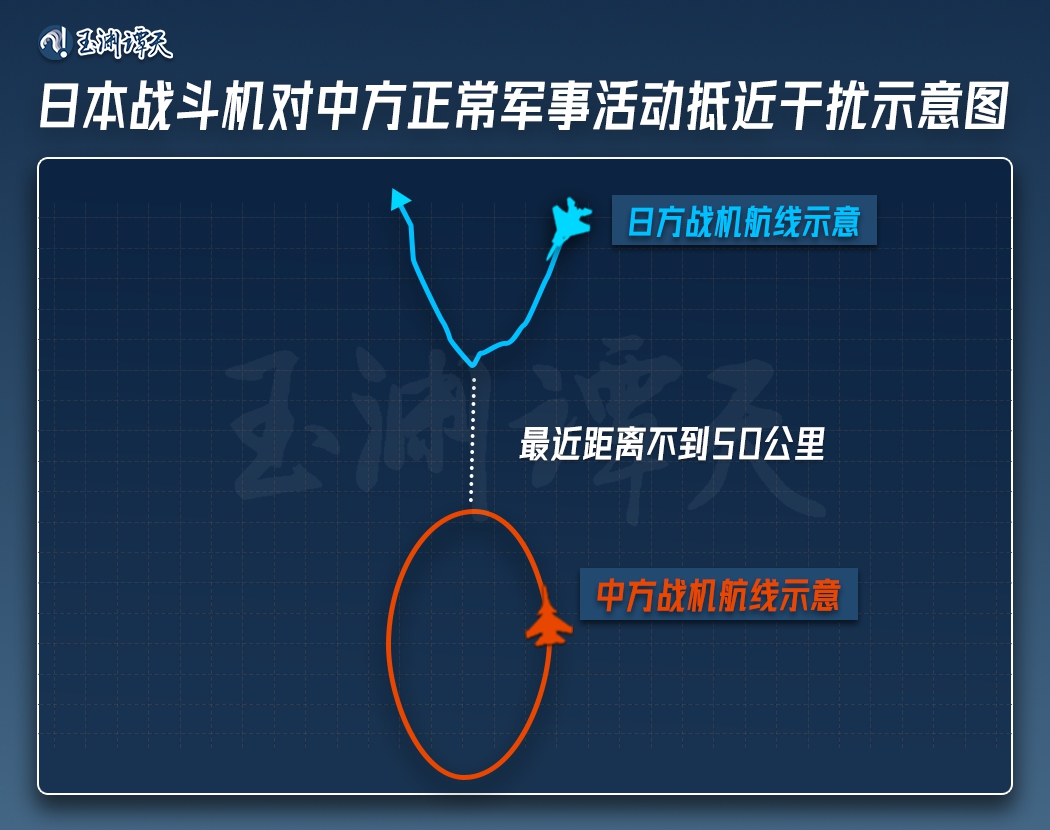
Schematic diagram of Japanese fighter jets approaching and interfering with China's normal military activities. Photo: WeChat account of yuyuantantian
According to an illustration drawn by yuyuantantian, it can be seen that the Japanese aircraft intruded into the designated exercise zone, which was also the sea and airspace notified in advance for the training. Their closest distance to the Chinese aircraft was less than 50 kilometers.
Currently, the airborne radar detection range of some mainstream fighter jets worldwide exceeds 50 kilometers. This means that Japan's actions have severely disrupted China's normal training operations and placed both sides in a dangerous situation. This is undoubtedly a reflection of Japan's increasingly aggressive and provocative behavior in the military security domain, the article said.
In an attempt to downplay its own provocative military actions, Japan has shamelessly hyped a basic military concept - radar illumination - seeking to portray a routine military operation as an extraordinary event.
Japan's Defense Minister Shinjiro Koizumi deliberately exaggerated the situation, claiming that Chinese military aircraft intermittently locked its radar onto Air Self-Defense Force fighter jets twice and "the actions of the Chinese military were dangerous acts that went beyond the scope necessary for the safe flight of an aircraft."
In reality, by entering China's exercise zone with malicious intent, the Japanese side has automatically come within the range of our radar detection and would naturally perceive the radar search signals, the article pointed out.
According to information obtained by yuyuantantian, Chinese aircraft have also detected radar signals from Japanese aircraft. However, China has consistently maintained rationality and restraint, fully demonstrating a responsible attitude toward safeguarding maritime and air security.
Turning on search radar during flight training for carrier-based aircraft is a common practice among nations worldwide and a standard procedure to ensure flight safety. Japan, by completely ignoring its own provocations and hyping a routine and standard military operation, overtly exaggerates common knowledge and distorts facts. This further proves the shallowness and lack of substance in Japan's pretext for such hype, it said.
Global Times
RELATED ARTICLES