Tianjin welcomes largest single shipment of Airbus large components
By Published: Dec 09, 2025 11:20 PM

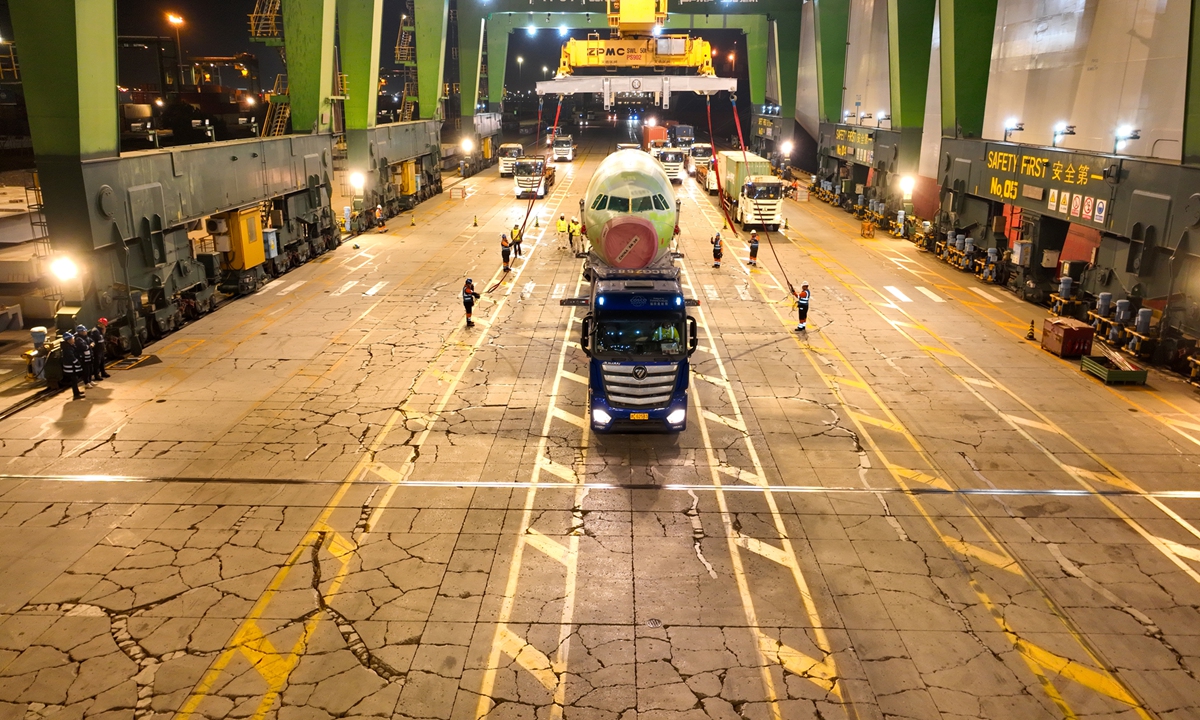
Photo: Courtesy of Tianjin Dongjiang border inspection station
Tianjin on Tuesday morning welcomed the largest single shipment of Airbus components ever received, with 12 large aircraft parts arriving at the port, according to information the Tianjin Dongjiang border inspection station sent to the Global Times on Tuesday.
The large components were carried via a container ship OOCL Denmark from Hamburg, Germany, and this shipment set a record for the largest single-entry volume of such components, the station said.
The delivery took place against the backdrop of growing maritime shipments of Airbus parts to North China's Tianjin, a trend that has accelerated since Airbus launched a new assembly line in China in October.
On October 22, EU plane manufacturer Airbus inaugurated its latest Final Assembly Line (FAL) for A320 family aircraft in the northern Chinese port city of Tianjin, the second of its kind in both China and Asia as a whole.
The project covers about 300,000 square meters, comprising 13 individual buildings including the final assembly workshop, painting hangar, and final assembly and working group hangars. The models produced include the Airbus A319, A320, and A321.
The new facility will double the A320 family's final assembly capacity in China, demonstrating Airbus' confidence in the country's thriving civil aviation market, resilient supply chain and favorable business climate, the Xinhua News Agency reported on October 22.
Using the FAL, the A320 planes will be assembled from large components such as fuselage sections and wings, painted, tested and delivered to customers in China and beyond, said Airbus CEO Guillaume Faury.
With the acceleration of deliveries, there will be a greater need to import aircraft components from Europe, and the smooth operation of this maritime route demonstrates not only highly efficient transportation between Europe and China but also the stability of China's role in the global aviation supply chain, Qi Qi, a veteran market watcher, told the Global Times on Tuesday.
On October 21, the day before the inauguration, Faury stated that Airbus' key objective is to reach a monthly production rate of 75 A320 aircraft by 2027. To achieve this ambitious goal, he emphasized the need for collective efforts to build a more resilient global supply chain.
Over the past four decades since Airbus established its presence in China, the company has consistently increased its procurement share in the Chinese market. This has played a significant role in driving the growth of China's aviation industry and even contributed to the global aviation supply chain, George Xu, CEO of Airbus China, said in an interview with the Global Times in June.
He added that Airbus' market share in China has grown substantially, rising from less than 10 percent in 1995 to more than half of the market today.
Airbus has not only significantly expanded its market presence in China but also strengthened its competitiveness and industrial resilience. This represents a mutually beneficial and win-win outcome for all parties involved. Xu said.
China and European countries have ramped up economic and trade exchanges lately. At the recently concluded 9th China-Germany Automotive Conference in Changchun, Northeast China's Jilin Province, German business leaders and industry representatives called for deeper cooperation with China's vehicle sector, arguing for mutual engagement while voicing opposition to unilateralism and protectionism.
RELATED ARTICLES