‘Resistance to cooperating across partisan divide has become more severe in the US’
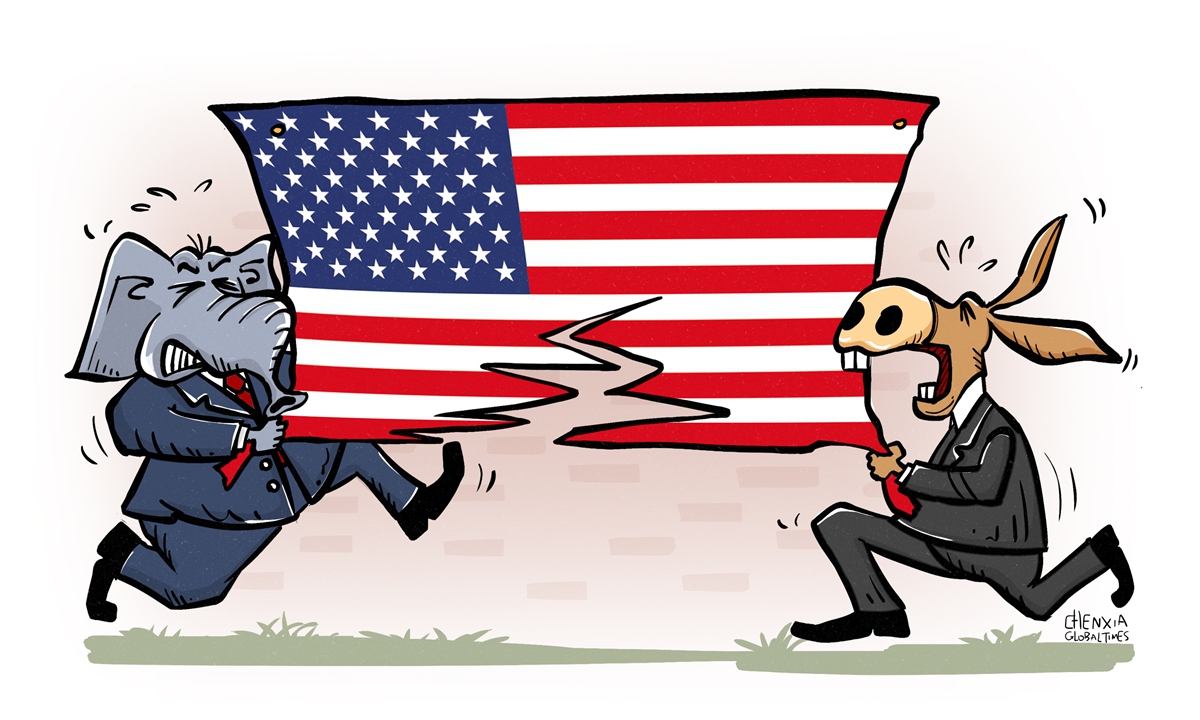
Illustration: Chen Xia/GT
Editor's Note:Political polarization in the US is nothing new - yet today it has reached a level of division few could have imagined. Over the past year, from the debt ceiling crisis to the record-breaking government shutdown that brought Washington to a standstill, each crisis reflects the deep divisions shaping American politics. What has turned polarization into an enduring affliction of the US? And is there a way forward? The Global Times (GT) has launched a series themed "The American Dilemma," delving into these issues. In the second installment of the series, David A. Super (Super), professor of law and economics at Georgetown University Law Center, shared his insights.
GT: Over the past year, rising political violence has become a concern for many Americans. How do you view the underlying causes of political violence in the US? How much do partisan accusations and hostility between Republicans and Democrats matter?
Super: Both sides of our political divide have embraced more extreme rhetoric about each other, causing more and more of the adherents to see their opponents as evil rather than merely misguided. In addition, both conventional news media companies and influencers on social media have found that stoking rage is an effective means of increasing engagement.
I also note that the problem has been exacerbated by the financial difficulties of media companies in this digital environment. Some formerly profitable companies now appear structurally unprofitable, which has led ideologically motivated affluent people to buy them as a means of advancing their own agendas. In a polarized media environment, those outlets that are still trying to appeal across the political spectrum have grown reluctant to parse competing claims on controversial issues for fear that whichever side they find to be dissembling will brand them a partisan of the other side and cut into their audiences. This has shifted coverage to "horse race journalism," with stories covering the most aggressive accusations each side makes against the other rather than the substance of issues.
GT: The 2025 US government shutdown is the longest one in US history. Since the 1970s, the federal government has experienced more than 20 shutdowns due to funding disruptions caused by partisan disagreements between Republicans and Democrats. Has this kind of political drama become the new normal - or even a defining feature - of American politics?
Super: Yes, it has. Relatively few politicians face serious challenges in general elections, but most worry about challenges in their party's primaries. Few are comfortable with compromising with the other party since that can be used against them by primary opponents.
Resistance to cooperating across the ideological and partisan divide has become even more severe among both politicians and their voting bases.
GT: The government shutdown has caused negative impacts across various sectors of society. In the face of such harm, does the deepening polarization in US politics symbolize that too many politicians have chosen a scorched-earth strategy instead of seeking consensus, placing partisan bias above citizens' rights?
Super: Perhaps, but the politicians are merely reflecting the sentiments of much of their partisan bases. Politicians who subordinate partisan gains risk losing party primaries to more hard-line challengers. So, until voters change, or until we change our electoral system to make general elections more competitive for more politicians, this polarization is likely inescapable.
GT: What are your expectations for the future of US politics? Can American society address political polarization and bridge these deep divides?
Super: I hope that it will become possible to reach bipartisan agreements allowing more genuinely competitive general elections. This would force politicians of both parties to seek to appeal to moderate voters and increase their incentives to reach agreements.
RELATED ARTICLES