China issues 3rd policy paper on LAC after 9 years
Document serves as guidebook for China-LAC relations in the new era: official
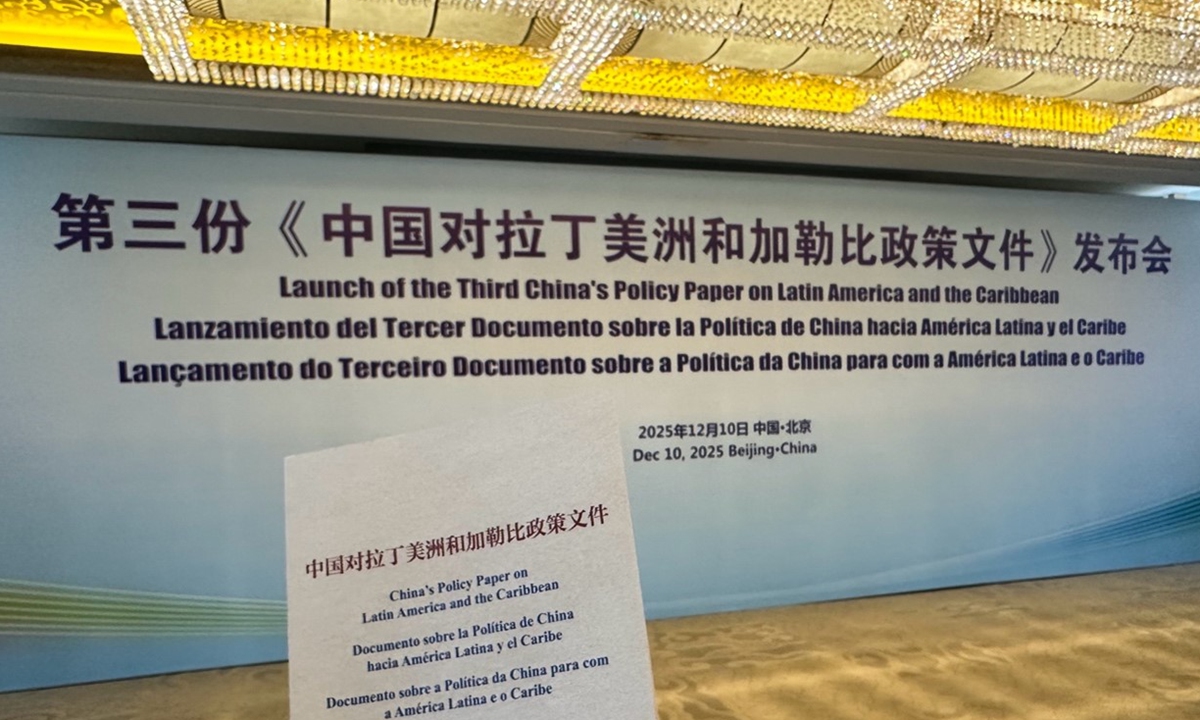
The venue for the launch ceremony of China's third Policy Paper on Latin America and the Caribbean (LAC) in Beijing, which was released on December 10, 2025. Photo: Feng Fan/GT
China on Wednesday released its third Policy Paper on Latin America and the Caribbean (LAC), underscoring that China-LAC relations have entered a new stage of equality, mutual benefit, innovation, openness and benefits for the people, setting a shining example of South-South cooperation.
The newly released paper follows the first China-LAC policy paper issued in 2008 and the second released in 2016. According to the document, the two sides will work together to advance five programs for building a China-LAC Community with a shared future, marking a new phase in bilateral relations.
The five programs include the Solidarity Program, Development Program, Civilization Program, Peace Program and People-to-People Connectivity Program. The paper elaborates China's policy proposals for exchanges and cooperation in more than 40 areas, covering high-level exchanges, high-quality Belt and Road cooperation, trade and investment, science and technology innovation, as well as military exchanges and cooperation. The document also emphasizes cooperation in promoting reform of the global economic governance system and advancing the Global Development Initiative, Global Security Initiative and Global Civilization Initiative.
The launch ceremony in Beijing was attended by diplomats and media representatives from multiple LAC countries. Chinese Assistant Foreign Minister Cai Wei delivered a keynote address. The paper "shows the great importance China attaches to this relationship and its deep commitment to pursuing common development with LAC countries," Cai said, adding that this policy paper will serve as a road map and guidebook for China-LAC relations in the new era.
"The five programs, aimed at boosting shared development and revitalization and building a China-LAC community with a shared future, have been widely welcomed by LAC countries," Cai noted. With the launch of the third policy paper, China is ready to follow through on that important guidance, advance the five programs and inject fresh momentum into China-LAC relations, he said.
Reflecting on previous cooperation, Cai said the first two policy papers had effectively guided and promoted the growth of China-LAC relations. He highlighted the deepening political trust and institutional cooperation, noting that "in recent years, China and LAC countries had frequent high-level exchanges and strengthened political mutual trust. Twenty-four LAC countries have joined the big family of the Belt and Road cooperation," Cai said.
"In presenting this document, we confirm that our relationship is not limited to economic transactions and exchanges, but is grounded in shared values that transcend political and economic circumstances, and in the deep conviction that together we can build a more prosperous, fair, and sustainable world," Martin Charles, Dean of the diplomatic corps of Latin American and Caribbean States in China and Ambassador of Dominica to China said when he addressed the event.
The implementation of the policy paper will be fundamental in continuing the advancement of a China-LAC community with a shared future, and will have direct impacts on cooperation in infrastructure construction, education, culture, agriculture and other areas, Charles said.
Notably, the paper also clarifies China's position on trilateral cooperation, stating that the China-LAC relationship does not target or exclude any third party, nor is it subordinate to any third party. It meets the fundamental interests of the two sides and the trend of our time featuring world peace, development, cooperation and win-win.
RELATED ARTICLES