ARTS / CULTURE & LEISURE
Cinema’s future lies in storytelling, not AI: James Cameron
Power of resonance
By in Sanya Published: Dec 10, 2025 10:52 PM

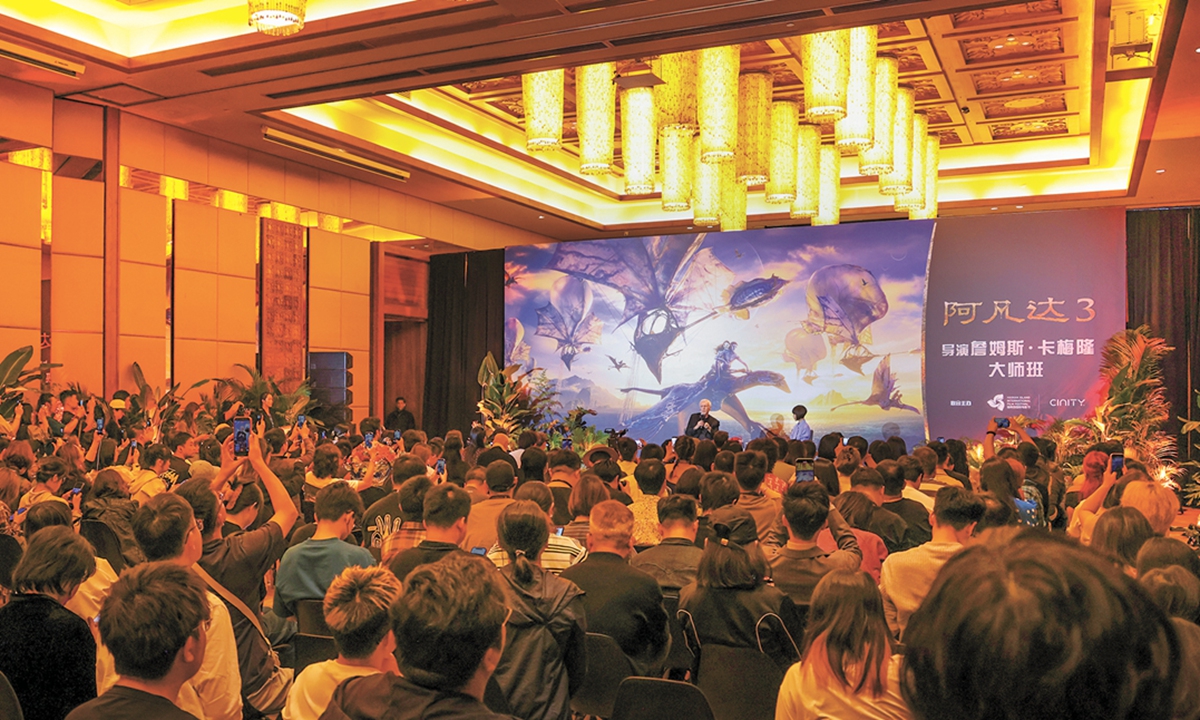
A masterclass is held at the 7th Hainan Island International Film Festival in Sanya, South China's Hainan Province on December 9, 2025. Photo: Courtesy of the Walt Disney Company
While attending events in Sanya, South China's Hainan Province, the internationally acclaimed director James Cameron kept returning to a single, powerful theme: resonance. Resonance between his films and audiences around the world; resonance between humanity and the natural world.Cameron was in Sanya for the China premier of his film Avatar 3 at the 7th Hainan Island International Film Festival.
"This China premiere is in a beautiful place that resonates with the natural beauty in the film and also resonates with the themes of environmental protection and respecting nature and changing our human relationship with nature," Cameron told the Global Times at a roundtable with reporters.
Widely known as a biodiversity hotspot of wildlife and nature, Hainan is renowned for its exceptional natural environment. But beyond nature, Cameron also highlighted the power of cinema in inspiring human resonance through storytelling.
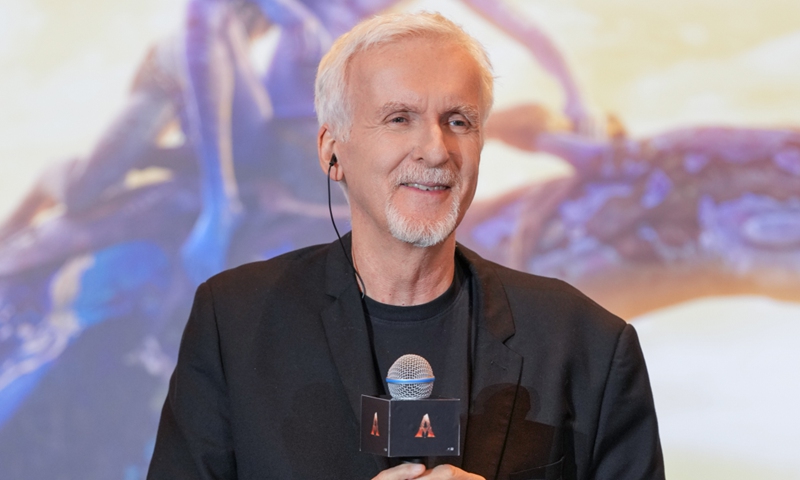
James Cameron speaks at an event in Sanya Photo: Courtesy of the Walt Disney Company
Universal themesCameron's Avatar sequels, scripted a decade ago and filmed over eight years, have struck a chord worldwide precisely because their core themes transcend time and culture.
"Our relationship with the natural world and the environment as human beings hasn't gotten better. It's only gotten worse. And I see a lot of hatred and violence in the world right now," he shared in the masterclass, adding that the themes of human connection, seeing each other, and being connected with nature seem just as relevant now as when he wrote it.
For Cameron, this focus on universality is deliberate. The first Avatar became a global phenomenon, topping box offices in every territory, because it leaned into shared human experiences rather than cultural specifics.
"It's not about the specifics of a particular country or cultural language, but the things that we all share - human emotion, how we deal with our own identity, how we fit into our family and our community," Cameron explained.
According to Chinese ticketing platform Maoyan, the first two films have grossed about $479 million combined in the Chinese mainland, which demonstrates this cross-cultural appeal.
For Cameron, these themes are deeply intertwined with his personal life, that is most notably, his role as a father of five. The Sully family's five children in the films are no coincidence. "It's life and art connecting," he emphasized, adding that every artist works through their own experiences.
Drawing on his journey watching his own children navigate their teens, he crafted Jake and Neytiri not just as heroic warriors, but as parents grappling with rebellious kids, fear of loss, and the duty to protect their family.
This blend of personal truth and universal struggle is what makes the Avatar films relatable, even amid Pandora's fantastical landscapes.
Cameron's remarks resonated deeply with the Chinese audience.
Gao Mingyang, a filmgoer from Beijing who watched the premiere, told the Global Times that the enduring global and domestic appeal of the Avatar franchise stems largely from its universal values. While watching the film, she said, she felt a profound emotional connection "to our beautiful home, Earth, as human beings."
Safeguarding creativity
As Avatar makes waves globally, a pressing question hangs over the film industry: In an age of streaming dominance and AI advancement, can live-action films still perform well?
Cameron told the Global Times at one roundtable that the actors' performances always come first, including the emotions expressed in the film. Storytelling is based on these emotional expressions that machines and technology cannot replicate.
For the Avatar sequels, he spent nearly five years revamping performance capture technology, not for spectacle, but to preserve the purity of the actors' performances.
He revealed that the team spent a lot of time and money creating a pipeline for facial performance to ensure nothing the actors did was lost. "They didn't have to act outwardly… they could be as internal as they wanted to be."
He draws a clear line between constructive tech use and replacing creators.
"I'm not personally interested in any pathway that uses the technology to replace human creativity," he stated firmly.
When asked about the changes in the world and film industry over the past three years compared to the 13-year wait between the first Avatar and its sequel, Cameron highlighted a seismic shift driven by streaming platforms, calling it the most significant disruption of his career.
The director shared that in the last five years, with the rise of streaming, the actual marketplace for people going to cinemas has been depressed by about 30 to 35 percent.
This downturn has made it increasingly challenging for big-budget films like the Avatar franchise to break even. "This is the biggest change in my lifetime. The theatrical experience has been predicted to be threatened many times throughout my career by television, VHS, Blu-ray…but this is the first time I feel it's under a real threat," he emphasized at a roundtable.
However, Cameron stressed that technological advancements alone are not enough. "The first step is we have to make a great movie… We have to continue to try to make films that will draw people back to the theater," he concluded, underscoring the enduring importance of compelling storytelling in preserving the theatrical experience.
When asked if China's landscapes, beyond Central China's Hunan Province's Zhangjiajie, might inspire future Avatar settings, Cameron revealed to the Global Times at the roundtable that Avatar 3 uses 100 percent CGI landscapes.
But he added "maybe we can use photography from Hainan Province to inspire some future Avatar settings."
Still, questions remain about any future Avatar sequel. Cameron noted future installments depend on Avatar 3's success - a top level success - since these movies cost a lot of money.
"If this film doesn't do that, it probably stops here… I'd love to continue, but it's okay, because we finish our story," he told the Global Times at the roundtable, adding that if he continues this project, it will be a new story.
RELATED ARTICLES