Moore Threads shares soar ahead of new GPU launch, as experts cite optimism over China’s tech self-reliance
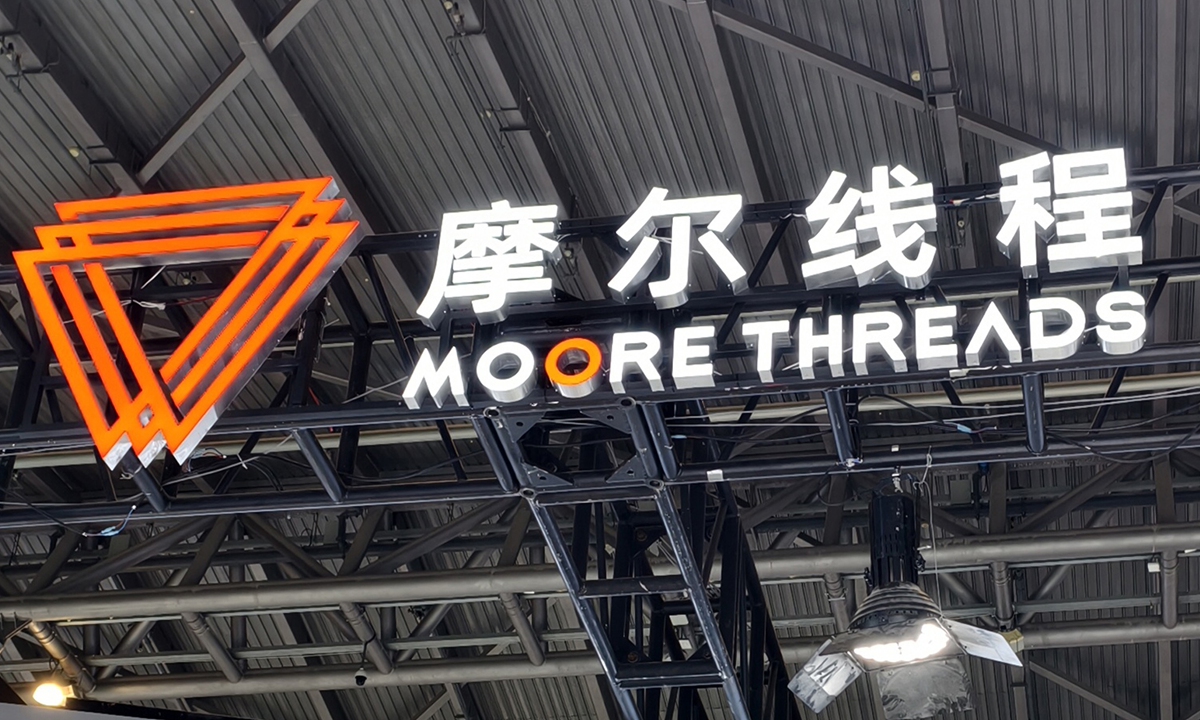
A logo of Moore Threads at the 2025 World Artificial Intelligence Conference in Shanghai on July 28, 2025 Photo: VCG
Shares of Moore Threads jumped more than 11 percent intraday on Wednesday, breaking above their IPO-day high of 688 yuan ($97) and lifting the company's market value to over 340 billion yuan at closing. The Chinese GPU designer is set to unveil its next-generation GPU on December 19-20, according to its official Weibo post on December 9.
Experts said that the newly listed Moore Threads is benefiting from investor optimism about China's push for technological self-reliance.
Moore Threads will hold its first MUSA Developer Conference on December 19-20 in Beijing. Founder, chairman and CEO Zhang Jianzhong is expected to outline the company's full-stack strategy and long-term vision centered on MUSA, unveil a next-generation GPU architecture, and roll out a comprehensive lineup covering products, core technologies and industry solutions, according to the company's official Weibo account.
The company will also showcase deployment cases across multiple sectors and updates on its ecosystem building.
Moore Threads, often described as "China's Nvidia," was listed on Shanghai's STAR Market at 9 am on Friday, according to The Paper.
Moore Threads is widely seen as Nvidia's challenger in China because it has followed a similar path in GPU design, with chips that were originally built to render high-quality graphics in films and games before becoming essential for artificial intelligence (AI) training. Most of Moore Threads' domestic AI chip rivals, such as Huawei and Cambricon, focus instead on designing customized application-specific integrated circuits, according to Lianhe Zaobao.
However, according to a Dow Jones report, despite strong investor enthusiasm for Moore Threads' shares, analysts still view the company as a second-tier domestic AI chip supplier, ranking behind Huawei and Cambricon, Lianhe Zaobao reported.
The market frenzy around Moore Threads reflects strong expectations for breakthroughs in domestic GPUs. When the sector was still overlooked, investment remained limited, but the company's rapid rise in market value now highlights the scale of the localization opportunity. The overheated trading and tight liquidity also show just how powerful the appeal of the Chinese GPU developer has become, Liu Dingding, a Beijing-based internet analyst, told the Global Times on Wednesday.
Liu noted that chips were long viewed as the most challenging frontier in China-US tech competition, yet multiple domestic players — including Moore Threads and Huawei's Ascend line — are making decisive progress.
Liu stressed that it is precisely these successive breakthroughs in algorithms, AI accelerators and full-stack server systems that have forced Washington to rethink its export policies. If Nvidia and other foreign high-end chip suppliers fail to re-enter the Chinese market soon, their products will face shrinking cost advantages, reduced scale and weakening competitiveness.
Ma Jihua, a veteran industry observer, told the Global Times that Moore Threads' core strength lies in its "full-function" approach. Built on its self-developed MUSA architecture, the company's GPUs are designed for multiple uses rather than being limited to AI computation, allowing for far broader application scenarios.
He added that Moore Threads is also pursuing a dual software strategy by building its own ecosystem while ensuring compatibility, and its products are already being deployed in large AI models and several key industries.
Ma noted that Chinese companies are making breakthroughs along different technical routes, with GPU development now covering the high-, mid- and low-end segments. Capacity is rising quickly and domestic demand is increasingly being met, he said. "The next step is to reach global customers and help make advanced AI more broadly accessible."
Global Times
RELATED ARTICLES