llustration: Xia Qing/GT
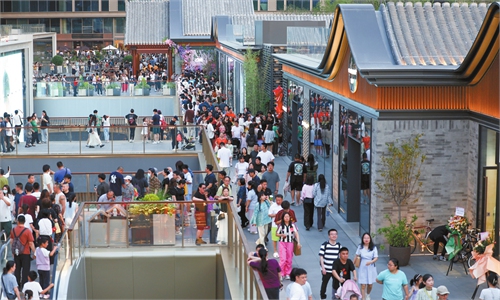
Since the beginning of this year, the Hubin commercial area along the shores of West Lake in Hangzhou, East China's Zhejiang Province, has experienced a surge of "debut stores." This vibrant locale is harnessing its unique setting to stimulate renewed consumer engagement. For foreign brands looking to enter or expand their presence in China, Hubin's concentration of retail debuts offers a valuable lens through which to understand local market dynamics and consumer preferences.According to a report by CCTV.com on Wednesday, Hangzhou welcomed 153 debut stores in the first half of 2025, a year-on-year increase of 39.1 percent. The Hubin commercial area, which is home to more than 1,800 retailers, has introduced more than 100 new brands this year alone.
This trend extends well beyond Hangzhou. Across China, an increasing number of "first" events, such as debut stores, product launches, exhibitions, and performances, are emerging as vibrant local consumption hotspots. This surge in inaugural activities has been aptly termed the "debut economy."
The debut economy encompasses a range of activities, including the launch of new products, the introduction of innovative business models, and the establishment of debut stores. This concept captures the entire chain of development, from the initial unveiling of products or services to their first public exhibitions, the opening of retail locations, the establishment of research and development (R&D) centers, and even the setting up of corporate headquarters.
The debut economy holds significant growth potential. First-tier cities such as Beijing and Shanghai are at the forefront of this trend, while emerging cities like Nanjing and Chengdu are harnessing their robust local industries and consumption capabilities to steadily advance the debut economy.
Vibrant stories are unfolding across China. For instance, in February, the debut economy development promotion center of Chengdu's Jinjiang district was officially inaugurated, providing first-launch enterprises with full-lifecycle services ranging from product R&D to showcase and release activities. In the first three quarters of this year, Chengdu registered 631 new debut stores, according to the People's Daily.
China is promoting the development of the debut economy. The Special Action Plan for Boosting Consumption issued by the General Office of the State Council this year calls for advancing the debut economy based on local conditions, and encouraging high-quality domestic and international brands of goods and services to open first stores and host first releases, debuts, and exhibitions. This encompasses both domestic as well as international firms during the surge of the debut economy.
Beyond the debut economy, a range of new trends is emerging. This year has witnessed the continuous development of various sectors, including the silver economy and the ice-and-snow economy, all of which reflect the evolving landscape of China's consumer market.
These expanding consumption sectors are not only generating new momentum for growth but also accelerating structural upgrading. Together, they reflect China's broader shift toward innovation-driven, demand-oriented, and diversified economic development.
While some foreign media outlets express skepticism about China's consumer market, the reality is that consumption in China is experiencing stable growth. In this process, it is natural for some traditional consumption patterns to weaken; however, it is essential to recognize that many new consumption trends are emerging swiftly. The tendency of some foreign media outlets to focus solely on declining traditional consumption while overlooking vibrant new trends misrepresents the overall narrative of China's consumption landscape.
The debut economy, along with other innovative consumption forms and trends, is rapidly evolving and creating new opportunities for domestic enterprises as well as for foreign companies looking to expand their presence in the Chinese market.
Of course, challenges are inevitable for any enterprise, and foreign companies are no exception.
First, these firms should cultivate a deeper understanding of the Chinese market and its consumers, approaching it with a forward-looking perspective rather than through the often-distorted narratives presented by some Western media outlets.
Second, they will face competition from rapidly growing domestic companies that are increasingly adept at meeting local consumer demands. After all, competition is an inherent aspect of any market.
Back to Hubin, this vibrant scene along the shores of West Lake exemplifies the depth of China's consumption upgrade. It provides valuable insights for foreign businesses, scholars, and others examining the dynamics of the Chinese consumer market and its import capabilities.
The author is a reporter with the Global Times. bizopinion@globaltimes.com.cn
RELATED ARTICLES