Key meeting maps out plan for China’s economic work in 2026
Policy measures on boosting domestic demand, promoting tech innovation, further opening-up highlighted
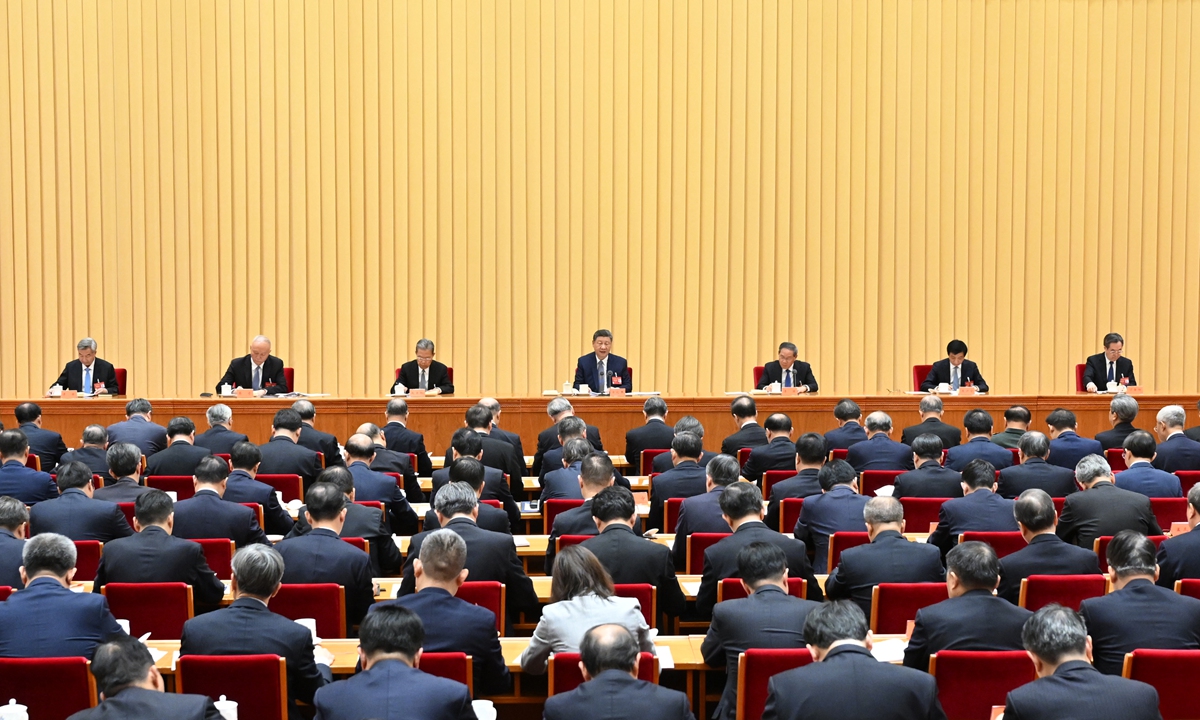
Xi Jinping, general secretary of the Communist Party of China Central Committee, Chinese president and chairman of the Central Military Commission, delivers an important speech at the annual Central Economic Work Conference in Beijing. The conference was held in Beijing from December 10 to 11. Photo: Xinhua
China will implement more proactive and impactful macroeconomic policies, formulate more far-sighted, more targeted and better-coordinated policies, continuously expand domestic demand and optimize supply, and develop new quality productive forces according to local conditions, according to the Central Economic Work Conference, which concluded on Thursday.The annual Central Economic Work Conference was held in Beijing from Wednesday to Thursday as Chinese leaders decided priorities for the economic work in 2026, the Xinhua News Agency reported.
Xi Jinping, general secretary of the Communist Party of China Central Committee, Chinese president and chairman of the Central Military Commission, delivered an important speech at the conference, Xinhua reported.
In his speech, Xi reviewed the country's economic work in 2025, analyzed the current economic situation and arranged next year's economic work.
It was noted at the meeting that 2025 is a truly extraordinary year, and the main targets for economic and social development will be successfully achieved.
As the 14th Five-Year Plan (2021-25) is set to approach a successful conclusion, the meeting noted that over the past five years, China has effectively navigated various shocks and challenges, and achieved new major accomplishments in the cause of the Party and the country.
Experts said the key meeting charts the course for the world's second-largest economy as it is about to enter the first year of the 15th Five-Year Plan (2026-30), while also providing greater predictability and certainty for the global economy amid an increasingly complex international landscape.
Major tasks highlighted
Major tasks have been outlined at the meeting to be effectively carried out next year. First and foremost is to maintain a demand-driven approach and build a strong domestic market.
This includes fully implementing special measures to boost consumption, formulating and executing plans to raise incomes for urban and rural residents, and expanding the supply of high-quality goods and services. Unreasonable restrictions in the consumption sector will be removed to unleash the potential of service consumption.
While the general tone remains largely unchanged, this year's meeting placed particular emphasis on boosting domestic demand, promoting technological innovation, and advancing further opening-up, highlighting the government's determination to stabilize economic development while fostering long-term structural upgrading and keeping the door wide open, analysts said.
"China's economic growth used to rely primarily on export-led and investment-driven models. However, against the backdrop of increasing external uncertainties, rising protectionism, and global inflationary pressures, expanding domestic demand has been established as a long-term strategic priority," Cao Heping, an economist at Peking University, told the Global Times on Thursday, noting that the government continues to advance special measures to boost consumption, including plans to raise incomes for urban and rural residents, which are expected to provide strong support for expanding domestic demand.
The key economic meeting emphasized a demand-driven approach and the building of a strong domestic market, identifying it as a key means to respond to external uncertainties, Cao added.
Among other major takeaways, the meeting stressed the need to adhere to an innovation-driven approach, and accelerate the cultivation and growth of new economic drivers.
Specifically, it called for the construction of international science and technology innovation centers in Beijing for the Beijing-Tianjin-Hebei region, Shanghai for the Yangtze River Delta, and the Guangdong-Hong Kong-Macao Greater Bay Area.
Efforts will be made to further strengthen the role of enterprises as the main drivers of innovation, improve the intellectual property protection system in emerging fields, and formulate action plans to expand and enhance the quality of the service sector.
"Innovation-driven development and domestic demand expansion are mutually reinforcing. Technological innovation drives adjustments in the production structure and fosters product innovation, ensuring that goods and services better align with the evolving needs and preferences of domestic consumers," Cao said.
By linking innovation with internal demand, China can not only stimulate consumption but also promote higher-quality, market-oriented industrial development, enhancing both economic resilience and growth potential, Hu Qimu, deputy secretary-general of the Forum 50 for Digital-Real Economies Integration, told the Global Times on Thursday.
The Central Economic Work Conference also repeatedly emphasized the need to uphold opening-up and advance mutually beneficial cooperation across multiple fields. The meeting called for steadily promoting institutional opening-up, expanding market access in the services sector in an orderly manner, optimizing the layout of pilot free trade zones, and making solid progress in developing the Hainan Free Trade Port.
Widespread attention
The key conference has garnered wide attention among foreign media and business representatives, who are closely watching the moves of the world's second-largest economy.
The latest policy signals come as the world's No. 2 economy is set to conclude a surprisingly resilient year, Bloomberg reported on Thursday, while closely following on specific policies measures that have been mentioned at the meeting.
The Wall Street Journal and Reuters also tracked the meeting closely, underscoring the measures announced to boost incomes and strengthen consumption.
The wide attention of the foreign media to the Chinese economy partially underscores the importance that the international community attaches to the world's second largest economy, which has proved its resilient trend despite external challenges this year, as this year marks the conclusion of China's 14th Five-Year Plan (2021-25), analysts said.
Looking ahead, external conditions remain uncertain, highlighted by lingering protectionism and unilateralism, as well as global inflation and geopolitical conflicts. However, to cushion against external volatility, China has introduced a broad set of countercyclical measures, including expanding domestic market capacity, unleashing potential through reforms, strengthening its innovation system, and fostering new industries to secure key positions in global industrial chains, Hu said.
These efforts aim to better withstand external risks, reduce the likelihood of disruptions in the supply chain, and provide greater certainty and stability for both the global economy and China's own economic development, laying a good foundation for the 15th Five-Year Plan period (2026-30), which starts next year, the expert said.
Predicting Chinese economic prospects for next year, Jens Eskelund, president of the EU Chamber of Commerce in China (European Chamber), told the Global Times that he has an expectation that there will be continued focus on developing the demand side of the Chinese economy.
"My expectation is that, going forward, the Chinese supply chain will continue to be very, very attractive. And China has today some of the world's most efficient supply chains, and that will not change next year," Eskelund said.
However, challenges persist. At the key meeting, it mentioned the need to better coordinate domestic economic work with struggles in the international economic and trade arena. Tian Yun, an economist based in Beijing, said this reflects the idea that China must strengthen its domestic economic fundamentals while ensuring that industrial policies take external frictions into consideration.
With a wide range of policy measures in place, as highlighted at the key meeting, expectations for China's economic performance remain strong. These domestic initiatives, including measures to expand domestic consumption and combine investment in both physical assets and human capital, help strengthen the country's economic fundamentals, said Tian.
At the same time, amid a complex global landscape, China continues to advance high-level opening-up while consolidating external markets and partnerships through multilateral mechanisms and regional cooperation. By aligning robust domestic policies with proactive international engagement, China demonstrates both confidence in its development and the ability to provide greater stability and certainty for the global economy, Tian said.
RELATED ARTICLES