2025 Yearender: Smart humanoids impress public in 2025 as AI continues to create new possibilities for humanity
By Published: Dec 12, 2025 09:51 PM

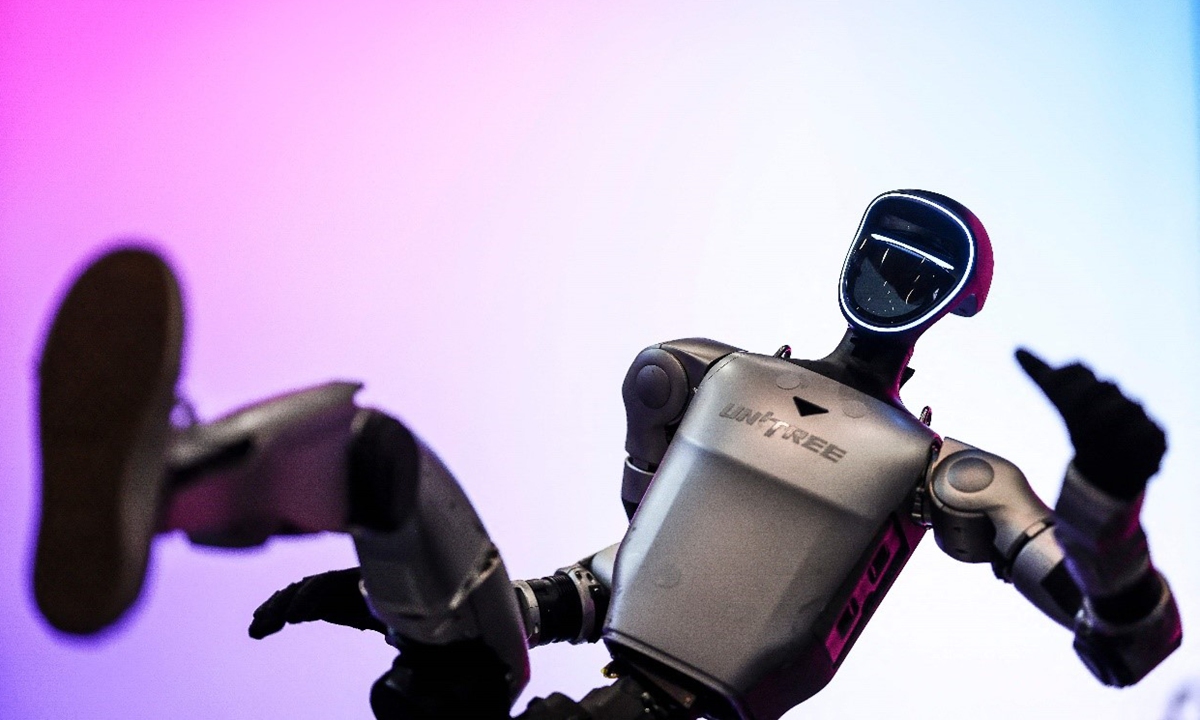
The Unitree robot is pictured at the Artificial Superintelligence Alliance stand during the Web Summit at Parque das Nacoes in Lisbon, on November 11, 2025. Photo: VCG
When a group of humanoid robots waved red handkerchiefs on the stage of the Spring Festival Gala at the beginning of 2025, the general public were amused, engaged in heated discussions, but many did not anticipate that it was a prelude to a year of explosive development of humanoid robots.
Throughout 2025, Global Times reporters have witnessed, experienced, and be inspired by how humanoid robots are "growing up" - emerging from laboratories, gaining new capabilities, entering the lives of the general public, and gradually shaping the future of humanity.
From sci-fi to real
The GT reporter still remembered how the Tien Kung Ultra robot learnt how to play with Lego in March at an innovation center in Beijing's Daxing district in March, and one month later in April, it competed in the world's inaugural humanoid robot half-marathon.
After roughly two hours and 40 minutes, the Tien Kung Ultra robot became the first to cross the finish line. The robot came to a smooth stop in the waiting area after completing the 21-kilometer course while some peer runners encountered some "amusing situations" of falling down and missing the direction.
Months later, the G1 robot developed by Unitree stood out as one of the undisputed stars in multiple occasions - not only executed professional combat moves, such as jabs, hooks, and sidekicks, with remarkable fluidity, but also showcased outstanding autonomous balance recovery when subjected to external impact. After an accidental fall, it could quickly rise within seconds and seamlessly re-engage in "combat."
It is also in 2025 that humanoid robots have gained much wider public recognition - they are no longer science fictions, but accessible real-life mates for us.
Shen Yang, a professor at Tsinghua University's School of Journalism and Communication and the College of AI, he also believed 2025 marks a year of significant strides for China in the fields of humanoid robots.
Very impressive, yet the hardware showcased is only part of the story. Many believe that the true catalyst for next-generation robotics will be breakthroughs in artificial intelligence (AI) large models.
Industry observers point to a key aspiration: a unified large model capable of processing sensor input and directly translating it into physical action. While significant steps remain to bridge this gap, the rapid development of open-source models has already turned many theoretical possibilities into tangible progress.
Commenting on this dynamic, Shen noted that China's open AI models have advanced with remarkable speed in recent years. This progress reflects not only the growing maturity of its developer community but also the country's strategic commitment to building accessible and foundational digital infrastructure.
A study by the Massachusetts Institute of Technology (MIT) and open-source AI startup Hugging Face reported that Chinese-developed open-source AI models accounted for 17.1 percent of global downloads over the past year, surpassing the US share of 15.8 percent for the first time, with DeepSeek and Alibaba's Qwen being the primary contributors.
These efforts have solidified China's increasingly important role in the global open-source AI ecosystem, contributing models, datasets and tools for developers worldwide. Extending beyond these tangible outputs, the value of this movement has shifted toward a broader intellectual paradigm.
New paradigm
Wang Jian, an academician of the Chinese Academy of Engineering and president of the Zhijiang Lab, told the Global Times that the most valuable assets from "open source" now extend far beyond the "source code" itself.
Today, critical resources, such as foundational research, have become universally accessible. For instance, many crucial papers are now first shared on open platforms, bypassing traditional publication routes in established journals, Wang said.
Reflecting on the profound implications of this shift, Wang said, "AI is not merely a tool - it is driving a new scientific revolution. The emergence of models like DeepSeek has demonstrated a tipping point for a fresh scientific research paradigm."
The scale of this development is vast. As of July, China has released 1,509 large models, ranking first in the world in terms of quantity and accounting for 40 percent of the global total, the Xinhua News Agency reported
At the 2025 Zhongguancun Forum in March, the GT reporter noticed that a crowd gathered around the CEOs of AI startups immediately after they had delivered their speeches on stage. Li Kaifu, Chairman of Innovation Works and CEO of 01.AI, said that the advent of large models represents a huge productivity revolution. From an industrial application viewpoint, he predicted that amid the explosive growth of AI technology, 2025 would mark the first year of its large-scale application.
His forecast aligns with national policy. In March, the Government Work Report called for cultivation of "embodied intelligence" and in August, China issued a guideline to implement the "AI Plus" initiative, promoting the extensive and in-depth integration of AI across various fields to accelerate the cultivation of new quality productive forces.
"When AI capabilities are internalized and become an inherent ability, intelligence is no longer a cost but a productive force," said Robin Li Yanhong, founder of Baidu,
New frontier
As AI fuels an insatiable appetite for computing power, a new frontier entered the spotlight in 2025: pushing intelligent computing into space.
In early November, a SpaceX rocket orbited the Starcloud-1 satellite equipped with Nvidia GPUs, thrusting space-based computing into public view.
Chinese tech firms have entered this race early, betting that the final frontier can overcome the Earth-bound limits of energy, space and cooling that increasingly constrain AI's growth. The latest competitor to emerge is Zhongke Tiansuan (Comospace), according to Xinhua.
It was until November that the GT reporter realized that China's first homegrown AI-enabled satellite Dongfang Huiyan Gaofen 01 has orbited throughout 2025 - it was deployed in December 2024.
Program leader from Chinese Academy of Sciences Han Yinhe, explaining why computing power and AI systems should be placed in outer space, told the GT that the goal is to eliminate the bottleneck of satellite-to-ground data transmission, especially in scenarios requiring ultra-low latency responses, such as disaster monitoring and early warning.
This cosmic shift addresses a fundamental constraint. "The exponential expansion of AI is, for the first time, making Earth feel 'inadequate,'" Shen Yang said.
For centuries, energy systems were built around the planet's surface, but as large models scale exponentially, we are approaching its supply limits. "At a certain critical point," he argued, "intelligent production will become an extension of the outer space industry rather than the Earth industry."
AI will be used to promote the improvement of medical and educational levels, facilitate scientific discoveries, optimize daily affairs and enhance the quality of life in various ways. AI will move beyond mobile applications and computer programs and enter homes, factories and offices, becoming a visible and perceptible reality, Shen noted.
It is believed that in 2026, the long-term impact brought by AI will become increasingly clear and continue to create new possibilities for humanity.
RELATED ARTICLES