GT on the spot: Hainan FTP's island-wide independent customs operations to accelerate flow of people, goods, capital
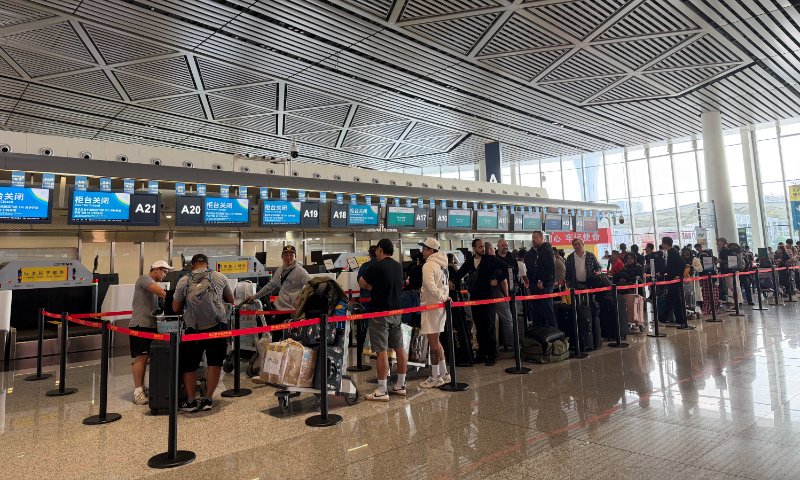
Visitors queue to claim their baggage at the departure hall of Haikou Meilan International Airport in Haikou, South China's Hainan Province, on December 6, 2025. Photo: Zhang Weilan/GT
When South Korean office worker Park Ji-hoon touched down in Haikou, South China's Hainan Province, he had one goal: to catch the final show of Katy Perry's China tour.
Recalling his visit to Haikou on November 28, Park praised the seamless experience in Hainan. "You can watch your idol's performance and enjoy an island holiday - it's perfect," Park told the Global Times, clutching a newly purchased perfume discounted by 50 percent.
The next day he used his concert ticket to redeem a shopping voucher at the China Duty Free Group (CDF)'s Haikou store, receiving 10 percent off most duty-free items and a 150-yuan ($21.3) no-threshold voucher. "I also booked a hotel with golf packages, which allowed me to fuse retail, entertainment and travel."
Local tourism, culture and sports industry associations partnered with travel and hospitality firms to offer "fan perks." According to local media, concert tickets could be used to obtain discounts on hotels, scenic tours, specialty dining and duty-free shopping, extending a single-event visit into a fuller Haikou experience.
Park's trip is emblematic of how Hainan's inbound tourism products are evolving. A growing wave of overseas travelers flock in with customized expectations and departs with one-of-a-kind experiences.
Ahead of the official launch of island-wide independent customs operations for the Hainan Free Trade Port (FTP) - along with phased steps to build an institutional framework for a free trade port with the highest level of openness - scheduled for December 18, 2025, business insiders, experts, and officials said the move is expected to further facilitate cross-border travel, boost duty-free sales and inbound consumption, attract more international carriers and support tailored tourism products that meet increasingly diverse visitor demands.
The island-wide independent customs operation is a policy innovation that will re-define trade, investment and people-to-people exchange with Southeast Asia and the wider world. The combination of increased international connectivity, policy reforms and an emphasis on sustainability positions Hainan to become a major player in global tourism, Chinese experts said.
Improved infrastructure
"Foreign visitor demand has changed significantly in Hainan," Zhang Hong, general manager of Hainan Haiwang International Travel Co, told the Global Times. "Southeast Asians want foodie night markets, Russians book 10-day traditional Chinese medicine slimming camps, Europeans chase reef-diving plus cultural embroidery, and South Koreans fly in for concerts and golf."
Zhang Hong said his agency now tailors cruise-matching itineraries and short-stay packages - city sightseeing, shopping and food experiences - to ensure travelers make the most of their stay ashore.
Hainan Airlines is stepping up airport transfer services to welcome more international tourists. The airline has implemented a one-stop "customs + immigration + security" process that cuts passenger walking distances by nearly 50 percent.
"We partnered with relevant agencies to upgrade through-checked baggage inspection equipment, boosting single-item inspection speed from about 40 seconds to 15-18 seconds," said Zhang Da, deputy director of the Hainan Regional Marketing Center at sales department at Hainan Airlines.
As the commencement of independent customs operations for the Hainan FTP draws near, and in response to rising international transfer demand, Hainan Airlines will leverage its local presence to provide convenient services for travelers. Meanwhile, it will add three new international routes in late December: Haikou-Hanoi, Haikou-Ho Chi Minh City and Qionghai (Boao)-Kuala Lumpur, lifting the hub's winter schedule to 28 destinations, said Zhang Da.
Wang Haiyan, assistant manager of the Logistics Development Department of Haikou Meilan International Airport, told the Global Times that the airport is stepping up efforts to build international and intercontinental passenger and cargo routes linking China with RCEP members and the South Pacific region.
In parallel, Meilan airport is in active talks with airlines to capitalize on Hainan's liberal aviation policies by developing "seventh freedom" operations - allowing foreign carriers based in Hainan to carry passengers and cargo onward to third countries, Wang said.
"On the policy side, in a move to enhance tourism development and expand its role in international tourism, Hainan is implementing a series of new tourism regulations that are set to reshape the industry. The visa-free policy in Hainan is the most open in the country, with 85 countries eligible for visa-free entry to Hainan," said Feng Fei, secretary of the Communist Party of China Hainan Provincial Committee.
The policy system of the FTP, underpinned by features such as zero tariffs, low tax rates and simplified tax systems, as well as a policy framework centered on free and convenient trade, investment, cross-border capital flow, personnel mobility, and the safe and orderly flow of data, is reshaping the area and driving it toward becoming an international FTP, Zhou Mi, a senior researcher at the Chinese Academy of International Trade and Economic Cooperation, told the Global Times.
Boosting consumption
Official data showed that, in 2024 Hainan received more than 97.2 million tourists, a year-on-year growth of 8 percent, and total tourism spending exceeded 204 billion yuan, up 12.5 percent year-on-year, the Xinhua News Agency reported.
Official data also showed that in the first nine months of 2025, Hainan recorded 973,900 overnight inbound travelers, up 29 percent year-on-year. Among them, 822,600 were foreign nationals, accounting for 84.46 percent of all overnight inbound visitors, an increase of 27.7 percent from last year. Visa-free entries have become the primary way for foreign tourists to arrive in Hainan.
Duty-free shopping remains a cornerstone of Hainan's tourism strategy, making the island a tropical shopping paradise. China aims to build Hainan into a globally influential tourism and consumption hub by 2035.
At Sanya International Duty Free City, the largest single duty-free shop in the world, the Global Times observed that tourists lined up for cosmetics, drones and pet-care items.
Effective November 1, Hainan's updated duty-free shopping policy increased the list of eligible goods from 45 to 47 categories, with new additions including pet supplies, portable musical instruments, micro-drones and small home appliances. Foreign passport holders and island residents can purchase and collect items under a "buy-and-take" model, reducing airport wait times to a few minutes, Sun Huiyan, a store manager at Sanya International Duty Free City told the Global Times.
The duty-free policy on Hainan Island has increased the number of tourists visiting Hainan, driven substantial increase in tourism income, and indirectly led to the rapid development of tourism-related industries such as accommodation, catering, transportation, said Zhou.
Liu Yuanchun, president of the Shanghai University of Finance and Economics, told the Global Times that Hainan's combination of a vast home market, favorable geography and targeted policies gives it a unique advantage in pursuing institutional innovation and becoming a globally competitive free trade port.
"Leveraging its market, geographical and policy advantages, and expanding duty-free offerings while enhancing the consumer experience, Hainan has illustrated how China is combining market access, regulatory innovation and institutional reform to attract visitors, capital and ideas," Liu said.
"This strengthens China's position as both a market for global brands and a testing ground for new business models," Liu added.
RELATED ARTICLES