China notes ‘positive move’ as India reportedly frees up visas for Chinese professionals


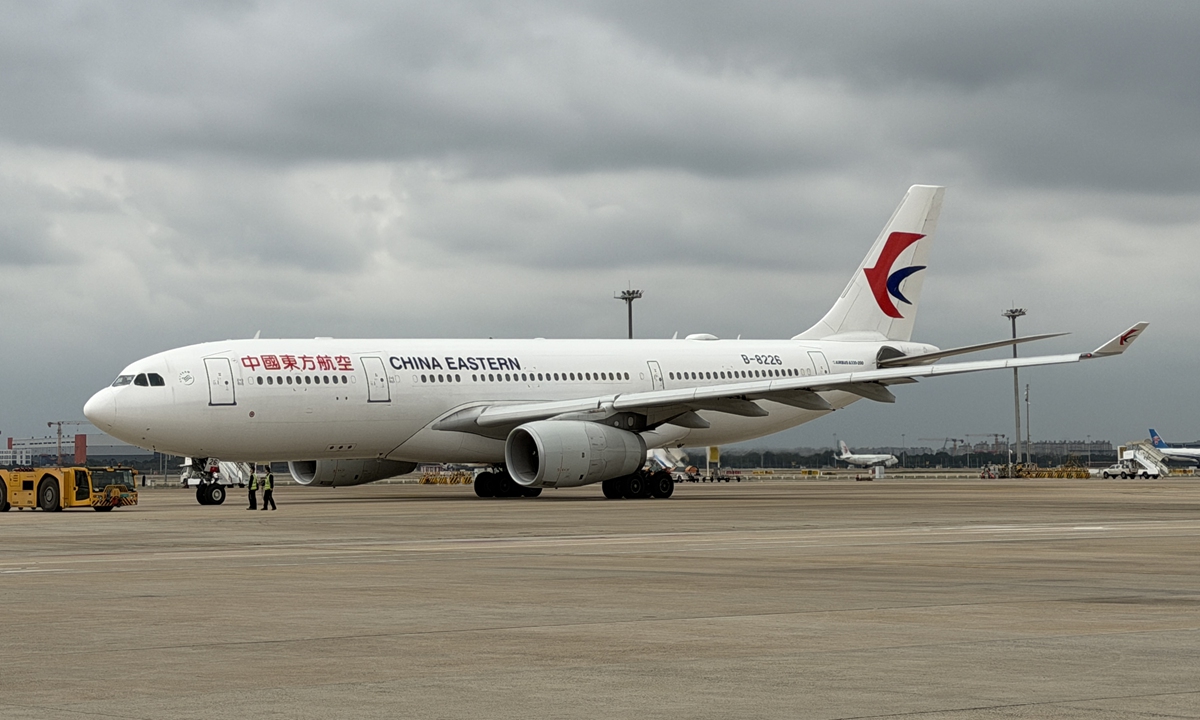
China Eastern Airlines flight MU563, carrying 248 passengers, prepares to depart from Shanghai Pudong International Airport bound for Delhi, India on November 9, 2025. Photo: Courtesy of China Eastern Airlines
A Chinese Foreign Ministry spokesperson said on Friday that China has noted India's positive move of speeding up visas for Chinese professionals, saying that easing cross-border travel serves the common interests of all parties.
Spokesperson Guo Jiakun made the remarks when asked to comment on a Reuters' report which suggested that India has moved to speed up visas for Chinese professionals by removing layers of scrutiny that prolonged approvals for years.
China will maintain communication and consultation with India to further facilitate people-to-people exchange, Guo said.
Earlier on Friday, citing two officials, Reuters reported that India has cut red tape to speed up business visas for Chinese professionals, in a major step to boost ties between the Asian giants and end chronic delays that cost output worth billions of dollars because of a scarcity of technicians.
As of press time, the Indian government had yet to make any official announcements.
Analysts interviewed by the Global Times noted that this policy easing serves India's dual strategic and economic purposes.
Speeding up visas for businessmen would help strengthen bilateral business relations, since Chinese citizens had faced tight scrutiny and low approval rates for Indian visas for business visits, and hurdles surrounding business visas had been a major block preventing business exchanges between the two nations from strengthening. They emphasized, however, that substantive and pragmatic measures from the Indian side are essential to genuinely advance and sustain the momentum in bilateral engagement.
This move comes at a time when travel between the two countries is gradually picking up.
India first resumed tourist visa processing for Chinese nationals in July this year, but only through its mission in Beijing and consulates in Shanghai, Guangzhou, and the Hong Kong Special Administrative Region, according to Indian media reports.
In October, China-India direct air services, which had been on a five-year hiatus, officially resumed, drawing welcome from travelers, business groups and companies from both countries.
Later on November 22, Indian media reported that in order to promote the normalization of India-China relations, the Indian government has fully resumed the issuance of tourist visas to Chinese citizens.
The reported new move will serve as a positive boost for product development for both local consumption and exports, Arjun Dhawan, governing council member of the Rubber Plastic and Skill Development Council of the government of India, told the Global Times.
The further improvement of visa facilitation for Chinese business travelers will make their business communications with Indian counterparts easier, a representative of a Chinese enterprise operating in India told the Global Times.
The Chinese businessperson said, however, that it remains to be seen how the visa procedures would be simplified and the pass rate will be improved. India still needs to make continuous improvements in enhancing the quality of their visa services, and increasing efforts in China to facilitate the exchanges of businessmen, he added.
"According to my observations, the visa acceleration mainly applied to the group of Chinese people that are urgently needed by the Indian side. It is far from an across-the-board policy easing," the Chinese executive said.
'Implement consensus'
A day earlier on Thursday, Liu Jinsong, Director-General of the Department of Asian Affairs at China's Ministry of Foreign Affairs held a new round of consultations with Sujit Ghosh, Joint Secretary of the East Asia Division at the Ministry of External Affairs in Beijing, according to a statement of the Chinese Foreign Ministry.
Both sides called the consultations "timely and efficient" and taking place in a "positive atmosphere" with "significant consensus" achieved, according to the statement.
Both sides affirmed the recent positive progress in China-India relations and expressed their commitment to making every effort to implement the important consensus reached at the Tianjin meeting between the two heads of state, promoting bilateral exchanges, restoring institutional dialogue, properly handling differences and sensitive issues.
During his visit to Beijing, Ghosh was also received by Chinese Vice Foreign Minister Sun Weidong on Thursday.
Zhao Gancheng, a senior fellow and director of South Asia Studies, Shanghai Institutes for International Studies, told the Global Times that the recent communications are a continuous progress for both sides to implement the high-level consensus, underscoring the active commitment of both sides to preserving peace and stability in the boundary regions.
In August, Chinese Foreign Minister Wang Yi, also a member of the Political Bureau of the Communist Party of China Central Committee, visited India. The two sides highlighted a series of consensus on boundary questions as well as outcomes in areas including direct flights and trade.
With the 24th Round of Talks Between the Special Representatives of China and India on the Boundary Question held in the same month, a 10-point consensus was reached, according to the Chinese Foreign Ministry.
While welcoming the accelerated engagements between the two neighbors, some Chinese analysts also struck a cautious note.
Elaborating on India's series of engagements with China, Lin Minwang, a deputy director of the Center for South Asian Studies at Fudan University, told the Global Times that since the US initiated tariff conflicts, India has been one of the countries most significantly affected, which has motivated it to seek an improvement in its relations with other countries strategically and tactically, including China.
From China's standpoint, China has consistently emphasized the importance of fostering a favorable neighboring environment. Improving relations with India aligns with China's strategic needs, Lin added.
India and China are partners, not adversaries. As two neighboring major countries, they should provide each other with strategic support and avoid letting their bilateral relations be swayed by signals from other countries, noted Zhao.
Regarding how mutual trust can be restored in practice, Lin stated that, for example, "India should gradually revoke its previous policies and practices that suppress Chinese enterprises. Such adjustments should not be made only privately but should be publicly communicated to demonstrate its policy shift."
For example, on the reported speeding-up of visa processing, analysts said it would carry greater positive significance for bilateral relations if India's definition of "professionals" is broad enough—encompassing not only engineers and technical personnel but also scholars in cultural exchanges, think tank dialogues, and other areas.
RELATED ARTICLES