Grandfather would be absolutely thrilled that humanity prevailed: grandson of US humanitarian who documented Nanjing Massacre
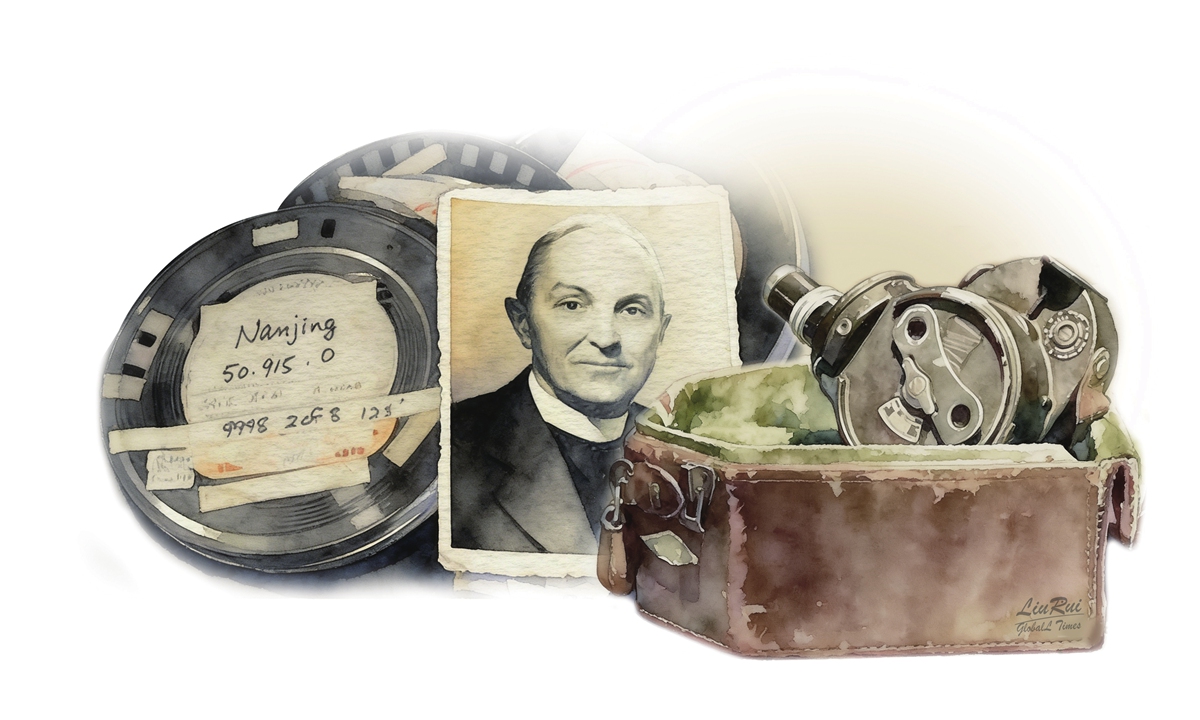
Illustration: Liu Rui/GT
Editor's Note:This Saturday marks the 12th National Memorial Day for the Victims of the Nanjing Massacre. On December 13, 1937, while the Japanese invaders captured Nanjing and carried out one of the deadliest mass killings in human history, John Magee, an American missionary who had been living in Nanjing since 1912, started to use his camera to film those brutal and inhuman incidents perpetrated by the Japanese troops. In 2017, Chris Magee (Magee), who is John's grandson and a professional photographer, traveled to Nanjing and filmed the people and places that appeared in his grandfather's images. He shared parts of his grandfather's story and his own experiences during his trip to the city in a recent interview with Global Times (GT) reporter Xia Wenxin.
GT: When did you realize that what your grandfather John Magee did in Nanjing was actually extraordinary and hugely significant? And how has your grandfather's experience in Nanjing affected you and your family?
Magee: As a child, I, of course, learned about my grandfather, but as a child, you don't really know what this is about. And as a young adult, I took a 20th-century Chinese history course - they didn't talk about the Nanjing Massacre. When Iris Chang, who is a Chinese-American author, came along and wrote her book, The Rape of Nanking, published in the West, that woke me up quite a lot. And then I tied all the strings together: "Oh, granddad's picture is in the book. What's going on here?"
But I think actually going to Nanjing, actually going to where he was and speaking to survivors, and talking to historians, attached to the Nanjing Memorial Hall - that was really incredible. It just woke me up and plugged me into the history. It's become so much more present. That part of history is almost inside of you, and you feel it very strongly. I think that's when it really hit hard to understand what my grandfather had done. And the absolute horror of being in Nanjing during that time, and the choice to stay, and then the choice of other brave people who stayed to help, too - not just the Westerners, also the incredibly brave Chinese people who stayed in Nanjing to help set up and run the safety zone.
GT: We know that the pictures and even video clips that your grandfather took during the Nanjing Massacre are among the most direct and powerful evidence revealing the atrocities of the massacre. As a professional photographer, how do you evaluate the power of photography in this context?
Magee: In fact, my uncle had the camera [my grandfather] used in Nanjing, and he gave it to me to use for film school. But I said, "No, it's too broken. I can't use it." I didn't realize at that time how valuable it was. Now, to see it, I have to put on my gloves at the Memorial Hall to do that.
As we know, film is really powerful because it's a moving picture that brings you much closer to the moment. To see people actually moving and changing and suffering and reacting, I think that is very powerful. And you add that to the photo evidence that we've seen, which is, in some ways, more horrific. Because grandad only had so much access. When he filmed in the Safety Zone hospital, he walked around. Outside, he hid, and that camera makes a lot of noise. You can't hide around the corner from a Japanese soldier and not get killed. So he chose his moments to film - usually scenes of devastation: People in the hospital, the wounded being brought in, and scenes from far away of men being taken away to be shot by the Japanese soldiers. All of it remains as very powerful evidence.
GT: You have visited Nanjing several times. What is the most touching moment that you have experienced in the city?
Magee: The most touching moment was when I was doing a project for the Nanjing Memorial Hall. I was taking photos of Nanjing and comparing the photos to all the photos from back then during the invasion. I was at a stadium at a sports university, taking my pictures quietly. Then I saw a man walking toward me from really far away, who looked like he was in his 60s. He came up to me and said, "Are you John Magee's grandson?" I said yes. "Well, I want to thank you. Thank him [your grandfather] so much." I can't accept the thanks, but it was just such incredible kindness by this man thanking me. That nearly brought me to tears, because here is someone who also had a connection to that time. And that was beautiful.
GT: If your grandfather were alive today, what message do you think he would most want to convey to the people of Nanjing?
Magee: I think he would go to Nanjing, absolutely excited with the fact that humanity won and the invaders are long gone. Nanjing is now a prosperous city full of good people. He would try to reconnect with people. He'd find out who had survived. He would probably go out and reconnect with people and say, "We got through this, and look at today: We're good. It's okay."
When you are in an incredibly horrifying situation, and the people around you are terrified, you head for the safety zone, and you try to get protection there. But I think if your job is to reassure people and to care for people, you leave that legacy behind. It is almost a legacy of love, a legacy of caring for other people. And I think that legacy of his is what actually remains today. And he would never claim to be a hero. He would say, "I just did what I was supposed to do."
RELATED ARTICLES