Resurgence of militarism’s dregs highlights vital significance of National Memorial Day: Global Times editorial
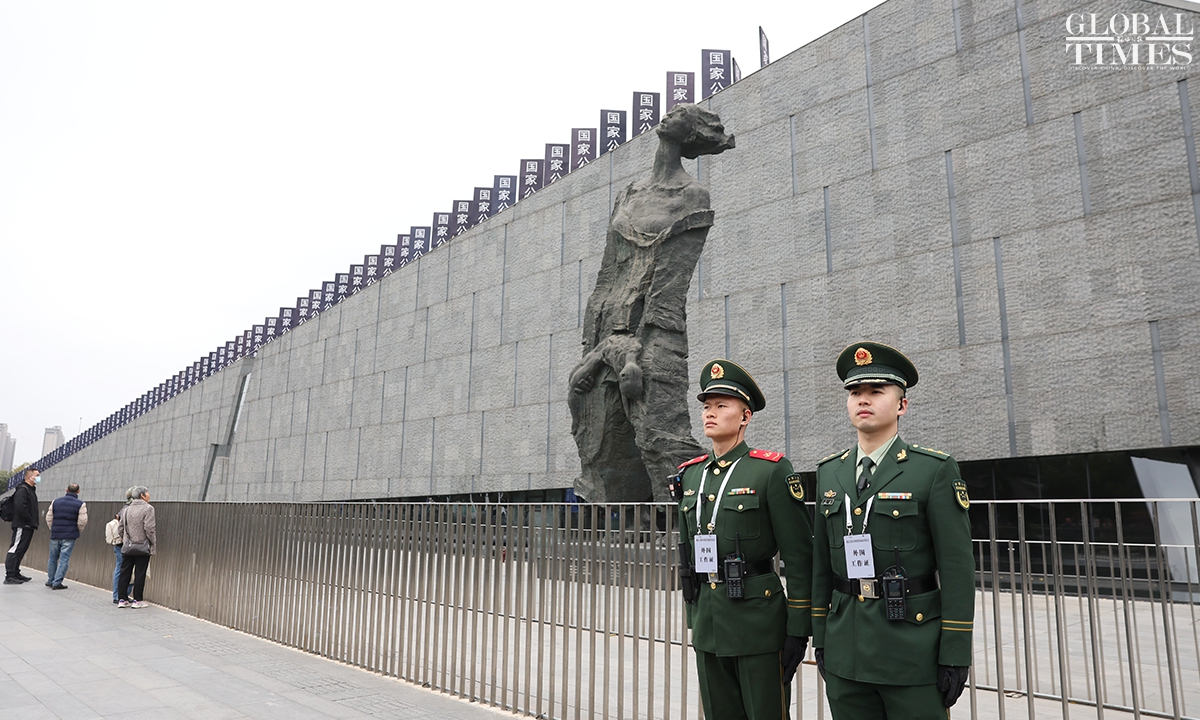
Photo: Cui Meng/GT
December 13, 2025 marks the 12th National Memorial Day for Nanjing Massacre Victims. In the name of the nation, we solemnly commemorate the 300,000 compatriots who perished in the inhumane massacres perpetrated by the invading Japanese army. Once again, air-raid sirens resound over the skies of Nanjing; at the same moment, the alarm bell tolls to warn against the resurgence of Japanese militarism from its ashes. We solemnly mark this day not to perpetuate hatred, but to illuminate the truth of history and to safeguard the hard-won peace.Back then, Japanese militarism, under the pretext of a so-called "survival-threatening situation," brazenly launched the war of aggression against China. After the Japanese army captured Nanjing, they carried out six weeks of slaughter and atrocities, creating one of the darkest pages in the history of human civilization. Three hundred thousand lives were brutally massacred; the waters of the Qinhuai River ran red with blood, and the ancient capital of six dynasties was turned into a living hell on earth.
The truth of history is supported by ironclad evidence. The judgments of the International Military Tribunal for the Far East and the Nanjing War Crimes Tribunal long ago nailed the atrocities of the Japanese army to the pillar of historical shame. Eighty-eight years have passed. Nanjing has risen from the ruins of that time into a prosperous modern city, and the survivors of those days are gradually passing away, but the memory of history must never be forgotten.
The agony of Nanjing is the same as that of Auschwitz - both are a shocking and glaring scar on the history of human civilization. The establishment of the National Memorial Day for Nanjing Massacre Victims elevates this painful chapter of the Chinese nation's history into a shared memory for all humankind. As the main battlefield in the East against Japanese fascism, China paid a heavy price of 35 million military and civilian casualties over 14 years of resistance. It contained and consumed the main strength of Japanese militarism, making an irreplaceable contribution to the ultimate victory in the World Anti-Fascist War.
The Nanjing Massacre under the sword of Japanese militarism was the most extreme and brutal manifestation of fascist expansion in East Asia. The archives of the Nanjing Massacre are listed in UNESCO's Memory of the World program. They share the same nature as atrocities such as the Auschwitz concentration camp. Both are essentially crimes against humanity perpetrated by fascism. Commemorating the Nanjing Massacre - this collective trauma in human history that must never be forgotten - is to defend humanity's conscience and justice.
As we profoundly mourn the fallen compatriots, we must clearly recognize that the specter of Japanese militarism has not been extinguished and is now showing dangerous signs of resurgence. In recent years, historical revisionism has proliferated in Japan: Right-wing forces run rampant, while a constant stream of statements denying, downplaying, or even glorifying the crimes of aggression has emerged. Japanese politicians frequently visit the Yasukuni Shrine, which honors convicted Class-A war criminals from World War II (WWII), openly calling back the spirit of militarism. Even more alarmingly, some continually peddle absurd claims such as the "theory" that "the Nanjing Massacre is fabricated," twisting facts and attempting to absolve themselves of guilt.
Toshio Tamogami, a former chief of staff of Japan's Air Self-Defense Force, recently openly declared that Japan's attack on Pearl Harbor was a "propaganda narrative" used by the US to discredit Japan, and that Japan's actions were a forced move after being "driven into a corner." Figures like Tamogami are by no means an isolated case; revisionist historical views circulate freely in today's Japanese society, and right-wing forces have become utterly reckless. Is such a country far from a revival of militarism?
Honoring the fallen and remembering history are equally important as a warning for the present. Japan has been accelerating its military buildup and expansion on an unprecedented scale and intensity since WWII. Its defense spending has increased for 13 consecutive years, and offensive weapons are being deployed extensively, rendering the principle of the "exclusively defense-oriented policy" based on the pacifist constitution null and void. Furthermore, Japanese leaders have resurrected the fallacy of a "survival-threatening situation" and openly made erroneous remarks concerning the island of Taiwan. This reckless dash down the path of military expansion inevitably recalls the militaristic Japan of the last century that plunged Asia into the abyss.
Militarism is not the enemy of a single country, but the enemy of all humanity. The lessons of history teach us this: A Japan that cannot squarely face its past and chooses to embark on a path of military adventurism will inevitably become a destroyer of peace in the region and the world once again.
Peace cannot rely on the illusion of the aggressor's "conscience"; it can only be secured on the basis of one's own strong capability. China is no longer the country that suffered humiliation 88 years ago. Today, as we commemorate our compatriots in the name of the nation, we demonstrate the firm resolve of the Chinese people to remember history and honor the fallen, while also making a solemn pledge to the world to safeguard peace and uphold justice. In the new era, China has the resolve, confidence, and capacity to defend its sovereignty, security, and development interests, and to work with countries around the world to firmly contain any attempt by Japanese militarism to make a comeback.
The alarm bell must keep ringing to safeguard justice. The National Memorial Day allows us to draw strength from shared memory and to move forward with resolve under the warnings of history. Historical truth cannot be distorted, the hard-won victories of the World Anti-Fascist War cannot be shaken, and the bottom line of human peace cannot be challenged. Faced with Japan's right-wing forces restlessly stirring up trouble in an attempt to subvert the post-WWII international order, all peace-loving forces around the world should unite and resolutely resist any attempt to whitewash or glorify aggression, making militarism like a rat crossing the street - reviled by everyone and with nowhere to hide.
RELATED ARTICLES