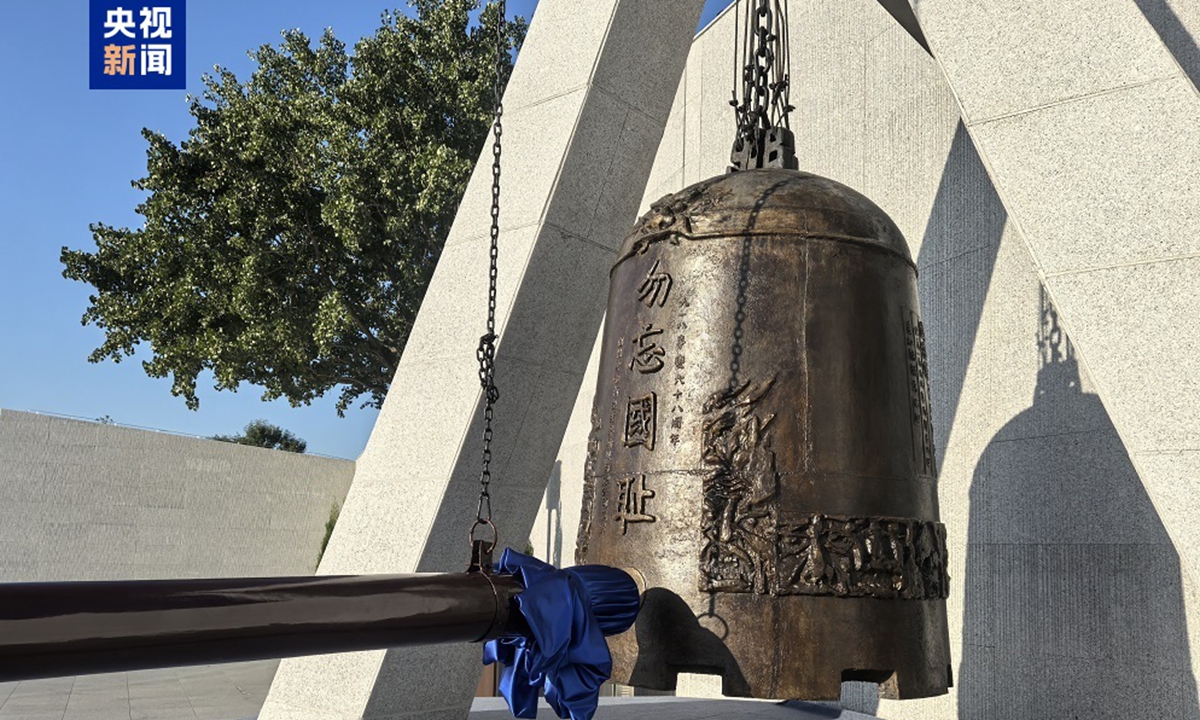
Picture of a bell-tolling ceremony held in Shenyang on September 18, 2025 to mark the 94th anniversary of the September 18 Incident Picture: CCTV
On Thursday, the 12th Beijing Xiangshan Forum opened at the Beijing International Conference Center, with an attendance of more than 1,800 official representatives, experts, scholars and observers from over 100 countries, regions and international organizations. This year marks the 80th anniversary of the victory in the Chinese People's War of Resistance against Japanese Aggression and the World Anti-Fascist War, the 80th anniversary of the founding of the United Nations, and the 94th anniversary of the September 18 Incident. By choosing the theme "Upholding International Order and Promoting Peaceful Development" at such a historic moment, the forum delivers a powerful response to the current global turbulence. It calls on the international community to jointly safeguard the hard-won achievements of the victory in the World Anti-Fascist War and the post-war order, while reaffirming peace and development as shared values of all humanity.Since its establishment in 2006, the Beijing Xiangshan Forum has been committed to pooling wisdom, expanding consensus, and enhancing mutual trust, becoming an influential international platform for security dialogue. Unlike some international security and defense forums, the Beijing Xiangshan Forum discusses common security rather than the security of certain blocs; it seeks not confrontation, but respect and dialogue. This year's forum, under the concepts of "equality, openness, inclusiveness and mutual learning," introduced for the first time a section of high-end interviews, showcasing China's sincere commitment and open attitude toward promoting international security cooperation. As one participant noted, the Beijing Xiangshan Forum is truly "unique" - it provides representatives of different countries with a candid platform for dialogue, opening new channels for mutual understanding and respect.
At the same time as the Beijing Xiangshan Forum was being held, 14 representatives from various sectors struck a huge bell 14 times at the square of the 9.18 Historical Museum in Shenyang, Northeast China's Liaoning Province. The 14 tolls symbolize the arduous years during which the Chinese military and people, through immense national sacrifice, upheld the Eastern pillar of the World Anti-Fascist War. They also serve as a warning bell for today's world, which stands at a crossroads between unity or division, dialogue or confrontation, win-win cooperation or zero-sum rivalry.
Harold E. Raugh, Jr., president of the International Commission of Military History and a participant in the Beijing Xiangshan Forum, noted that some Western powers have sought to dominate the postwar political narrative and neglected China's significant contributions to the Allied victory in the World Anti-Fascist War. The convening of this Beijing Xiangshan Forum will help improve understanding and return to an objective, fair view of WWII history.
Also on Thursday, the film Evil Unbound was simultaneously released in multiple countries and regions around the world. As of 8 pm that day, the box office had exceeded 300 million yuan. This work, which directly confronts one of the darkest and most brutal chapters of Japan's aggression against China, is resonating across borders and languages with a power that has surpassed expectations, stirring profound reflection on history and human nature worldwide. This in itself is a strong signal: A correct understanding of WWII history and reflection on the atrocities of fascism and militarism are not merely an "internal affair" of any one country or people, nor are they a form of hate education; rather, they represent a shared moral responsibility of all humanity.
History is the best textbook. For many years, the Japanese right wing has shown a serious lack of reflection on that war. From altering history textbooks and downplaying or even glorifying acts of aggression, to politicians year after year visiting the Yasukuni Shrine, which honors Class A war criminals, and even attempting to revise the post-war pacifist constitution, Japan is gradually deviating from its commitment to post-war peaceful development.
A recent poll released by Japanese media is concerning: about 40 percent of young Japanese people do not know that August 15 is Japan's day of defeat. This historical disconnect is severely misleading and damaging the mainstream public opinion of the country.
In fact, after the Chinese embassy in Japan recently shared a bilingual poster for the film Evil Unbound, many Japanese netizens called for the film to be screened in Japan. Indeed, this profound history lesson is one that Japan should not miss. It relates to the younger generation's understanding of history and impacts the peace in East Asia and the order of the world.
From the smoke-filled battlefields of the past anti-fascist war to today's international stage for maintaining world peace, China has always been a champion of justice in this world. As the director of the film Evil Unbound said, "we look back on history in the name of remembrance, not to uncover painful scars, but to let the light of peace shine on the path of human civilization." To forget history is to betray it; only by safeguarding order can we embrace peace. On this path of upholding global justice and peace, China has clear goals and firm steps, working hand in hand with various countries to seek development and prosperity.
RELATED ARTICLES