Chinese FM discusses 2nd China-Arab summit, advances talk on FTA with UAE counterpart
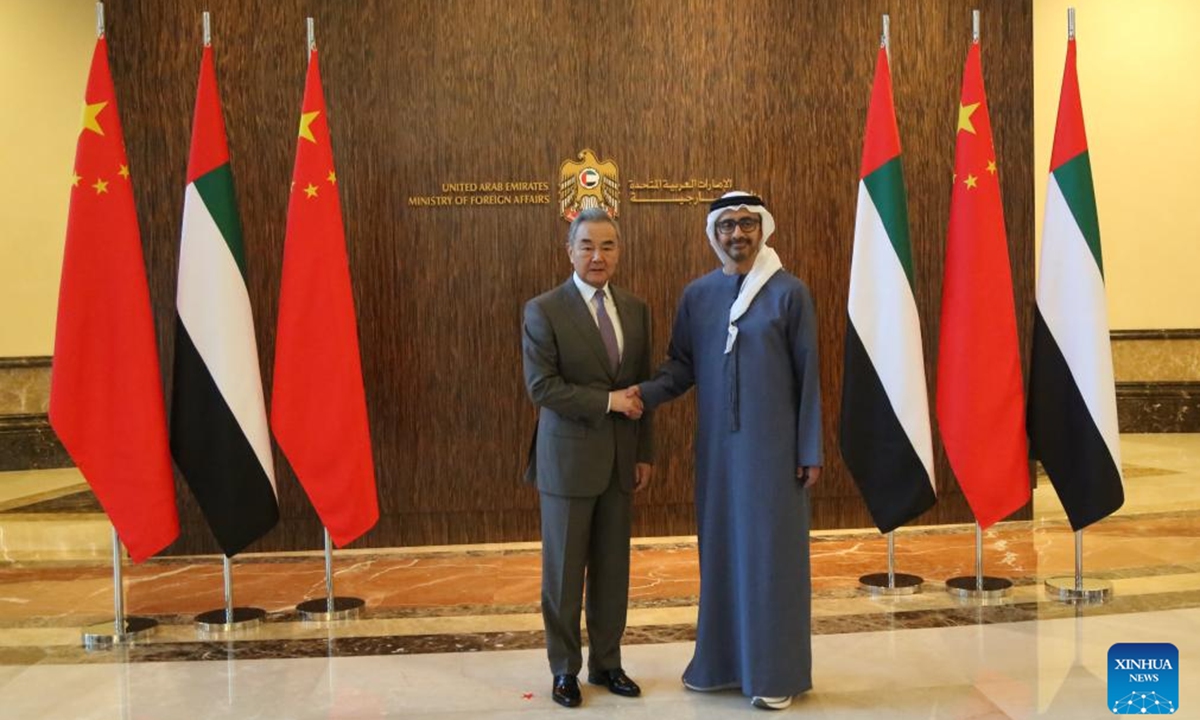
Chinese Foreign Minister Wang Yi, also a member of the Political Bureau of the Communist Party of China Central Committee, holds talks with Deputy Prime Minister and Minister of Foreign Affairs of the United Arab Emirates (UAE) Sheikh Abdullah bin Zayed Al Nahyan, in Abu Dhabi, the UAE, Dec. 12, 2025. (Xinhua/Wen Xinnian)
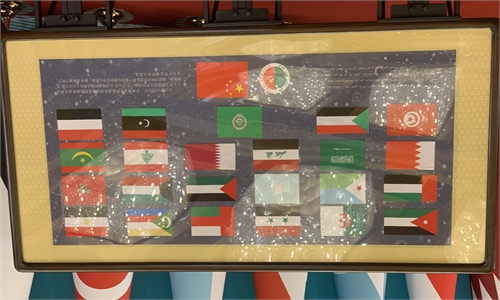
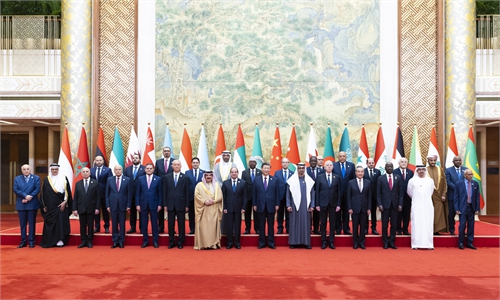
As the second China-Arab States Summit is scheduled to be held in China next year, Chinese Foreign Minister Wang Yi, who is on a three-nation trip to the Middle East, expressed the hope that the summit will yield positive outcomes and elevate China-Arab states relations to a new level, and that China is ready to promote the early completion of talks on a China-Gulf Cooperation Council (GCC) free trade agreement, Wang noted during a meeting with his United Arab Emirates counterpart, the Xinhua News Agency reported on Saturday.
Wang, also a member of the Political Bureau of the Communist Party of China Central Committee, paid a visit to the United Arab Emirates (UAE) from Friday to Saturday, according to Xinhua. Afterwards, he is scheduled to travel to Saudi Arabia and Jordan, a Chinese Foreign Ministry spokesperson announced.
During a meeting with Deputy Prime Minister and Minister of Foreign Affairs of the UAE Sheikh Abdullah bin Zayed Al Nahyan, Wang said in the more than four decades since the establishment of diplomatic ties, China and the UAE have respected and supported each other, and bilateral ties have withstood the test of the changing international landscape and maintained a sound and steady development.
The Chinese side voiced its firm support for the UAE in safeguarding national sovereignty, independence and territorial integrity, while the UAE stressed its firm adherence to the one-China principle, noting that Taiwan is an inalienable part of China's territory, read a joint statement issued after the meeting.
Per the statement, the two sides agreed to strengthen cooperation in a wide range of fields, including economy and trade, oil and gas, renewable energy, military, and counter-terrorism and de-radicalization, so as to constantly enrich the China-UAE comprehensive strategic partnership.
They have also pledged to strengthen communication and coordination on multilateral platforms such as the UN, BRICS and the Shanghai Cooperation Organization, and to jointly work for a more prosperous and progressive world, per Xinhua.
Zhu Yongbiao, executive director of the Research Center for the Belt and Road at Lanzhou University, told the Global Times on Sunday that the three countries are highly significant in the Arab world.
The UAE is significant due to its unique geographic position and foreign policy while Saudi Arabia has the strongest overall strength among Arab countries. Jordan is closely linked to the Palestinian issue, as it hosts a large number of Palestinian refugees and therefore plays a special role. Zhu added that the selection of the three destinations reflects a comprehensive consideration of regional political, security and diplomatic factors, and is also based on the solid foundation of China's existing cooperation with the region particularly in economic and industrial fields.
Niu Xinchun, executive director of the China-Arab Research Institute of Ningxia University, told the Global Times on Sunday that the Chinese Foreign Minister's visit carries three key implications. First, the Middle East is now at a critical turning point, with major hotspots in a temporary bottleneck period but no fundamental resolution, making coordination between China and Arab countries particularly important. Second, the visit may also serve as preparation for the second China-Arab Summit to be held next year, including prior consultations on participation and agenda setting. In addition, Niu noted that with China-Arab relations having developed well in economic, trade and political fields in recent years, the visit provides an opportunity for further communication and coordination on bilateral ties.
Zhu added that talks around the China-GCC free trade agreement (FTA) is one of the highlights of Wang's visit. "Although China-Arab cooperation has grown rapidly, there is still substantial room for improvement. An FTA would help expand bilateral trade, optimize trade structures and improve trade quality, reflecting the shared willingness of both sides to deepen cooperation."
He added that China and Arab countries also show strong, full-chain economic complementarity across sectors including energy, agriculture, industry and emerging fields. "Taking the energy sector as an example, some Arab countries have significant advantages in the oil and gas industry, as well as in solar energy. China, on the other hand, has established a relatively complete system in new energy products and technologies, laying a solid foundation for cooperation between the two sides," the expert noted.
The GCC is a political and economic union consisting of Bahrain, Kuwait, Oman, Qatar, Saudi Arabia and the UAE. It is headquartered in Saudi capital Riyadh.
Per a separate Xinhua report, trade between China and members of the Arab League reached 1.72 trillion yuan ($ 241.61billion) during the first seven months of 2025, setting a record for this period and rising 3.2 percent year-on-year, official data showed.
According to China's General Administration of Customs, bilateral trade has expanded steadily in recent years - with China remaining this bloc's largest trading partner for several consecutive years.
RELATED ARTICLES