Illustration: Liu Xidan/GT
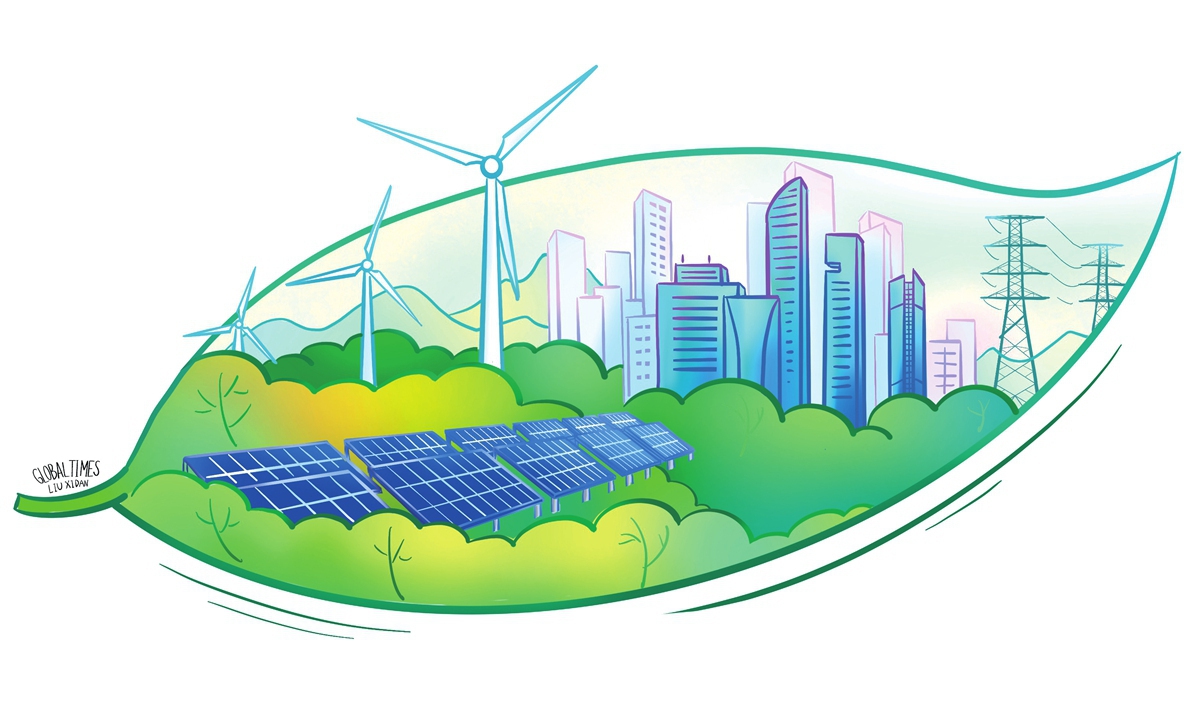
In 2025, China's renewable energy industry continued its steady, methodical expansion. A recent report by China National Radio noted that Northwest China's Gansu Province has seen total installed power generation capacity surpass 120 gigawatts, marking a year-on-year increase of 27.1 percent, with renewable energy accounting for 64 percent of the total.On the surface, this may seem like a localized achievement. In reality, it provides a revealing lens through which to examine the scale, momentum and orientation of China's monumental energy transition.
China's renewable energy development is drawing sustained international attention for a range of reasons, one of which is its increasing relevance to data centers and the artificial intelligence (AI) industry. Globally, the accelerated build-out of digital infrastructure - from cloud computing platforms to large-scale AI training facilities - is driving a structural rise in electricity demand, placing mounting pressure on existing power systems across both advanced and emerging economies.
In recent years, AI has shifted from a predominantly academic endeavor to a capital-intensive industry which is underpinned by substantial investment in physical infrastructure.
According to an April report by the International Energy Agency, global electricity demand from data centers is projected to double by 2030, reaching approximately 945 terawatt-hours - slightly exceeding Japan's yearly electricity consumption. The scale of this projected increase illustrates how the AI boom is rapidly transforming energy demand from a peripheral consideration into an increasingly influential factor in technological debate worldwide.
This highlights a shared challenge facing major economies worldwide: how to support the rapid development of AI while ensuring a reliable and sustainable energy supply. Historically, every major wave of technological and economic transformation - from electrification to digital revolution - has been accompanied by rising energy demand and recurring concerns over access.
AI industry is poised to follow a similar trajectory, potentially leading to an explosive growth in electricity consumption in the years ahead. Unlike previous periods of rising energy demand, the current surge presents a distinct opportunity: the rapid advancement of renewable green energy.
Breakthroughs in solar, wind, nuclear, and hydropower technologies are steadily increasing the share of clean and sustainable generation. This transition has the potential to shift energy availability from a zero-sum challenge to a more inclusive and widely accessible framework, allowing economies to accommodate growing demand without intensifying environmental pressures.
China provides an example of how the renewable energy sector can grow rapidly.
According to the Xinhua News Agency, China added 268 gigawatts of renewable power generation capacity in the first half of 2025, up 99.3 percent year-on-year, accounting for 91.5 percent of all new power installations. As of the end of June, total renewable capacity nationwide had reached 2,159 gigawatts, up 30.6 percent year-on-year and representing about 59.2 percent of China's installed power generation capacity.
In Gansu Province, renewable green energy generation has continued its rapid expansion this year, rising by 21 percent year-on-year and accounting for 38 percent of the province's total electricity output. This growth is equivalent to saving roughly 27 million tons of standard coal and cutting carbon dioxide emissions by 72 million tons.
Beyond these immediate environmental benefits, the figures provide clear evidence of renewable energy's accessibility, inclusiveness, and development potential, demonstrating that large-scale deployment of clean renewable energy is both practical and impactful.
Through mutually beneficial international cooperation, China's experience in renewable energy development can provide valuable insights for a broader range of economies in the world. Promoting free trade, open and fair competition, and cross-border investment is a critical step toward narrowing the so-called "electricity gap," accelerating global adoption of clean energy, and supporting the expansion of AI and other digital industries.
The growth of renewable green energy depends on inclusiveness and cooperation, while not erecting trade and investment barriers. Ensuring clean energy technology and infrastructure are widely accessible in the world will be essential for advancing global energy transition while fostering innovation and sustainable growth.
RELATED ARTICLES