Illustration: Tang Tengfei/GT
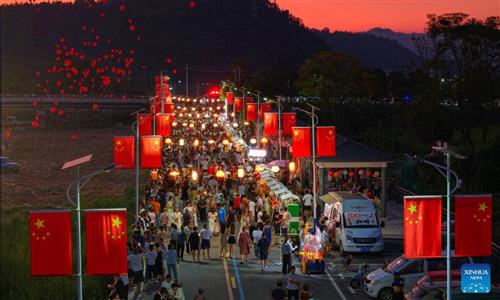
A report by the Workers' Daily on Sunday exposed an emerging shift in China's domestic consumption patterns: while many residents continue to flock to urban shopping centers, or seek warmer places during winter, an increasing number of the younger generations are opting for what has come to be known as "reverse tourism."Villages such as Caojiazhuang in Jiaozhou, East China's Shandong Province, have turned empty mud-brick houses into multi-functional community spaces, or new bookstores that offer cafés, reading areas, and cultural activities. Complementary businesses - including teahouses, restaurants, homestays, and bars - have emerged alongside these spaces, creating an integrated new tourism ecosystem. Their visitors include mainly young sightseers, university students, or urban white-collar workers who come for corporate team-building and educational tours.
This emerging trend reflects a broader structural change in tourism and domestic consumption, where deep cultural experiences and new lifestyle choices are becoming key drivers of market demand.
The rise of "reverse tourism," where young travelers choose quieter rural destinations over crowded urban centers or traditional resorts and hotspots, offers a revealing window into the tourism shift amid the consumption upgrading in China's economy.
Today, the traditional model in China's consumption sector of scale expansion seems to be giving way to value-driven consumption, where consumers prioritize experience, quality, and personal fulfillment over sheer quantity, driven largely by younger generations.
From a macro perspective, China's consumption landscape is in the course of undergoing a structural transformation. The quality, composition, and underlying logic of consumer demand are being reshaped. In 2024, Chinese household spending on all types of services rose 7.4 percent year-on-year, accounting for 63 percent of the growth in total consumer expenditure, according to the Xinhua News Agency.
"Reverse tourism" illustrates that the emotional and cultural factors attached to physical goods - time, space, and community -- become the currency of value. Nowadays, Chinese young consumers are increasingly looking for personalized and diversified outing experiences. They are willing to pay for emotional well-being, aesthetic value, cultural authenticity, and real-time experiences aligned with personal identity.
The rise of village leisure destinations exemplifies this new trend: restored culture-rich buildings, local cafés, and multi-purpose community spaces are increasingly expressions of identity and cultural engagement. Consumption is becoming a tool for lifestyle articulation rather than purely transactional activities.
According to a 2024 research report by McKinsey, Chinese consumers prioritize experiences and investments that bring personal and familial joy, such as travel, dining out, entertainment, and education. The change highlights an important redirection of consumer power: from standardized goods to services, experiences, and culturally resonant products.
For Chinese companies, this structural change could generate multi-layered opportunities. Businesses that are positioned to deliver experience-based services, cultural consumption, and integrated lifestyles - combining tourism, education, leisure, and community engagement - are likely to capture disproportionately high growth.
For example, the country's rural tourism market income reached 1.32 trillion yuan ($187 billion) in the first quarter of 2024, up 9.8 percent year-on-year, with experience-oriented tourism segments contributing a significant share.
International companies face a similar set of opportunities. Traditional competitive levers, such as brand recognition or price advantage, are losing influence to some extent. Business success in China now depends on distinct cultural content, and the ability to integrate products and services into meaningful consumption scenarios.
In this context, "premium" products and services signify authenticity, well-designed offering, and emotional resonance. Collaborative strategies - including partnerships with local operators and innovative content creators - are effective in embedding foreign offerings into the local consumption ecosystem.
To sum up, the new trends suggest that China's consumer market is reconfiguring around quality, emotion, and value creation. For domestic and international investors alike, understanding this structural transformation is essential. The next phase of China's consumption-driven growth will favor players who can create lasting cultural and experiential value, rather than simply scaling up production or competing on prices.
The author is a reporter with the Global Times. bizopinion@globaltimes.com.cn
RELATED ARTICLES