Shanghai-New York ‘river dialogue’ held in Shanghai to strengthen people-to-people ties
By in Shanghai Published: Dec 15, 2025 06:29 PM

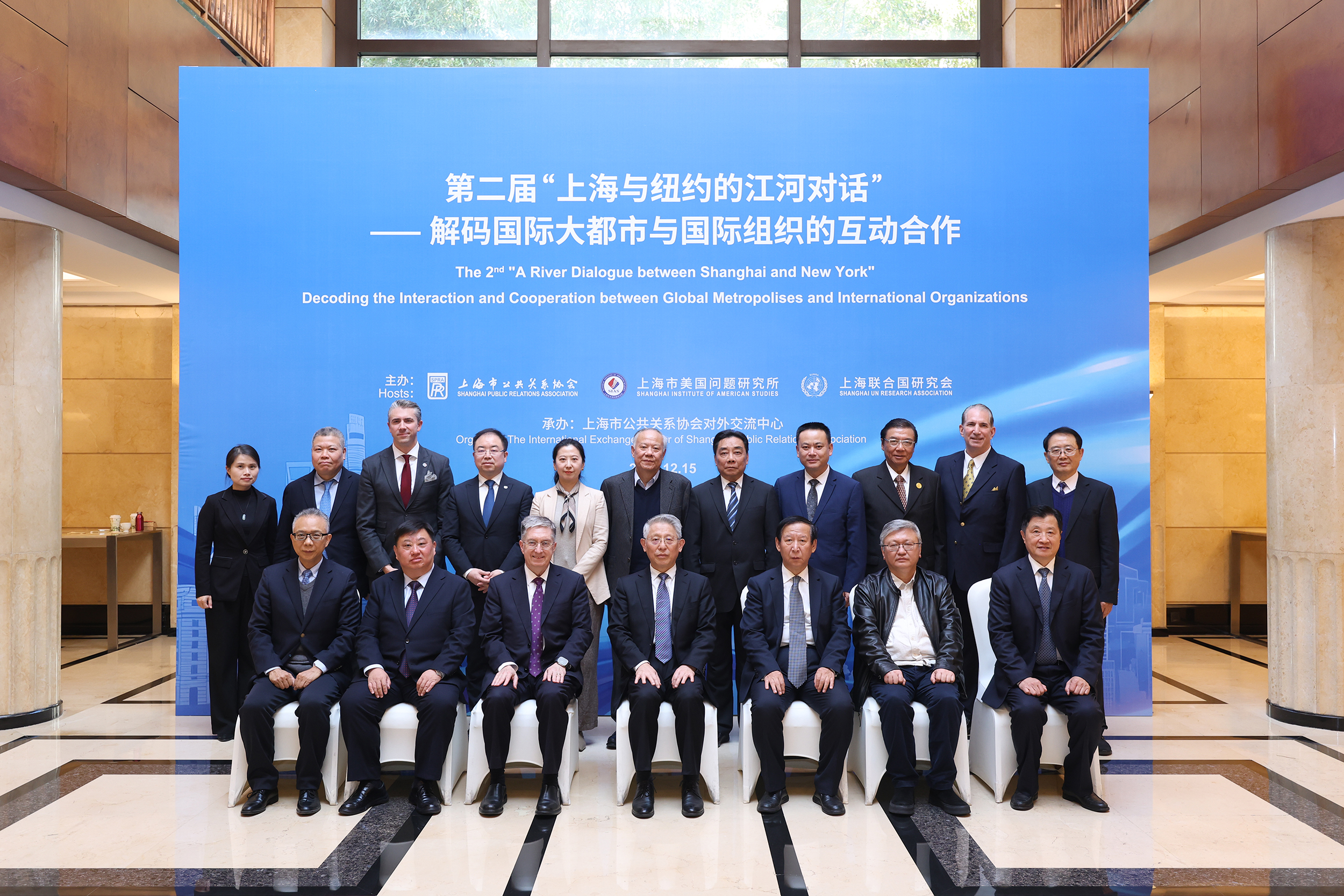
The second “A River Dialogue between Shanghai and New York” is held in Shanghai on December 15, 2025. Photo: Courtesy of Shanghai Public Relations Association
Rivers have long served as bonds that promote communication and contact. The second “A River Dialogue between Shanghai and New York,” a China-US forum which focuses on “decoding the interaction and cooperation between global metropolises and international organizations,” was held in Shanghai on Monday.
Inspired by the Huangpu and Hudson rivers - the “mother rivers” of Shanghai and New York, respectively - the dialogue, themed around the concept of the river, brought together representatives from multiple fields and international organizations to discuss ways to deepen people-to-people exchanges in areas such as trade and economics, education, and cultural engagement.
The event aimed to promote in-depth exploration of shared opportunities and challenges facing Chinese and American cities, said Sha Hailin, President of the Shanghai Public Relations Association.
“Rivers endure because of their deep sources and continuous flow,” Sha said in his opening remarks. “[We must] carry forward the friendship between the peoples of China and the US with the same enduring spirit of rivers... We believe that only with a solid foundation of people-to-people goodwill, can the great ship of China-US relations weather the winds and waves and sail steadily into the future.”
This year’s dialogue focused on “decoding the interaction and cooperation between global metropolises and international organizations.” Under that theme, Chinese and US experts and industry observers explored how to build mutually beneficial economic and trade ties, deepen friendship through cultural exchange, and create more livable waterfront cities through effective urban planning. Many speakers drew on case studies from Shanghai and New York across a range of fields, highlighting shared strengths and envisioning new avenues for future cooperation.
Among the participants was Jeffrey Lehman, Executive Vice Chancellor of New York University Shanghai and Chair of the AmCham Shanghai Board of Governors. In a speech he delivered at the forum, Lehman cited the World Health Organization’s “Decade of Healthy Aging 2021-2030” initiative, noting how cities like Shanghai and New York can collaborate to create age-friendly environments and foster healthy living for their aging populations.
Focusing on “river dialogue,” Lehman shared with the Global Times his insights into the similarities between Shanghai’s Huangpu River and New York’s Hudson River. “Both rivers are anchors for their respective cities, and are important points of connection. They also help to define a city,” he said during tea break. “There’s a wonderful parallelism for the two cities in terms of their relationship with water.”
Lehman added that Shanghai and New York share other advantages as well, such as serving as points of connection between their countries and the rest of the world. “[Therefore,] when we’re talking about international partnership and cooperation, it’s very natural for New York and Shanghai to be at the center of that conversation,” he said.
The Monday dialogue was held at the Jin Jiang Hotel, where the first China-US joint communiqué, the Shanghai Communique, was signed in 1972.
At this critical juncture in the development of China-US relations, promoting mutual understanding through civil exchanges and city diplomacy is crucial for the future trajectory of bilateral ties, noted a speaker of the forum Xu Bu, research fellow and former president of the China Institute of International Studies.
Xu cited some important areas in people-to-people exchanges between China and the US, such as education, youth exchanges, environmental protection, and cultural heritage protection. “The key is to make these exchanges substantive, so they truly resonate with the people and lay a solid foundation for long-term cooperation between the two countries,” he told the Global Times.
The dialogue was organized by the Shanghai Public Relations Association, the Shanghai Institute of American Studies, and the Shanghai UN Research Association.
RELATED ARTICLES