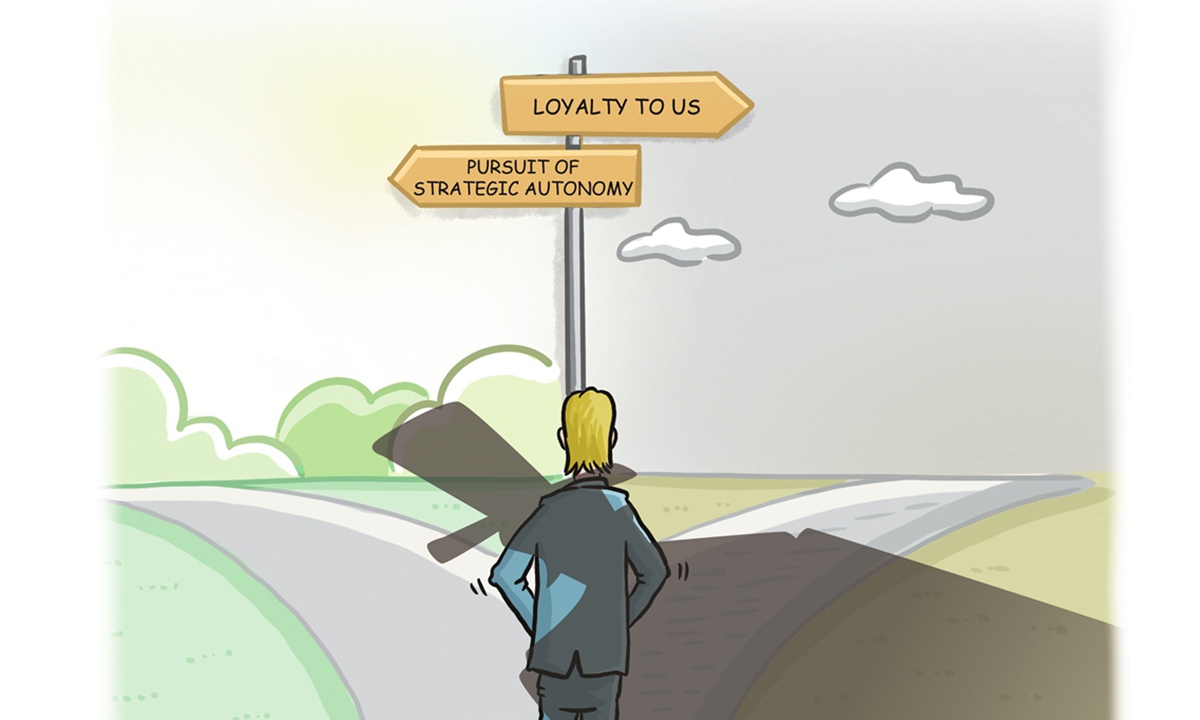
Illustration: Xia Qing/GT
US President Donald Trump's "harsh criticism" has sent shockwaves through Europe. On December 10, during an interview with American media, President Trump delivered scathing remarks targeting European nations and their leaders. He accused Europe of failing to control immigration issues and not taking decisive actions to end the Russia-Ukraine conflict, while asserting that Europe is "decaying." Earlier this year, US Vice President JD Vance asserted at the Munich Security Conference that Europe is retreating from some of its most fundamental values. Just this month, the US National Security Strategy report warned that Europe faces the risk of "civilizational decline."
Some observers suggest that the US is directing a barrage of criticism toward Europe, exposing unprecedented cracks in transatlantic relations. Europe's response indicates that sustained criticism from its traditional ally has cast a shadow over the continent. German Chancellor Friedrich Merz stated, from Europe's perspective, some content in the report is unacceptable, adding that Europe must prepare to manage on its own "democracy." In fact, while the US criticism is biased, it is not entirely without merit. Europe faces severe internal and external challenges, with both its hard power and influence on the international stage diminishing.
Economically, Europe is enduring a prolonged period of low growth. Politically, social fragmentation is intensifying across Europe, fueling political fragmentation. Regarding security, Europe's long-standing reliance on the US-led NATO, coupled with chronic deficiencies in defense development, has left its defense capabilities insufficient to meet its own needs.
What makes matters more complicated is that Europe currently faces a situation where economic, political and security factors are deeply intertwined. The most immediate challenge is the conflict in Ukraine, but whether it's supporting Ukraine or increasing defense spending, a most pressing issue is a shortage of funds. External geopolitical crises have prolonged economic stagnation, already straining government finances.
Excessive borrowing risks triggering deeper crises and could directly undermine domestic social and political stability. Europe finds itself in a predicament where pulling on one thread unravels the entire tapestry, leaving it tightly constrained at every turn.
Europe's challenges are revealing deeper structural problems.
First, the inherent institutional constraint of integration. While EU decisions require the unanimous agreement of all 27 member states, this very requirement frequently leads to delays and compromises on pressing on many pressing issues. It often creates problems, particularly in key areas like fiscal policy, industrial subsidies and AI regulation, where member states hold significant divergences. Second, the increasingly evident "democratic deficit." European citizens no longer buy into the "values wars" touted by mainstream politicians, yet they bear the brunt of the energy crisis, soaring inflation and declining living standards. The gap between ordinary people and political elites is widening, undermining not only trust in national governments but also collective identification with the EU. Third, a maladjustment to the external environment. Europe's responses often seem "a step behind," with adjustments made only when crises hit.
Europe is seeking a change. Pressured by fragile defense frailties, political fractures and stalling economy, it has embarked on profound self-examination and difficult strategic adjustments.
At the core of this adjustment is advancing strategic autonomy to better safeguard European sovereignty amid intensifying geopolitical competition and increasing autonomy in both internal and external action. This encompasses sovereignty in economy, security and defense, requiring a psychological shift away from increasingly unrealistic dependence on the US.
Crucially, Europe must carefully consider its relationship with China, balancing strategic autonomy with so-called economic de-risking to explore more rational, pragmatic, concrete and complementary cooperation based on mutual strengths. The key lies in preventing rigid thinking and translating strategic autonomy into concrete actions. Only then can it better safeguard its own interests and earn respect and recognition on the global stage.
The author is a professor at the School of International Relations, Beijing Foreign Studies University. opinion@globaltimes.com.cn
RELATED ARTICLES