The ‘30 million-plus’ has helped pave the way for China’s large passenger jet: Global Times editorial
Listen
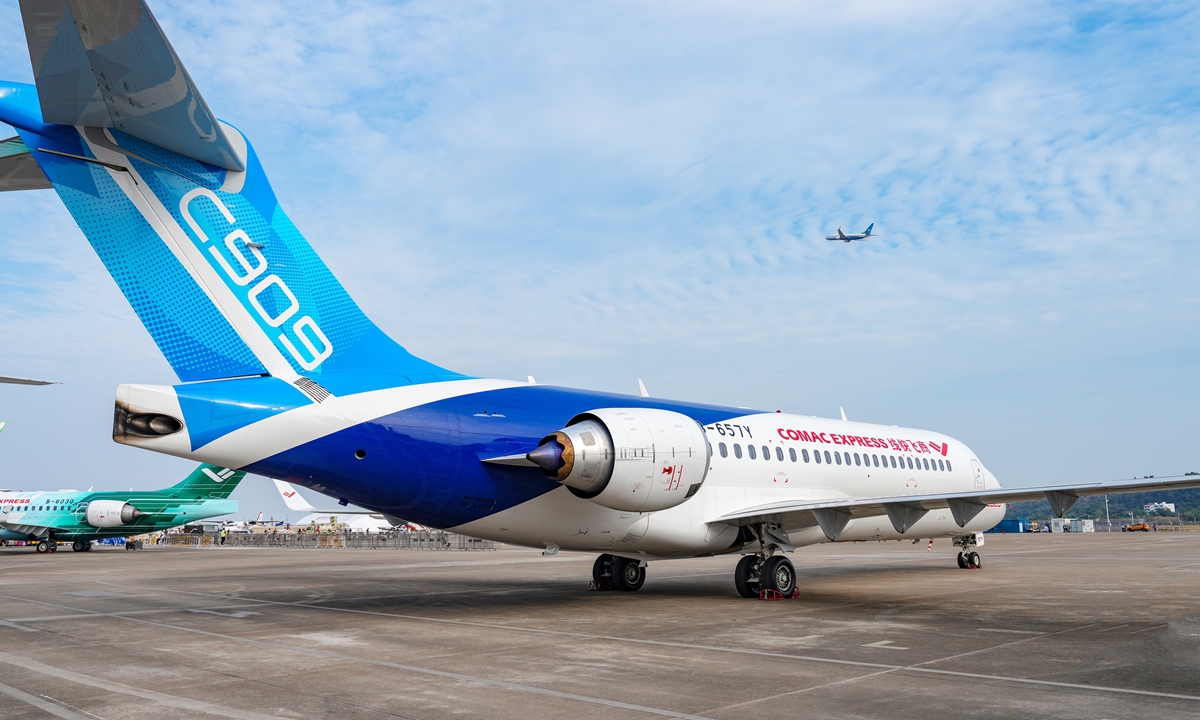
The displayed C909 aircraft at the ongoing the 15th China International Aerospace Expo in Zhuhai, South China's Guangdong Province on November 12, 2024 Photo: Courtesy of COMAC
The Chinese-developed regional jetliner, the C909, has so far safely transported more than 30 million passengers, marking a major milestone for the country's civil aircraft industry. In aviation history, there is an unwritten benchmark: Only after delivering 100 aircraft and transporting 10 million passengers can a plane be said to have completed the transformation from an "industrial product" into a true commodity. To date, 175 C909 aircraft have been delivered, accounting for more than 60 percent of China's domestic regional aviation market, with operations extending to 12 countries. As a trailblazer in China's commercial aircraft sector, the C909 not only achieved the breakthrough of moving domestic passenger aircraft commercial operations from "0 to 1," but also paved the way for the development of larger homegrown aircraft such as the C919.
A good aircraft is not only built on the production line but also proven in the skies. Over nine years of commercial operation, the C909 has undergone comprehensive market testing. In China, the C909 serves nationwide trunk-to-regional route networks and has become a mainstay on frontier and remote routes. Overseas, the aircraft has been delivered to Indonesia, Laos and Vietnam, and has obtained airworthiness certification from the Brunei civil aviation authority. In civil aviation, where safety is regarded as a lifeline, "safely transporting 30 million passengers" is by no means a superficial marketing slogan, but a hard-earned answer that China's civil aircraft industry has delivered to the market.
At the end of last year, the ARJ21 was officially renamed the C909, joining the C919 and C929 to form the "C-series" family. This was far more than a simple change of name - it marked a watershed moment as China's civil aircraft program shifted from model development to brand building. Today, China's domestically developed large aircraft, the C919, has been in commercial operation for more than two years, while the C929 has set a target of achieving its commercial maiden flight before 2035. Over the years, the C909's steady progress in gaining market acceptance and building trust has helped accumulate valuable credibility in advance, paving the way for the C919 and C929 to expand into both domestic and international markets.
As a domestically developed regional jet, the lessons C909 has learned, including hard-earned experiences and setbacks, are invaluable to the development of China's large aircraft industry. The C909, through exploration and experiment, has charted a comprehensive life-cycle development path for China's civil aircraft industry, from research and development and manufacturing to airworthiness certification and commercial operations. In doing so, it has systematically addressed a range of fundamental challenges faced in the early stages of industrialization.
At the same time, a professional talent pool covering design and R&D, manufacturing, flight testing and certification, and customer support has grown through hands-on practice. The smooth advancement of the C919 and other future aircraft programs will benefit greatly from the technological accumulation, system building, and talent development achieved during the C909 phase.
Civil aviation is the "crown jewel" of modern industry. For China's economy and technological development, it has a pronounced multiplier effect, driving breakthroughs across dozens of key fields such as materials, electronics, manufacturing, and computing, while promoting industrial upgrading and job creation. For the world, China's C909 and C919 are not only alternatives to Boeing and Airbus, but also represent a Chinese approach to breaking Western technological and industrial monopolies and enhancing the stability of global supply chains. The warm reception of the C919 at last month's Dubai Airshow clearly demonstrates that breakthroughs in China's large aircraft industry are not only a confident statement from China's high-end manufacturing sector, but also a beacon of hope for greater diversity in the global aviation market.
The C909's verified path of from "0 to 1" inspires China's technological independence, and its significance goes beyond just a single aircraft. Looking ahead, China's advantages - such as possessing the fastest-growing and most promising single aviation market in the world - remain unchanged.
The strength of having a complete industrial system is also intact. The large aircraft industry, as a national strategic priority, will continue to receive long-term, stable, top-level resource support and policy guarantees. In fact, accelerating the development of strategic and emerging industry clusters such as aerospace has been prominently included in the "15th Five-Year Plan" proposal. China's large aircraft development has never lacked confidence.
However, at milestone moments like this, we must clearly recognize that in the face of over half a century, or even a century, of accumulation by Airbus and Boeing, the C909's achievements are merely a "ticket to entry," not a "merit list." The delivery of 175 aircraft is still just a drop in the bucket compared to the global fleet of tens of thousands of commercial passenger aircraft; our "home-field advantage" in the domestic market cannot obscure the challenges we face in the international market.
Currently, our global service network has yet to be fully established, and we have not yet obtained airworthiness certifications from the Europe and the US. The localization of core components is still in a challenging phase of development. This is a "long-term battle" that requires sustained investment, and we should maintain a sufficient respect for the objective laws of industrial development and the harsh realities of international competition. The C909 has already overcome many challenges, but the journey of China's large aircraft has just begun. The development of China's civil aviation is never a solitary endeavor; the C909 is a successful product of international cooperation. Independent research and development do not mean manufacturing every single screw, but rather mastering overall design and integration capabilities. Cooperation, openness, and win-win outcomes will always be the key forces driving China's aviation industry to the world. We believe that one day in the future, Chinese-made passenger aircraft will soar confidently along routes to every corner of the globe.
RELATED ARTICLES