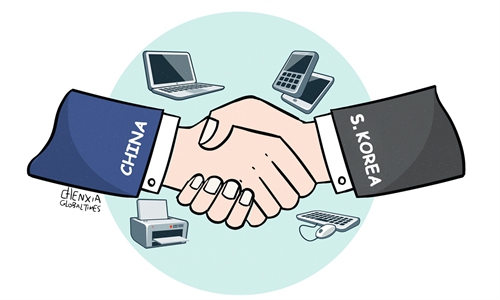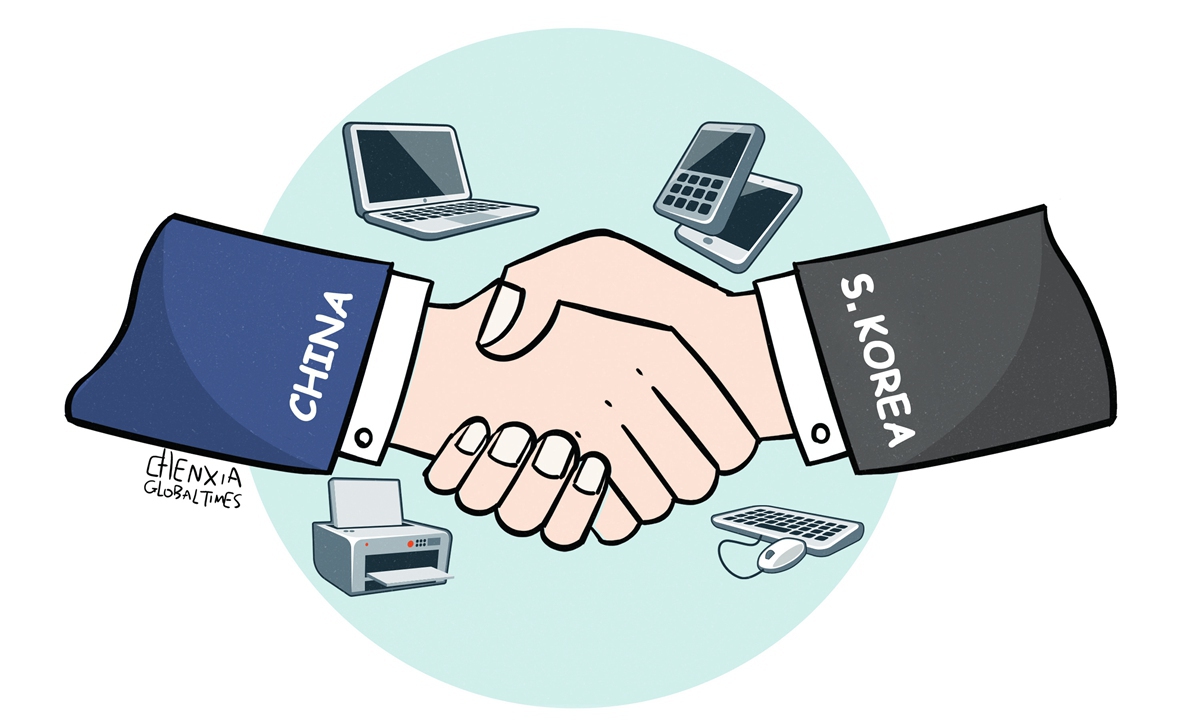
Illustration: Chen Xia/GT
A report released by the Korea International Trade Association's Institute for International Trade on Monday suggested that the diversification of China's export markets represents a structural change, and it urged South Korean companies to adopt a long-term perspective by developing high value-added products for markets where China is also expanding, while diversifying their own export offerings to build competitive advantages, the Yonhap News Agency reported.Amid global supply chain restructuring and the impact of US tariffs, the pursuit of export diversification has become a common strategy among nations. In this context, China's export growth should not be viewed merely as a source of competitive pressure. Rather, it embodies significant potential for deeper industrial chain collaboration between China and South Korea.
As Chinese manufacturing moves up the value chain, competition between the two countries in certain sectors has intensified. But this competition is by no means the whole picture of bilateral industrial relations.
The core logic behind export diversification is not a zero-sum contest for existing market share, but the exploration of new demand and incremental growth. The industrial structural complementarity between China and South Korea precisely provides a solid foundation for this kind of cooperative expansion. South Korea's technological prowess in high-value-added fields and China's strong capability in forging market channels across emerging economies together form a natural and powerful synergy for collaboration.
China's diversified economic outreach has established increasingly close trade and investment networks in regions such as ASEAN, Africa, and the EU. Industrial parks, transportation infrastructure and energy projects developed by Chinese enterprises in these regions have sparked sustained demand for high-end components, fine chemicals and precision equipment, areas where South Korean companies excel.
For instance, as Chinese companies expand their footprint in electric vehicle batteries and vehicle manufacturing in Southeast Asia, they rely heavily on key supporting elements such as high-performance chips and specialty materials, areas where South Korean companies excel. The synergistic integration of these complementary strengths in third-party markets helps build more resilient regional industrial chains.
Realizing this potential requires overcoming entrenched mindsets. South Korea would benefit from looking beyond perceiving China's industrial upgrading solely as a threat and avoiding an excessive focus on areas of competition, while recognizing the substantial opportunities for cooperation and the market expansion it brings.
The complexity of modern supply chains makes it nearly impossible for any single economy to dominate all high-value segments. Differentiated strengths are precisely what enable meaningful partnerships. China, for its part, needs to foster more open institutional arrangements to actively incorporate international partners, including South Korean firms, into its global network-building efforts, ensuring intellectual property protection and cooperation sustainability to strengthen long-term confidence.
Both sides can deepen intermediate product cooperation by integrating South Korea's high-value-added components into China's export system to emerging markets. They can also jointly participate in major third-party projects and conduct joint research and development of products suitable for emerging markets in fields such as new energy and smart manufacturing.
China and South Korea are closely intertwined economies within East Asia, with bilateral trade exceeding $328 billion in 2024. This deep interdependence means that the two share common interests in maintaining stable and resilient regional supply chains. Amid a weak global recovery and rising protectionism, building a cooperative industrial system based on comparative advantages is a rational path toward shared prosperity.
As South Korea continues to support exports, seizing the opportunity presented by China's industrial chain transformation and embedding its technological strengths within China's expanding market reach can effectively transform concerns about "competition" into new avenues for growth and cooperation.
RELATED ARTICLES