China’s domestic chip drive remains on track despite mixed signals over Nvidia H200: experts
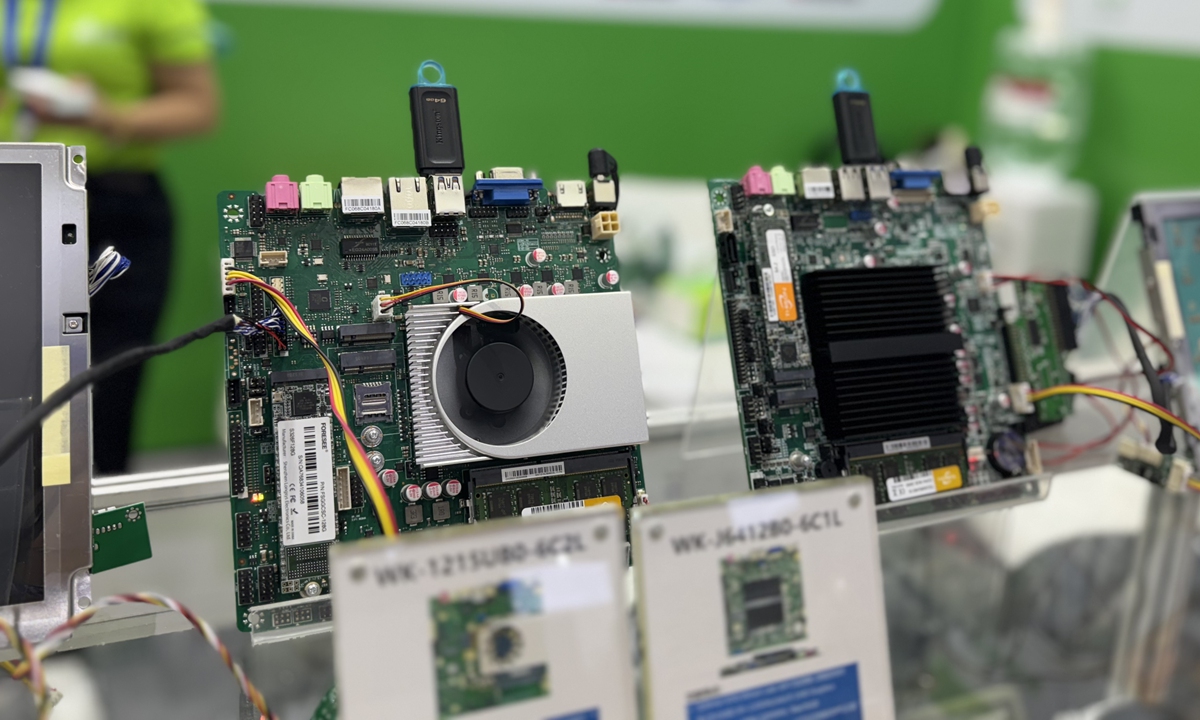
Shenzhen-based N&S Electronic shows their chips at the 14th Beijing International Robot Exhibition in Beijing on May 21, 2025. Photo: Liu Caiyu/GT
China's push to advance its domestic semiconductor industry will remain unchanged regardless of whether Nvidia's H200 artificial intelligence (AI) chip ultimately enters the Chinese market, analysts said, noting that recent mixed signals from US media over the chip's fate in China reveals a potential shift that strategic initiative is undergoing a structural transfer in advance chip sector and computing power.
Since media reports emerged that US President Donald Trump had approved exports of Nvidia's second-most advanced AI chip, the H200, to China, information surrounding Nvidia's China business has become increasingly complex and contradictory.
Reuters reported on Friday that Nvidia is considering increasing H200 output due to what sources described as "robust China demand." The sources said Chinese companies, including Alibaba and ByteDance, had placed large orders, and Nvidia had told Chinese clients it was evaluating adding production capacity for the H200.
On the other hand, White House AI czar David Sacks cited media reports saying that China had seen through the US strategy behind allowing H200 sales and was rejecting the chip in favor of domestically developed semiconductors, Bloomberg reported on Sunday local time.
As of press time, China's Ministry of Commerce and the Ministry of Industry and Information Technology had not responded to Global Times requests for comment. Nvidia had also not replied to inquiries regarding the potential sales of the H200 in China.
Asked whether China would allow purchases of the H200, Chinese Foreign Ministry (FM) spokesperson Guo Jiakun said on Tuesday that China had "noted relevant reports" and that China has consistently advocated mutual benefit and win-win cooperation between China and the US.
Security concerns and domestic advances
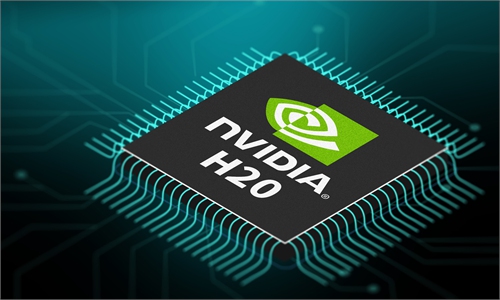
Although one generation behind Nvidia's latest Blackwell chip, the H200 is still regarded as one of the most powerful AI chips currently in mass deployment. It is estimated to deliver roughly six times the performance of the H20, a downgraded model Nvidia tailored for the Chinese market and released in late 2023.
"The H200 still offers advantages in large-model training and inference and can help improve computing efficiency, making it practically valuable for AI application development," Liu Gang, chief economist at the Chinese Institute of New Generation Artificial Intelligence Development Strategies, told the Global Times. "But these strengths coexist with unresolved security questions and their potential impact on China's domestic chip ecosystem."
China's cyberspace regulator in late July summoned Nvidia over security risks linked to vulnerabilities and potential backdoors in its H20 AI chips sold in China, requiring the company to provide explanations and supporting materials in accordance with China's laws on network security, data security and personal information protection.
In August, Reuters, citing sources, reported that US authorities had secretly placed location-tracking devices in shipments of advanced chips deemed at high risk of illegal diversion to China. The report followed news that a US senator introduced a bill in May to require location-verification mechanisms for export-controlled AI chips, raising concerns over the security of US chips.
Adding to the uncertainty, Reuters reported last week that Nvidia has developed location-verification technology capable of identifying the country in which its chips are operating — a move intended to prevent AI chips from being diverted to restricted destinations.
When asked to comment on the report and whether China would have any security concerns about taking Nvidia chips, FM spokesperson Guo Jiakun said last Wednesday that he was not familiar with the specifics mentioned.
"A systematic assessment is needed to determine whether the chips contain potential vulnerabilities such as backdoors," Liu said. "If Nvidia chips were to be widely deployed in China, the associated risks could be amplified, making proactive risk management and security safeguards necessary."
Ma Jihua, a veteran telecom industry analyst, warned that long-standing policy uncertainty and repeated reversals by the US government mean American chip supplies still carry significant risks for Chinese firms, making cautious procurement inevitable.
In reality, it is the US that imposed years of sweeping restrictions, pushing China's chip industry to accelerate self-reliance across design, manufacturing, process capability and capacity — developments that are reshaping global competition and challenging US firms, including Nvidia, Ma added.
China's domestic innovation continues to show tangible progress. Recent market movements, including a surge in shares of domestic GPU developer Moore Threads, have underscored growing confidence in homegrown GPU and AI chip alternatives. Huawei's latest Mate 80 smartphones are powered by the Kirin 9030 chip, which was manufactured by China's top foundry SMIC, according to TechInsights.
China's domestic AI chips led by Huawei's Ascend are rapidly closing the gap with global leaders, while firms such as Moore Threads are pursuing differentiated strategies in efficiency and system integration, said Tian Feng, president of the Fast Think Institute and former dean of Chinese AI software giant SenseTime's Intelligence Industry Research Institute.
Nvidia has been seeking to regain access to the Chinese market, which remains critical to its global growth prospects. Analysts said the conflicting messages from the US side highlight deepening unease over China's technological trajectory. But whether Nvidia's H200 enters the Chinese market or not, China's commitment to indigenous innovation, supply-chain security and steady industrial upgrading will continue on its established course, they added.
RELATED ARTICLES