Chinese carmakers accelerate L3 autonomous driving rollout after official approval
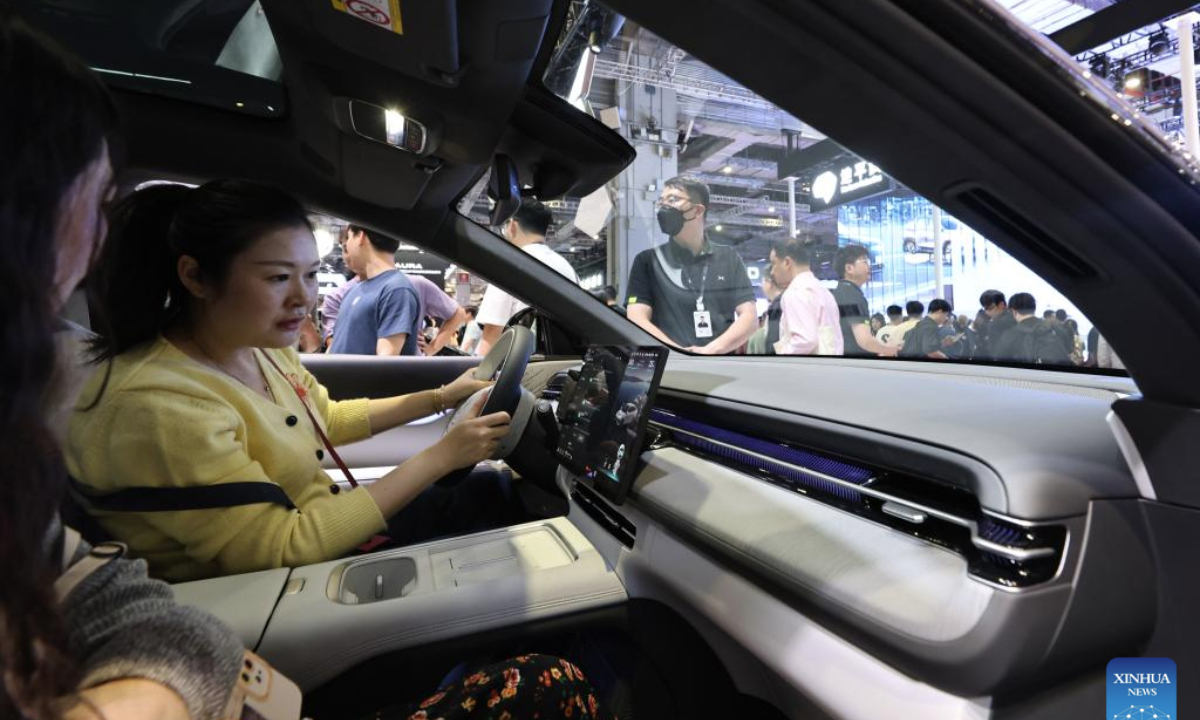
Visitors sit in an Xpeng G6 on display at the 21st Shanghai International Automobile Industry Exhibition in east China's Shanghai, April 26, 2025. (Xinhua/Fang Zhe)
Chinese electric carmaker XPeng Motors has obtained a Level-3 (L3) autonomous driving road test license in Guangzhou, South China's Guangdong Province, and launched normalized L3 road testing, the company told the Global Times on Tuesday.
This came after the Ministry of Industry and Information Technology (MIIT) on Monday granted road approval for two electric sedan models equipped with L3 autonomous driving capabilities.
The models were developed by automakers Changan Automobile and BAIC Motor's Arcfox, according to a statement released by the MIIT.
Wu Shuocheng, a veteran auto industry analyst, said that the move carries clear significance, marking the formal involvement of national-level authorities in regulating and guiding the development of L3 autonomous driving, and sending an important signal to the auto industry.
On Tuesday, A-share listed BAIC Bluepark New Energy Technology Co closed limit-up at 8.24 yuan ($1.17) per share, while Chongqing Changan Automobile Co shares closed at 12.06 yuan, up 4.42 percent, having reached 12.24 yuan during trading.
According to the MIIT, the Changan vehicle is capable of single-lane autonomous driving at speeds of up to 50 kilometers per hour during traffic congestion. It is approved to operate on select highway and urban expressway sections in Southwest China's Chongqing.
The Arcfox vehicle is permitted to operate autonomously at speeds of up to 80 kilometers per hour on designated highway and urban expressway sections in Beijing.
The two models approved by the MIIT are listed under the national management system, signifying a higher-level entry, Wu told the Global Times on Tuesday, noting that this move benefits the entire industry chain and has been reflected in the positive market reaction on Tuesday, signaling another step in the commercialization of China's L3 autonomous driving.
Autonomous driving is categorized in six levels from L0 to L5. The higher the level, the more advanced and intelligent the technology involved. L3, classified as "conditionally automated driving," allows vehicles to perform automated dynamic driving tasks while requiring a human driver to remain available to take control when requested.
Prior to the MIIT's approval, several Chinese automakers had announced that they possessed L3 autonomous driving technology and had obtained licenses to conduct L3 road testing.
On July 21, 2023, BYD obtained a conditionally automated driving (L3) testing license for expressways in Shenzhen, becoming the first automaker nationwide to receive such approval. On November 18 this year, GAC Group's premium brand Hyptec received an "L3 autonomous driving road test license for specific scenarios," which allows testing on designated autonomous-driving highways at speeds of up to 120 kilometers per hour, according to its official social media account.
XPeng told the Global Times on Tuesday that its L3 test license is mainly used for conditional autonomous driving tests on intelligent connected vehicle expressways in Guangzhou. While XPeng already holds an L3 testing license, its technological roadmap is targeting Level-4 autonomy. The company plans to launch mass-produced vehicles with both hardware and software reaching Level-4 autonomous driving capability by 2026, the company said.
Overall, this is widely regarded as a milestone for the industry, signifying the MIIT's assumption of national-level oversight of L3 autonomous driving demonstration operations, Zhang Xiang, secretary-general of the International Intelligent Vehicle Engineering Association, told the Global Times on Tuesday.
Previously, such L3 tests were mainly managed by local authorities, he said, adding that with national involvement, the approval process is expected to become more standardized.
RELATED ARTICLES