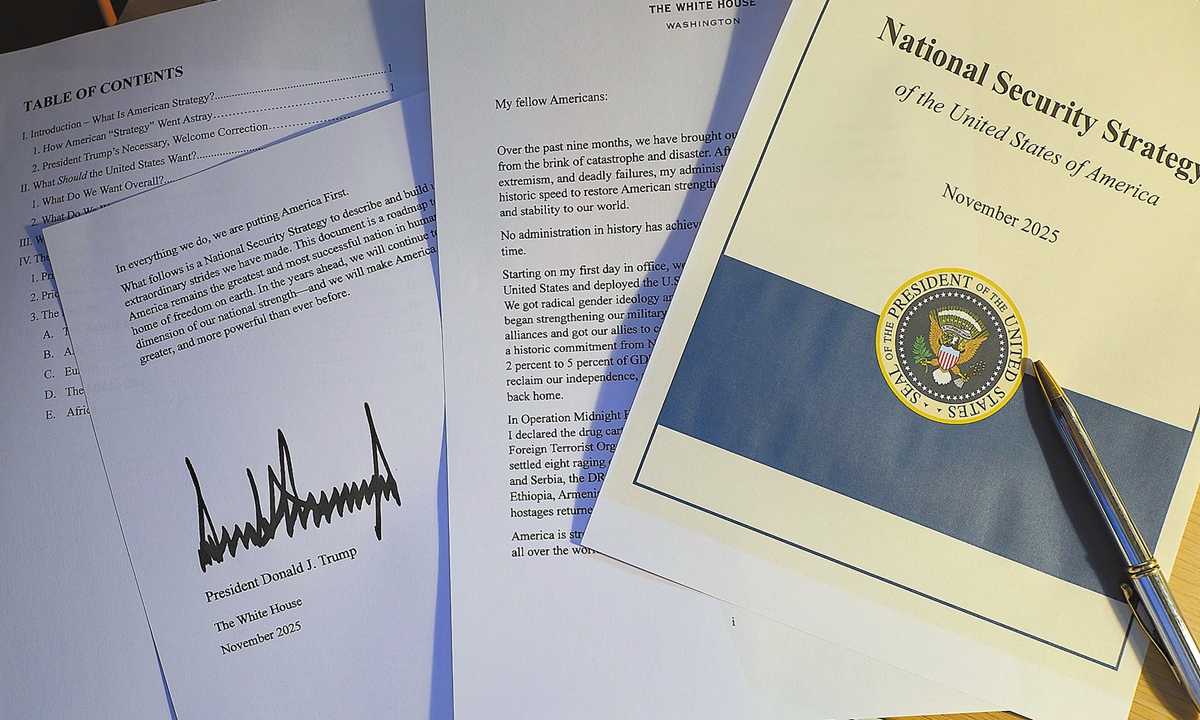
A view of the US administration's newly released National Security Strategy Photo: VCG
"America First" is the resounding central message of the Trump administration's newly released National Security Strategy (NSS), a 33-page document that reorients US global engagement around national interests, hemispheric dominance and deal-making.
While it is a longstanding US tradition for each administration to release its own NSS, the latest version stands in sharp contrast to those of its predecessors. As Foreign Policy observed, while past strategies typically featured minor variations on the broad post-World War II and post-Cold War foreign-policy consensus, the latest one represents a "dramatic rupture" from that consensus.
To what extent does it represent a rupture from established tradition, and does it signal a substantive readjustment of US foreign policy?
Cui Hongjian, a professor from the Beijing Foreign Studies University, told the Global Times that this is the US' "strategic repositioning" - an adjustment of force nodes in different directions.
"The Trump administration's logic is that the US faces major strategic competition issues, stemming not only from China's rising, but also from changes in the structure of interests and the differentiation of international forces. If the US continues to follow the previous strategy of 'shaping the global order,' not only would America's returns diminish, but it could even generate a large number of negative assets," Cui said.
"Therefore, the US currently needs to focus more on capability building and 'consolidating the foundation,' while creating time and space to address its domestic problems."
Monroe Doctrine revived?
The Global Times found the 2025 report on the White House website and the 2017 version on the website of the National Archives of the US government. The Global Times found that the 2017 report, spanning 68 pages, centered on "great-power competition" as its core theme. Its logic was based on deterrence through strength, viewing the world as a competitive arena dominated by the US. At that time, the strategy placed almost equal emphasis on the three major regions of the Indo-Pacific, Europe, and the Middle East, while retaining a certain weight for global counterterrorism, striving to maintain US global hegemony in all directions.
In contrast, the 2025 report, at just 33 pages, adopts a low-key and restrained tone, with its core being "America First." It criticizes the post-Cold War policy of global dominance for hollowing out American strength, rejects indiscriminate global interventions, and instead focuses on core interests. The strategy is guided by the principle of controllable costs.
Scott Anderson, a fellow in Governance Studies at the Brookings Institution, wrote in an article published on the Brookings website that the worldview underlying the new NSS appears to be quite a departure from what has guided US foreign policy for the past decade. "That may in turn portend more substantial changes down the road," he wrote.
A prominent feature of the new NSS is its manifestation of the nationalist characteristics, which asserts the US' renewed focus on the Western Hemisphere as its global strategic priority.
"We want to ensure that the Western Hemisphere remains reasonably stable and well-governed enough to prevent and discourage mass migration to the US; we want a Hemisphere whose governments cooperate with us against narco-terrorists, cartels, and other transnational criminal organizations… In other words, we will assert and enforce a 'Trump Corollary' to the Monroe Doctrine," read the NSS document.
Since the proclamation of the Monroe Doctrine, the US has consistently regarded North America and Latin America as the core of its national interests. As an enduring tradition in American foreign policy, the Monroe Doctrine has had varying geographical scope across different historical periods, shaped by evolving interpretations.
When first articulated in 1823, the doctrine aimed to oppose European colonialism in the Western Hemisphere, according to an introduction of the document on the website of the US National Archives. Under leaders such as Theodore Roosevelt, it evolved into a justification of US control over the Western Hemisphere. Later, during Woodrow Wilson's presidency, the regional leadership originally confined to the Western Hemisphere was gradually extended to the entire world, according to a report in the New York Times Magazine published in September, 1984.
Throughout this process, the scope of the Monroe Doctrine closely mirrored US outward expansion, reflecting the trajectory of its global strategy.
Cui pointed out that the so-called "Western Hemisphere first" policy centers on building a sphere of influence with the US at its core. Security in the Western Hemisphere is regarded as an extension of US homeland security itself.
"In terms of foreign policy, the Trump administration seeks to purge the previous American worldview centered on global leadership, its vision of international order, and the elitist ideology that underpinned them. This effort is essentially an outward spillover of Trump's domestic struggle against elites and the establishment," Cui said.
Reassessment of China ties?
The Global Times found that the 2017 US NSS explicitly designated China as a primary competitor. It first identifies China and Russia as the US' main competitors in the world, claiming the two countries "challenge American power, influence, and interests, attempting to erode American security and prosperity."
In comparison, the 2025 report tones down ideological confrontation, placing discussions of China within the Indo-Pacific regional chapter. The scope of competition focuses on the trade, economic, and technology domains, advocating for trade in non-sensitive areas while prioritizing safeguards against supply chain dependencies and technological rivalry.
The document claimed that since 1979, when China's economy reopened to the world, the initial relationship pattern between the two countries - "a relationship between a mature, wealthy economy and one of the world's poorest countries" - has now evolved into "one between near-peers." Building on this assessment, the document further claimed that the US will adjust its economic relationship with China, prioritizing reciprocity and fairness.
"It is worth noting, however, that the ultimate goal of the US adjusting economic ties with China is to 'maintain our status as the world's leading economy.' This indicates that the underlying tone of US strategic competition with China has not undergone a fundamental change," Li Haidong, a professor at the China Foreign Affairs University, told the Global Times.
In other words, against the backdrop of enduring economic interdependence between China and the US, the intensity of America's "cooperative competition" with China in the economic domain may intensify over time, he said.
Additionally, the document emphasizes the need to establish independent supply chains in critical resources related to national defense and security. This could foreshadow potential risks of "decoupling" or supply chain disruptions in the layout of global industrial chains and supply chains between China and the US. The US' insistence on maintaining absolute leadership in cutting-edge fields may further escalate the contest between China and the US in the technological domain, the expert noted.
In addition to the economy, China's Taiwan island is mentioned multiple times in the 2025 NSS.
In the 2017 NSS version, it mentioned Taiwan island only three times, with restrained language, emphasizing solely the provision of defensive weapons in accordance with the Taiwan Relations Act.
However, in the 2025 NSS, the confrontational stance on the Taiwan question escalates: Taiwan is mentioned eight times and linked to the security of the second island chain, claiming the importance of preserving military superiority to prevent conflict in the Taiwan Straits.
"How to resolve the Taiwan question is solely a matter of the Chinese people, which brooks no external interference," said Chinese Foreign Ministry spokesperson Guo Jiakun at a regular press briefing in response to a media query about the USS report.
Taiwan is an inalienable part of China's territory. The Taiwan question is at the core of China's core interests and the first red line that must not be crossed in China-US relations. "China will never flinch in defending its sovereignty and territorial integrity," Guo stressed.
Cui pointed out that the reason the US views China as a challenge is because it believes China's power is approaching its own. "Unless this state of approaching parity in strength is altered, the US will remain perpetually trapped in strategic competition anxiety."
In response to the US strategic repositioning, China also needs to take proactive measures, he said. "The US has clearly adopted a posture of prioritizing economic means for long-term competition, indicating that it lacks the capacity to engage in a comprehensive competitive rivalry against China. This also means that we will have more time to strengthen our economy and consolidate our foundations while protecting our borders," he said.
"The major economic reforms and opening-up measures proposed in the 15th Five-Year Plan recommendations are perfectly timed," Cui noted.
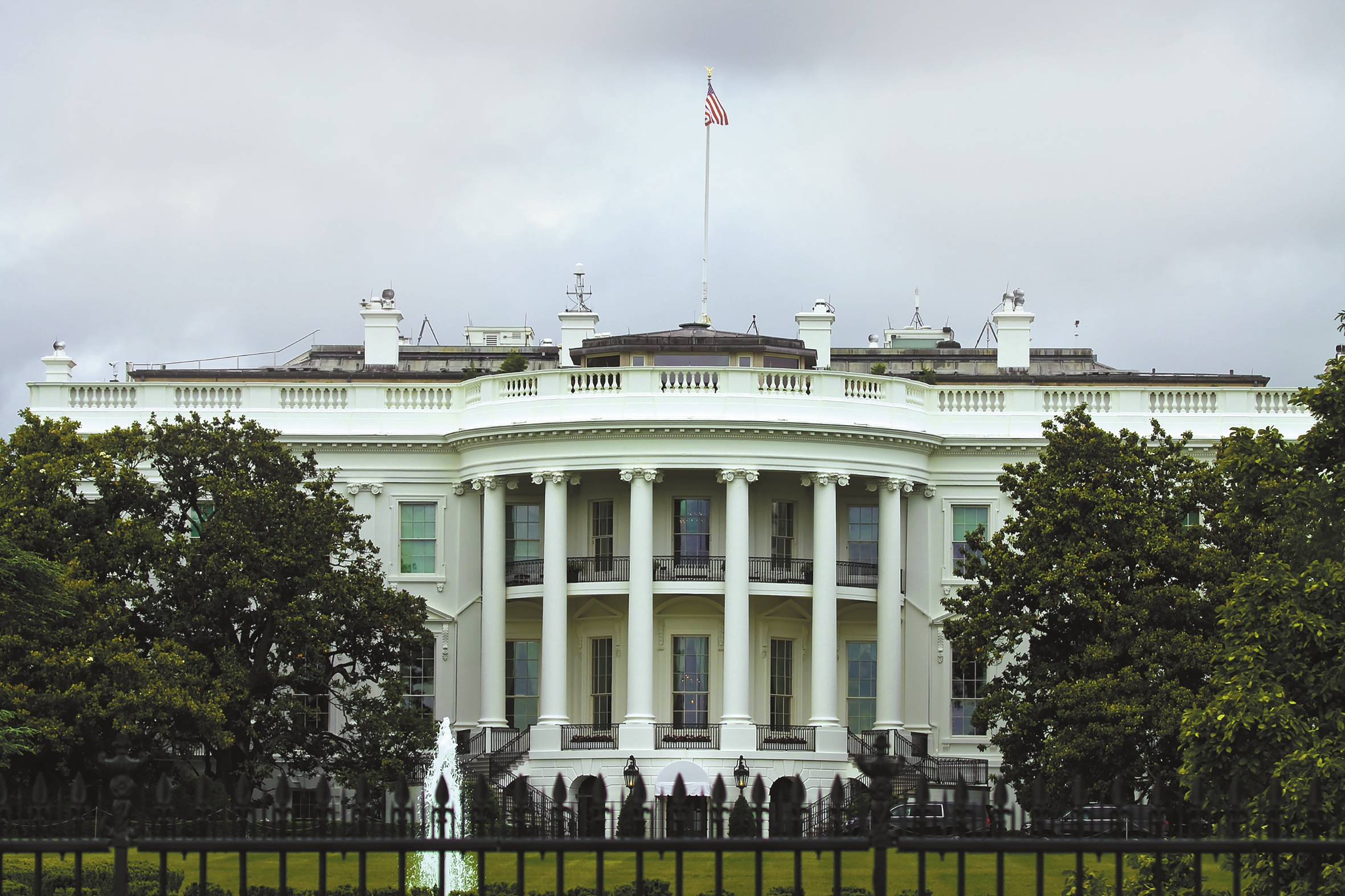
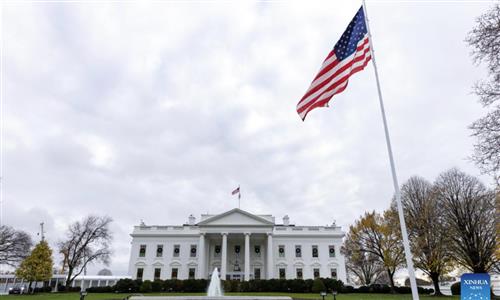
A view of the White House in Washington DC, the US Photo: VCG
Declining US-Europe relations?
The new NSS directly claims that Europe faces the "prospect of civilizational erasure." It criticizes Europe for being hindered by "regulatory suffocation," vulnerable to migration pressures, and politically fragmented.
The NSS blames transnational bodies such as the EU for undermining "political liberty and sovereignty," warning that migration is transforming the continent, among others.
"Should present trends continue, the continent will be unrecognizable in 20 years or less," read the document.
According to Cui, the Trump administration's domestic opposition to Biden manifests externally as opposition to Europe's mainstream - namely, the so-called elites and liberals. In Europe, he supports the far-right. He believes that many current problems - such as immigration and the economy - are difficult to resolve primarily because the ideas of political elites in the US and Europe have already "strayed from the right path," while the truly effective Western political values are held his hands and those of Europe's far-right political forces. "On a deeper level, through political criticism of Europe, he can further prove his own legitimacy and justification in domestic US politics."
Meanwhile, this NSS document, for the first time, does not list Russia as a direct threat. Cui noted that this indicates a major shift in the strategic direction of the US.
To achieve the goal of shedding burdens, the US needs to help Europe resolve the Russia-Ukraine conflict. Therefore, it must first stabilize relations with Russia on a broad level, preventing Europe from becoming a source of escalating US-Russia contradictions, Cui said.
According to the expert, if the early US-Europe alliance system was part of America's overall strength, the Trump administration now views it as depleting US strength - Europe has shifted from a "net asset" to a "negative asset" for the US. Therefore, a restructuring of the power architecture is needed, starting with reclassifying various regions according to interests and strategic priorities, ranked in the order of the Western Hemisphere, the Asia-Pacific, Europe, and the Middle East.