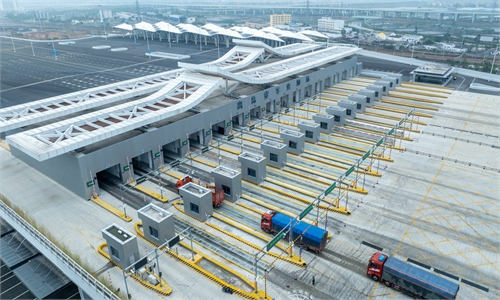
Hainan FTP to launch island-wide special customs operations, signaling China’s determination for high-level opening-up
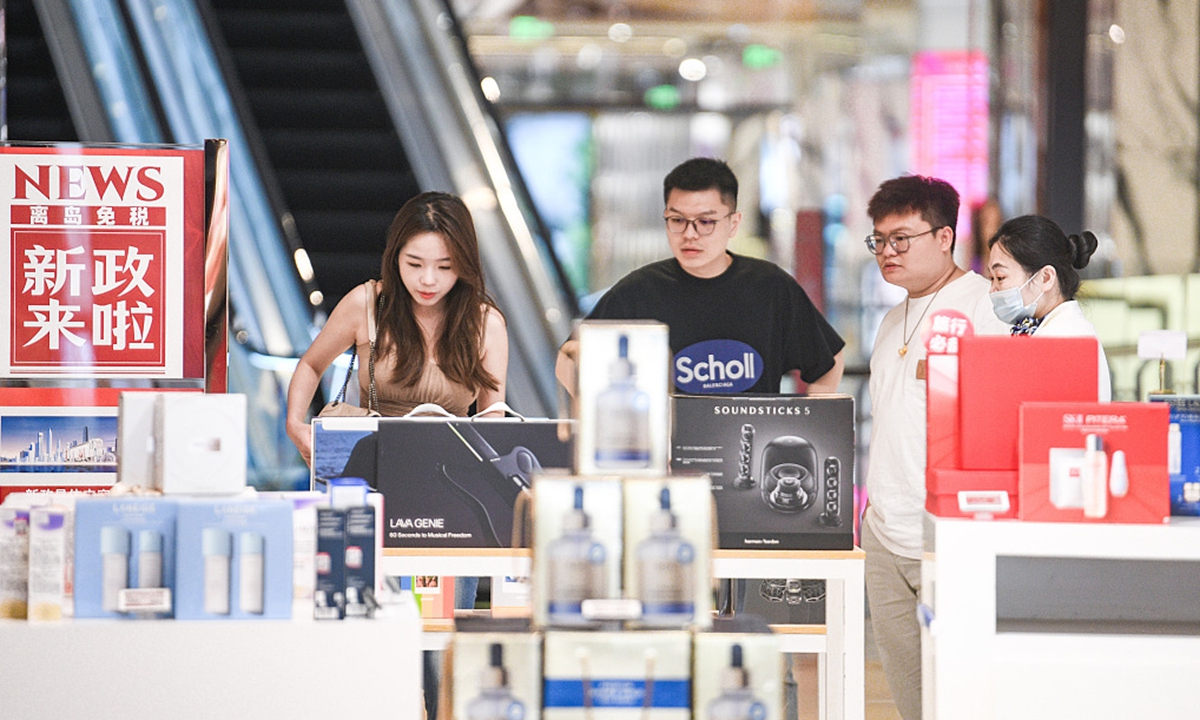
Consumers choose goods in a duty-free store in Haikou, South China's Hainan Province, on November 2, 2025. Photo: VCG
Hainan provincial government officially issued a notice on Tuesday announcing that the Hainan Free Trade Port (FTP) will commence island-wide special customs operations starting Thursday.
Chinese President Xi Jinping announced in April 2018 a decision to build the whole island of Hainan into a pilot free trade zone, according to the Xinhua News Agency.
Experts said that the landmark move set to be launched on Thursday marks a pivotal step in China's pursuit of high-level opening-up and its commitment to building an open global economy.
Experts also describe the start of special customs operations as a milestone - shifting Hainan from policy experimentation to institutional maturity, and positioning it as a new frontier for international trade and investment, which will offer rich opportunities to the world.
Mechanics of customs operations
According to the notice by the Hainan provincial government, a series of previously published documents regarding the operation of the FTP will be implemented from Thursday.
The FTP will establish a special supervision model described as "freer access at the first line, regulated access at the second line, and free flows within the island," the Office of the Hainan Free Trade Port Working Committee told the Global Times.
According to the office, the "first line" refers to Hainan's connection with overseas markets. "Freer access at the first line" allows overseas goods to enter the island more conveniently, with most benefiting from zero tariffs and expedited clearance.
The "second line" refers to the customs boundary between Hainan and the mainland, where goods will undergo standard customs oversight to ensure fairness and prevent smuggling.
A major upgrade is the expansion of zero-tariff coverage starting Thursday. The proportion of products eligible for zero tariffs will jump from 21 percent to 74 percent. For imported duty-free goods, a negative list management system will be implemented, with the number of zero-tariff taxable items increasing from over 1,900 to over 6,600, the office said, noting that this number will continue to expand.
Additionally, products processed in Hainan that achieve a 30 percent value-added threshold can be sold to the mainland duty-free - a powerful incentive for manufacturing and innovation, the office said.
Institutional opening
The importance of building Hainan into an FTP was highlighted several times by the central government.
During the Central Economic Work Conference in 2024, it was stressed that work should be done to expand voluntary and unilateral opening up in an orderly manner, steadily enhance institutional opening up, improve the quality and efficiency of pilot free trade zones and expand mandate for reform tasks, and accelerate the implementation of core policies of the Hainan FTP, according to Xinhua.
The just-concluded Central Economic Work Conference in 2025 underscored "the need to steadily advance institutional opening up, expand self-initiated opening up in the service sector in an orderly manner, and make solid progress in developing the Hainan FTP," Xinhua reported.
Experts pointed out that the full special customs operations at Hainan FTP represent more than economic liberalization, "it reflects a deeper transformation in China's opening-up strategy."
"As China advances comprehensive reforms toward Chinese modernization, our openness is evolving from factor-based and scale-driven models to one centered on rules, institutions, and environment," Chi Fulin, President of Hainan institute for free trade port studies, told the Global Times.
Hainan is a national laboratory for institutional innovation, tasked with pioneering reforms that could eventually be replicated nationwide, said Chi.
Chi noted that in today's world of rising geopolitical tensions and fragmented markets, Hainan's role as a hub for market linkage, rule alignment, and industrial synergy is more critical than ever. It can serve as a convergence point between domestic and foreign markets, a node in global industrial chains.
The Office of the Hainan Free Trade Port Working Committee stressed that after the island-wide special customs operations, the flow of people, goods, capital, and data in and out of the Hainan FTP will become significantly more convenient - accelerating the agglomeration of globally competitive resources and factors. This creates an open platform and development opportunities for all market entities investing, operating, or seeking cooperation in Hainan.
Experts noted that as Hainan enters this new era, its significance extends beyond economics. It symbolizes China's unwavering commitment to opening-up amid global uncertainty.
More importantly, Hainan stands as a model of institutional innovation driven by openness. From redefining customs frameworks to attracting global talent and capital, it shows how strategic reform can turn a tropical island into a nexus of global commerce, experts said.
Looking ahead, experts believe Hainan is poised to become a strategic gateway between China and international markets during the 15th Five-Year Plan period (2026-30). By establishing a two-way hub for opening-up - one for Chinese companies going global, and another for foreign firms entering China - Hainan will become a vital bridge connecting China and the world.
Real gains
For businesses, the benefits are already tangible.
Zhang Xinyu, Chairman of Datang (Danzhou) Marine Energy Development Co, called the island-wide special customs operations "an unprecedented opportunity" for offshore wind power.
"Zero-tariff policies cover critical areas like ship repair and equipment maintenance. Importing turbines and components into Hainan will become significantly less costly," Zhang Xinyu told the Global Times.
Currently, Datang has led the formation of an offshore wind power industry alliance in Hainan, partnering with equipment manufacturers to build offshore wind power industrial park in Hainan's Yangpu. "This has successfully drawn six upstream and downstream companies to invest, with a total commitment of around 6 billion yuan ($852 million)," said Zhang Xinyu.
Similarly, Zhang Zhendong, General Manager of a Hainan-based rubber processing enterprise, told the Global Times that on Thursday that his company will clear 42 tons of Vietnamese natural latex through Xinhai Port in Haikou. Thanks to the 30 percent value-added rule, they will save 37,800 yuan in tariffs. With an annual capacity exceeding 30,000 tons, these savings add up fast.
Foreign investors are equally enthusiastic. Xian Haiyan, Plant Manager at Hainan Zambon Pharmaceutical Co., Ltd, an Italian-owned enterprise, told the Global Times how preferential policies have already benefited their operations.
Two key products - acetylcysteine granules and arginine ibuprofen granules - have utilized tariff exemptions on three types of imported excipients totaling 35 tons, saving around 350,000 yuan in customs duties. Nearly 74-million-yuan worth of goods already sold in the Chinese mainland, with tariff exemption worth about 210,000 yuan, said Xian.
"Now, with island-wide special customs operations, the business environment will become even more predictable and attractive," said Xian.
RELATED ARTICLES