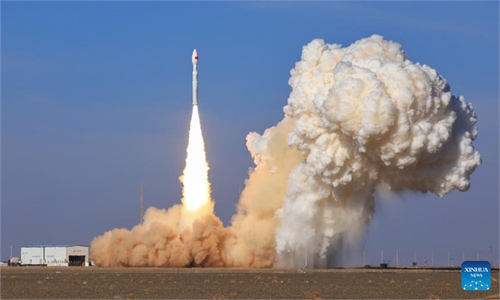
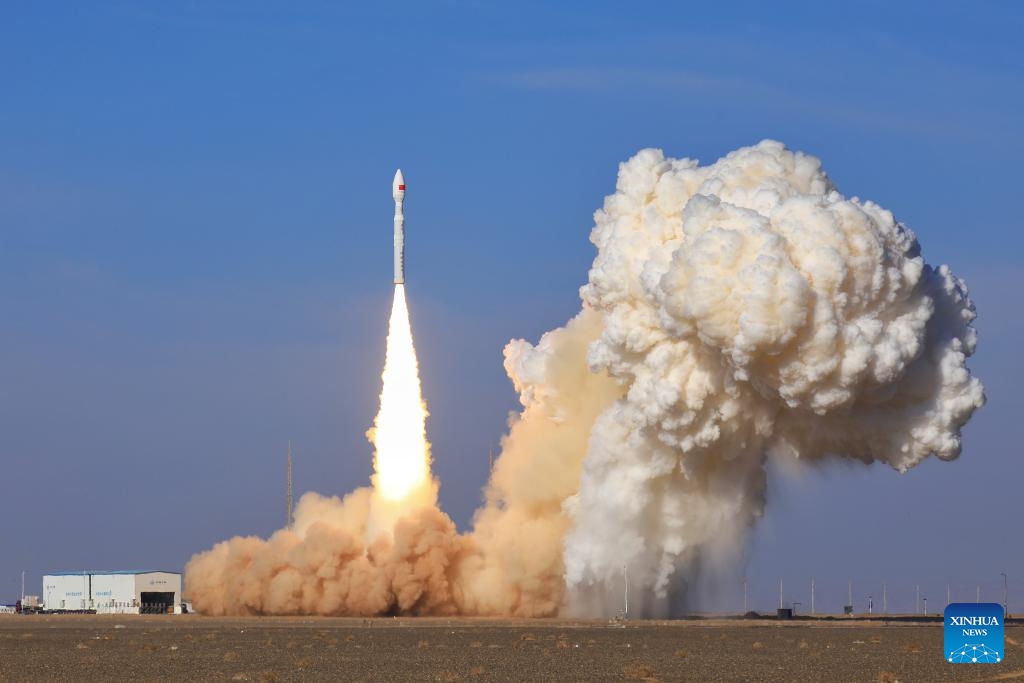
The Lijian-1, also known as Kinetica-1 Y11, carrier rocket carrying 9 satellites, including one from the United Arab Emirates, blasts off from the Dongfeng commercial space innovation pilot zone near the Jiuquan Satellite Launch Center in northwest China, Dec. 10, 2025. The rocket blasted off at 12:03 p.m. (Beijing Time) and successfully sent the satellites into their planned orbits. (Photo: Xinhua)
SpaceX recently claimed that one of the nine spacecraft that was launched atop China's Kinetica-1 rocket on December 9 zoomed dangerously close to one of its Starlink satellites, accusing the rocket operator for "lack of coordination." In response to the accusation, CAS Space said the incident, if confirmed, occurred nearly 48 hours after payload separation, by which time the launch mission had long concluded.
A Chinese expert on Tuesday told the Global Times that given Starlink's dense orbital deployment and frequent orbital maneuvers, for a responsible major aerospace player, it must first notify relevant parties or publish relevant information.
In a post on X, Michael Nicolls, vice president of Starlink engineering at SpaceX, claimed on December 13 that no coordination or deconfliction with existing satellites operating in space was performed, resulting in a 200-meter close approach between one of the deployed satellites from China and STARLINK-6079 (56120) at 560 km altitude.
China's Kinetica-1 carrier rocket, also known as the Lijian-1, was launched on December 9 with nine satellites onboard, including three international payloads for the United Arab Emirates (UAE), Egypt and Nepal.
Kinetica-1's developer CAS Space soon responded on December 13 to Nicoll's post, saying that all of their launches select their launch windows using the ground-based space awareness system to avoid collisions with known satellites/debris, which is a mandatory procedure. The company added that they will work on identifying the exact details and provide assistance as the LSP.
In another X post a few hours later, the company said, "If confirmed, this incident occurred nearly 48 hours after payload separation, by which time the launch mission had long concluded. CAS Space will coordinate with satellite operators to proceed."
The Chinese operator also called for re-establishing collaborations between the two New Space ecosystems, per the post.
The Global Times verified with CAS Space the authenticity of the aforesaid response on Monday.
In 2021, Starlink satellites launched by SpaceX approached China's Space Station twice in succession, posing a threat to the lives and health of the astronauts onboard. In response, China's Space Station conducted two preventive collision avoidance maneuvers, namely emergency evasive operations, according to the Xinhua News Agency.
Starlink is a high-speed space-based internet initiative proposed by SpaceX. Initially, the project aimed to build a vast satellite constellation consisting of 12,000 satellites by the mid-2020s, which was later expanded to 42,000 satellites. According to Starlink's official website, as of the end of February 2025, the number of its satellites in orbit had exceeded 6,750.
International space expert Yu Guang told media on Tuesday that although the planned number of Starlink satellites is large, sheer quantity alone is not the primary threat to space safety. What makes Starlink satellites distinctive, he noted, is their frequent use of electric propulsion systems to change their orbits, said the expert.
According to the latest report filed to the US Federal Communications Commission, SpaceX's Starlink satellites performed 145,000 collision-avoidance maneuvers in the six months prior to July 2025. That would be equivalent to around four maneuvers per satellite per month, space.com reported.
Yu explained that in order to fully utilize the payload capacity of the Falcon 9 rocket, SpaceX initially deploys Starlink satellites into particularly low orbits during launch, after which the satellites rely on electric propulsion to raise themselves to their designated orbital altitudes. When a satellite encounters problems or is no longer in use, it must also actively deorbit. As a result, Starlink satellites conduct orbital raising and lowering operations with high frequency.
"For an operational satellite that has altered its orbit, if we don't know how the maneuver was executed, when it took place, where it occurred and by how much the orbit was changed, no one can predict its subsequent trajectory." Wang Ya'nan, editor-in-chief of Aerospace Knowledge magazine, emphasized that for a responsible major aerospace player, once a spacecraft performs an orbital maneuver, it must notify the relevant parties, or publish the relevant information on its official website. "This is essential to prevent space collisions," Wang told the Global Times.
"Amid the fast expanding deployment of satellite constellations worldwide, the international community - especially major spacefaring nations such as China and the US - should step up cooperation and establish a data-sharing mechanism as soon as possible," Wang noted.