Macron calls for rebalancing EU-China ties, warns against tariffs
Cooperation, not confrontation, offers constructive path: experts
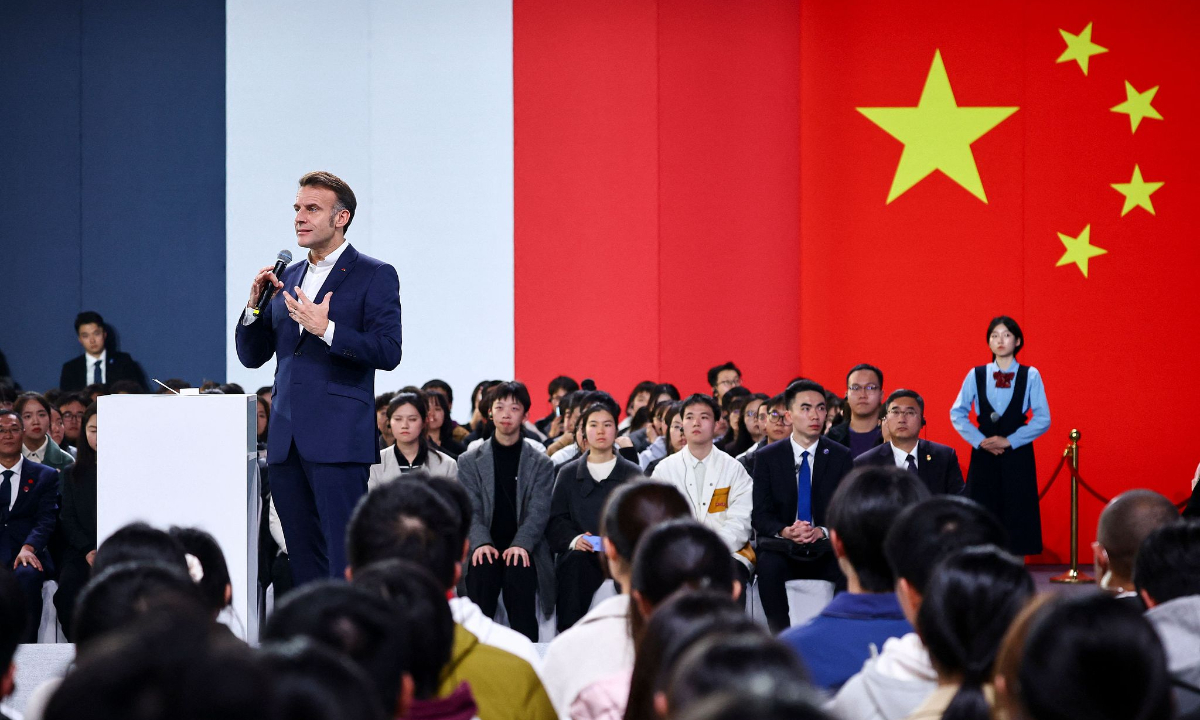
French President Emmanuel Macron speaks at Sichuan University during a meeting with students in Chengdu, Southwest China's Sichuan Province on December 5, 2025. Photo:AFP
French President Emmanuel Macron on Tuesday penned a piece urging a rebalancing of economic relations between the EU and China, stressing that placing tariffs and quotas on Chinese imports would be "an uncooperative answer."
The article published by the Financial Times outlined steps that Macron argues that both sides must take to address existing imbalances, highlighting cooperation potential with China in clean energy and services and emphasizing that an optimal framework for both regions is "a cooperative one."
The trade balance issue reflects multiple structural factors, and an excessive focus on the EU's deficit with China risks oversimplifying the complex nature of bilateral economic ties, Chinese experts said. They agreed that dialogue and cooperation, rather than confrontation, offer a more constructive and win-win path to addressing imbalances.
In the article, Macron pointed to the current trade surplus of 300 billion euros ($352 billion) that China runs with the EU, which he claimed was "not sustainable" - either for Europe or China.
Meanwhile, the French president acknowledged that the imbalance cannot be attributed to a single cause, noting that current challenges are also tied to "weak EU productivity." He warned that tariffs and quotas on Chinese imports would be an uncooperative response and could trigger "a dire trade dispute."
Instead, Macron wrote that both China and the EU have the means to "reverse the imbalances." On the European side, he argued that the priority should be to deliver a new economic agenda based on competitiveness, innovation and protection.
Turning to China, Macron claimed that addressing internal imbalances and rebalancing foreign direct investment flows is essential, while highlighting the strong potential for cooperation.
"Today, it [China] leads in the energy transition and clean mobility technologies, while Europe continues to lead in many services sectors. An optimal framework for our two regions is a cooperative one," Macron wrote.
But the French president also emphasized that a protection strategy requires the EU to defend itself. He wrote that the bloc has a range of trade protection tools, including tariffs and anti-coercion measures, claiming that "no one should be in any doubt about our willingness to use them."
Macron's article strikes a largely pragmatic tone, but it is clearly grounded in a "Europe-first" perspective, Jian Junbo, director of the Center for China-Europe Relations at Fudan University's Institute of International Studies, told the Global Times on Wednesday.
While Macron underscores cooperation and rejects outright trade confrontation, his call for "rebalancing" is primarily shaped by concerns over Europe's own industrial competitiveness and economic pressures, Jian said.
Jian emphasized that current trade imbalances should not be viewed in isolation, but rather as the result of multiple factors, including the global economic environment, Europe's own economic slowdown, and the impact of US tariff policies.
"Europe's declining industrial and product competitiveness has eroded its foothold in the Chinese market, making it increasingly difficult for European goods to compete," he added.
Sun Yanhong, a senior research fellow at the Institute of European Studies at the Chinese Academy of Social Sciences, stressed that the trade imbalance reflects the combined effects of differing stages of economic development, industrial structures, market size and demand patterns on both sides.
China's strong export competitiveness has emerged naturally from the global division of labor, underpinned by its robust manufacturing capacity and a complete industrial chain, Sun said. By contrast, she noted that Europe's overall competitiveness has been weakened in recent years by high energy prices, rising labor costs and a post-pandemic decline in labor productivity - factors that have constrained its ability to expand exports to China.
Macron visited China in early December and was warmly received during his visits to the Sichuan University. During the trip, he said that France is ready to work with China to promote mutual investment, strengthen cooperation in areas such as economy, trade and renewable energy, and deepen friendly cultural exchanges, according to the Xinhua News Agency.
France welcomes more Chinese investment and will provide a fair and non-discriminatory business environment, Macron said during the visit.
However, in a subsequent interview with a French media outlet, Macron claimed that "China wants to pierce the heart of the European industrial and innovation model," a remark that Chinese experts said reflects his attempt to strike a balance in his stance toward China.
Both Jian and Sun warned that protectionism is not a fundamental solution, and only cooperation offers a more constructive path. "While protectionism may offer short-term relief, it ultimately risks further weakening competitiveness and harming both sides," Jian said.
Sun noted that expanding China's investment in the EU, strengthening cooperation in technology and innovation, and deepening industrial collaboration could enhance Europe's competitiveness and ease tensions.
"As Chinese manufacturing integrates with European technology and capital, the shared benefits will grow and trade imbalances will gradually become less significant," Jian added.
China stands ready to work with France to champion the spirit that guided the establishment of China-France diplomatic ties, and to step up strategic communication, deepen practical cooperation, and work for closer coordination in multilateral affairs, Lin Jian, a spokesperson of China's Foreign Ministry, said on December 1 when commenting on China's relations with France.
"Together, the two sides can make new progress in their comprehensive strategic partnership, promote the sound and steady development of China-EU relations, and contribute more to multilateralism and a peaceful, stable and prosperous world," Lin said.
RELATED ARTICLES