EU drops 2035 combustion engine ban; Move reflects waning EV competitiveness vs China,US
By Published: Dec 17, 2025 02:22 PM

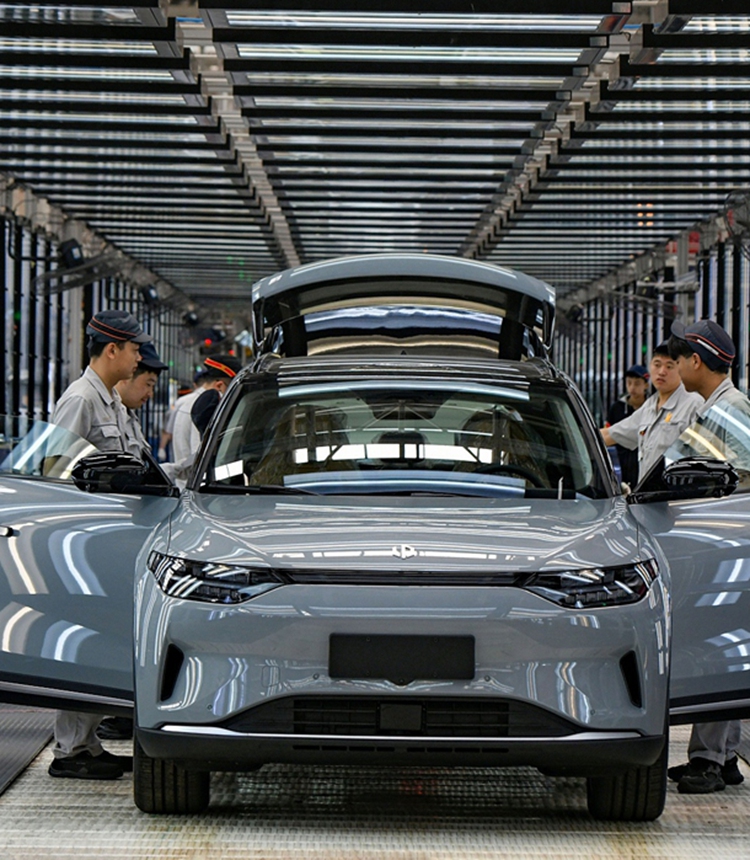
Workers complete assembling an electric vehicle (EV) at China's EV start-up Leapmotor in Jinhua, East China's Zhejiang Province on April 1, 2024. The smart EV factory delivered 14,567 new vehicles in March, a yearly increase of 136 percent. Photo: VCG
The European Commission unveiled a plan on Tuesday to drop the EU’s effective ban on new combustion-engine cars from 2035 after pressure from the region’s auto sector, “marking the bloc's biggest retreat from its green policies in recent years,” the Reuters reported.
While the move may stem from multiple pragmatic factors, it underscores the bloc's deep-seated anxiety over the waning competitiveness of European local carmakers amid fierce global rivalry in the electric vehicle (EV) sector, in particular from Chinese and US peers. This unease is particularly heightened by the fact that, despite the EU's imposition of tariffs on Chinese EVs last year, the resulting higher prices have failed to curb the growing popularity of Chinese cars, analysts said, warning that recent developments indicate the tariff policy may be producing the opposite of its intended effect.
The move, which still needs approval from EU governments and the European Parliament, would allow continued sales of some non-electric vehicles, the Reuters reported. The EU executive “appears to have bowed to calls from carmakers to keep selling plug-in hybrids and range extenders that burn fuel as they struggle to compete against Teslaand Chinese EV makers,” according to the report.
Feng Shiming, a car analyst from Menutor Consulting, told the Global Times on Wednesday that the EU has been sitting unease, watching its traditional industry of auto manufacturing at risk of lagging behind the US and China. The European EV brands’ waning competitiveness is because that “the core technologies of pure electric vehicles are not in the hands of Europeans.”
“In the ‘three electric systems’ (battery, motor and electronic control), Chinese companies hold a clear advantage in batteries and motors, while electronic control is dominated by Tesla in the US and other US tech giants. In terms of intelligence, China and the US are also far ahead of European carmakers,” Feng explained.
Observers doubt whether the new plan that shakes the principle of “environmental protection”would help European automakers to reverse its sliding EV trend.
Under the proposal, EU targets would shift to a 90 percent cut in carbon dioxide emissions from 2021 levels, instead of current rules that all new cars and vans from 2035 have zero emissions, the Reuters report noted.
Meanwhile, the policy won’t have much impact on Chinese EVs’ sales in Europe, and it may fuel the Chinese exports of plug-in hybrid models, which Chinese carmakers also have demonstrated a clear advantage, analysts said.
“In the medium- to long-term, whoever masters the core technologies and development direction of EV while maintaining low costs will win the market. In these aspects, Chinese carmakers are expected to retain considerable advantages in the foreseeable future,” Feng said. He noted that Chinese carmakers also possess ample technological reserves and industrial support across horizontal technology routes, vertical industry chains, and even paths toward intelligence.
In October 2024, the EU decided to impose definitive countervailing duties on Chinese-made EVs for a period of five years. Analysts suggest the bloc to abolish the tariff policy, which is functioning in the opposite way, and resort to a cooperative approachwith China instead.
Despite the protectionism move, China’s EV market share hasmore than trebled in Europeto around 7 percent in the first half of 2025 compared with about 2 percent in 2022, Forbes reported, citing data from BMI, a Fitch Solutions company.
The Forbes report also cited a report by Schmidt Automotive Research as saying that Western Europe market share for Chinese EVs will jump to 11 percent this year or 269,450 vehicles, up from 9.6 percent in 2024, and compared with only 3.8 percent in 2021.
“Even after factoring in the higher tariffs, the steep cost advantage of Chinese EVs ensures they still have considerable pricing headroom in Europe. This stems from inherent disparities in raw material costs, production methods, and labor expenses,” Feng said.
RELATED ARTICLES