Patient successfully controls smart devices with mind in second human trial of China’s BCI
By Published: Dec 17, 2025 08:06 PM

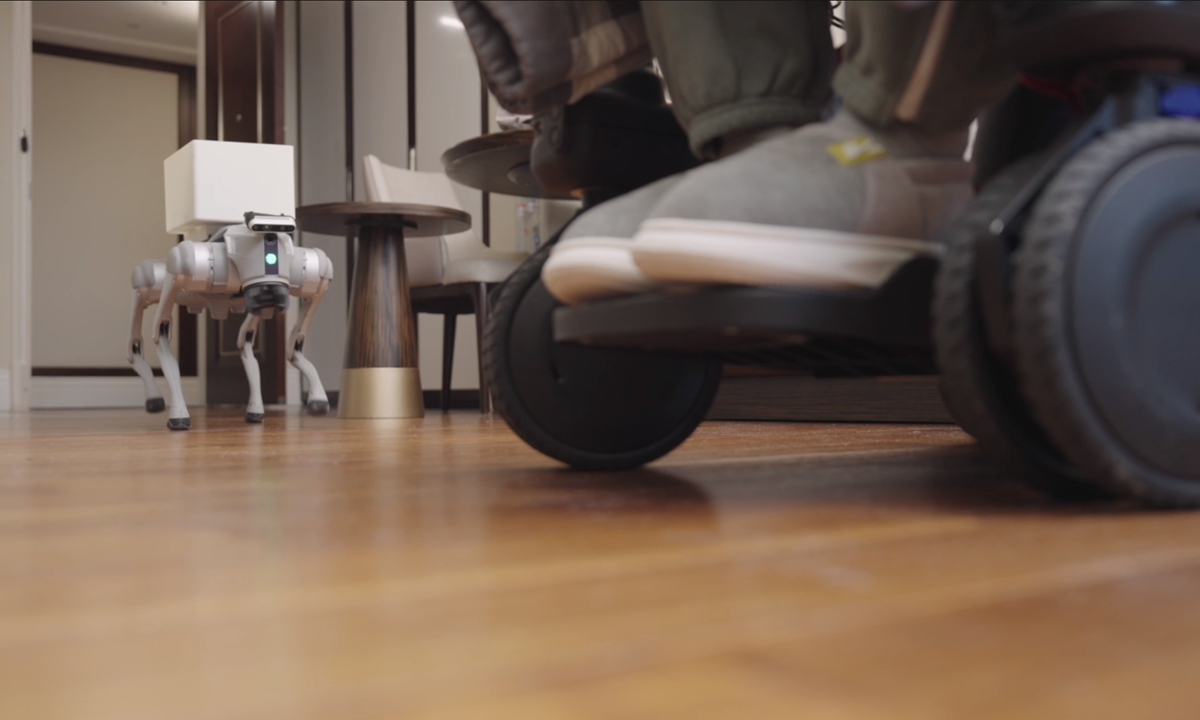
A patient controls a robotic dog during the BCI clinical trail. Photo: Courtesy of the CEBSIT
The Global Times learned on Wednesday from Shanghai-based Center for Excellence in Brain Science and Intelligence Technology (CEBSIT) of the Chinese Academy of Sciences that, in collaboration with the Fudan University's Huashan Hospital, the center has successfully carried out a second in-human clinical trial of its independently developed invasive brain-computer interface (BCI) device. The trial enables a patient with high-level paraplegia to reliably control a smart wheelchair and a robotic dog using brain electrical signals (EEG), achieving autonomous mobility and object retrieval in real-world scenarios.
The patient suffered a spinal cord injury in 2022, resulting in high-level paraplegia. In June, a BCI system was implanted. After several weeks of training, the patient was able to stably control a computer cursor and a tablet device. After that, the team further extended the system to three-dimensional physical device control, achieving continuous, stable and low-latency operation of a smart wheelchair and a robotic dog, enabling the patient to perform multiple functional activities in complex real-world daily scenarios, the CEBSIT revealed to the Global Times in a statement.
"It's just like controlling a character in a video game — you don't have to consciously think about which way to push the joystick; you naturally think about the direction you want to go, and it just goes there. The signal transmission is quite stable, with very little delay," said the patient.
Previously, the center and the hospital carried out the country's first clinical trial of an invasive BCI device and in June they announced that the trial was successful, with a tetraplegic patient being able to control electronic devices with his mind, skillfully operating racing games, chess, and other programs. The achievement makes China the second country globally, only after the US (Neuralink), to enter the clinical trial phase for invasive BCI technology, according to the CEBSIT.
The clinical trial has achieved a series of key technological breakthroughs, developers told the Global Times.
For neural information extraction, the team developed high-compression-ratio, high-fidelity data compression technology, innovatively combining "spike-band power," "inter-spike interval," and "spike count" methods. This hybrid decoding model efficiently extracts useful signals even in noisy environments, boosting overall brain-control performance by 15 to 20 percent.
The team also pioneered an "online recalibration" technology that allows real-time fine-tuning of decoding parameters during daily use without interrupting operation or requiring dedicated sessions. This feature ensures sustained high performance and delivers a "the more you use it, the smoother it gets" experience.
Response speed is a core BCI metric. Human neural conduction delay is about 200 milliseconds; in this system, a custom communication protocol reduced end-to-end latency from signal acquisition to command execution to under 100 milliseconds, enabling a more fluid and natural control experience.
Zhao Zhengtuo, who led the research team told the Global Times that he hopes to further accelerate the clinical translation and application validation of the achievement, enabling BCI technology to move closer to real-world clinical use.
The research team also identified the patient's deeper social need for "re-employment." They worked with a local disabled persons' federation on a "technology-assisted disability" project, enabling the patient to participate in online work, such as verifying the accuracy of AI recognition in vending machines.
Though the job appears simple, it helped the patient rebuild confidence and regain a sense of self-worth. For a person with high-level paraplegia, earning income through work means no longer being solely a recipient of one-way care from family and society, but once again becoming a contributor of social value, according to the CEBSIT.
Speaking with the Global Times, Zhao outlined a clear roadmap for the development of BCI technology.
According to Zhao, in the short term within three years, large-scale applications will emerge for reconstructing motor and language functions. In the medium term within five years, breakthroughs are expected in perceptual restoration, such as artificial vision and hearing, along with precise modulation of neuropsychiatric disorders like Parkinson's disease and depression. In the long term around 10 years, highly minimally invasive systems could enable medical and even everyday consumer uses, allowing a degree of functional enhancement.
RELATED ARTICLES