Shanghai’s ‘embroidery needlework’ fixes city’s toilet problem
By Published: Dec 17, 2025 08:54 PM

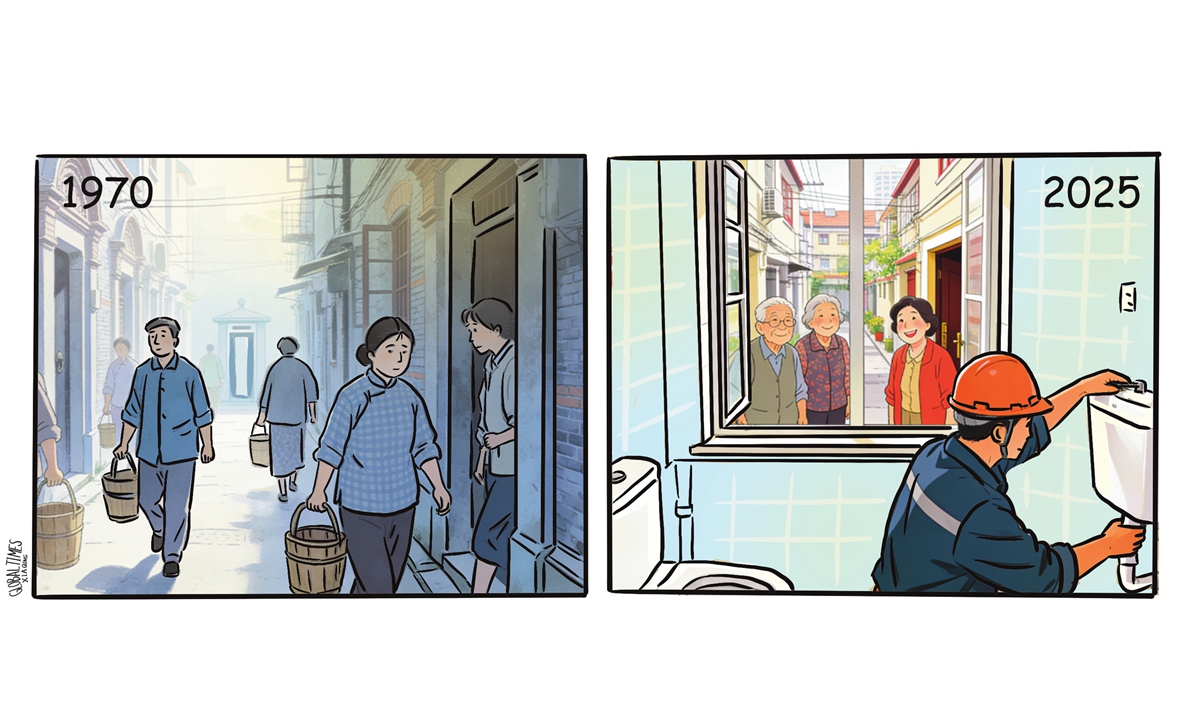
Illustration: Xia Qing/GT
Back in the 1970s, I lived for a time in a neighborhood nestled in a Shanghai longtang - the old residential alleyway. Every morning, between 4 and 6 am, a peculiar scene would unfold: Residents trudged out of their cramped dwellings, wooden buckets in hand.
These buckets were portable toilets that needed to be emptied daily at public dumping stations. The image was surreal: In modern Shanghai, a central financial hub, millions of people streamed through pre-dawn streets with their household waste.
Yet this was the legacy of a housing shortage so severe that 5 million residents lived in homes without basic sanitation. In such conditions, private bathrooms were unimaginable luxuries. The wooden toilet buckets were the system's pragmatic response to an impossible situation.
What makes this story remarkable isn't that Shanghai faced this problem - many cities have struggled with inadequate housing and sanitation - but how the city solved this problem.
Between 1994 and 2024, after three decades of patient, meticulous work, Shanghai transformed 5 million morning journeys into history. It was not achieved through grand gestures or large-scale demolition, but through what Chinese officials refer to as "embroidery needlework" - a precise, detailed, labor-intensive approach where each stitch is deemed indispensable.
This transformation offers a window into something that rarely makes international headlines: How different political systems approach the fundamental responsibility of improving ordinary people's lives. What makes the case instructive is how different political systems tend to respond to such challenges. In a Western market-driven system, solutions hinge on individual incentives and property rights frameworks.
In many large cities in the US and Europe, the government doesn't micromanage to that extent. They may focus on an issue for a while to gain votes, but it's difficult for them to commit to solving a significant problem that affects residents' housing and well-being in the long term. The city of Shanghai chose a different path, one embedded in how Chinese governance actually works at the municipal level.
A fundamental difference lies in what a city mayor is responsible for. In Shanghai, a mayor's political legitimacy doesn't just depend on economic growth or business-friendly policies. It depends on concrete improvements in residents' living standards. This isn't ideological piety - it's how performance is measured and how officials advance. The toilet problem was no peripheral matter to be left to market forces; Rather, it was a direct barometer of governmental effectiveness.
This created an entirely different calculus. Instead of waiting for private investors or individual homeowners to solve the problem, the Shanghai municipal government treated it as a public responsibility, not as charity, but as governance.
Between 1994 and 2024, the city implemented the official "one household, one plan" Strategy. This was no mere bureaucratic jargon - it represented a genuinely radical approach: For each household still lacking adequate sanitation, the government conducted door-to-door assessments, held neighborhood meetings and crafted customized solutions. When you have 282 different types of irregular housing layouts, you can't apply a single standard, so the city compressed them into 94 renovation plans, each tailored to the specific needs of thousands of individual families.
This required coordination across multiple government agencies, as well as consistent political commitment across multiple mayoral administrations - no single term could complete such a project.
This endeavor called for long-term public investment that yielded no immediate financial returns, while also engaging of efforts of thousands of workers, engineers and administrators. Most critically, it required treating this not as an emergency to be managed, but as a fundamental responsibility to be fulfilled. The "embroidery needlework" was actually an expression of a people-centered approach - the opposite of what outsiders often imagine when they think of centralized governance.
This isn't just sentiment; it shows how systems impact results. China's municipal system holds government accountable for all residents' basic needs, incentivizing comprehensive, long-term solutions that market-driven systems often neglect. This doesn't mean Chinese cities are perfect, or that this approach solves every problem. But it means certain classes of issues - housing inadequacy, sanitation deficits, basic infrastructure for people with low incomes - are treated as governance failures rather than individual misfortunes. The system's very logic demanded a solution. That's not a small thing.
The author is a senior editor with the People's Daily and currently a senior fellow with the Chongyang Institute for Financial Studies at Renmin University of China. dinggang@globaltimes.com.cn. Follow him on X @dinggangchina
RELATED ARTICLES